
TL;DR:
- Mastering a structured content creation workflow is essential for small businesses to produce consistent, high-quality marketing content.
- A documented process across ideation, research, drafting, editing, and distribution helps scale output without sacrificing quality or effectiveness.
The content creation process is the structured sequence of stages that transforms a raw idea into published, effective marketing content. For small to medium-sized business owners and content creators, mastering this workflow is no longer optional. The global creator economy surpassed $250 billion in 2026, with 207 million creators worldwide competing for audience attention. That scale means a repeatable, documented process is what separates businesses that grow through content from those that publish sporadically and wonder why nothing sticks. This guide walks you through every stage, from ideation to measurement, with practical steps you can apply immediately.
What are the core stages of the content creation process?
The content creation process, known in professional publishing as a content production workflow, moves through five distinct stages. Each stage has a specific function, and skipping any one of them creates problems downstream.

1. Ideation
Ideation is the sourcing of topics worth creating. Strong ideation pulls from at least four inputs: audience research (comments, support tickets, social questions), keyword data from tools like Google Search Console or Ahrefs, subject matter expert (SME) interviews, and competitive gap analysis. Relying on a single source produces a narrow topic pool that exhausts quickly.
2. Research
Research is where accuracy gets built in. Long-form blog posts require up to 4 hours of dedicated research to achieve the depth that earns reader trust and search visibility. That number surprises most solo creators who budget 30 minutes. Cutting research time is the fastest way to produce content that ranks poorly and converts nobody.
3. Drafting
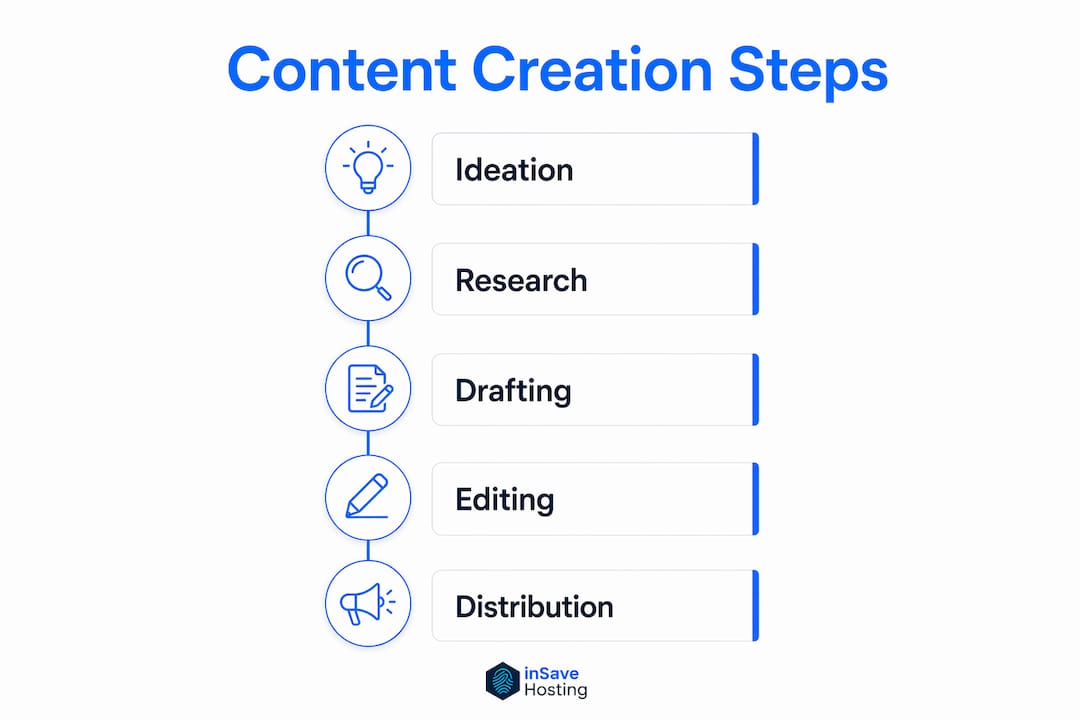
Drafting produces the first complete version of the content. AI-assisted drafting tools can speed this stage significantly, but they shift the bottleneck to editing rather than eliminating it. The draft stage is where structure, argument flow, and brand voice get established. A content brief written before drafting reduces revision cycles by giving writers clear direction on scope, audience, and key claims.
4. Editing
Editing is the main bottleneck in scaled content operations because it requires human judgment that technology cannot fully replace. Clarity, accuracy, tone consistency, and factual verification all happen here. Teams that rush editing to hit publish deadlines consistently produce content that underperforms. Build editing time into your schedule as a fixed, non-negotiable block.
5. Distribution
Distribution is where most SMBs lose value they already created. Writing composes about 20% of the modern content workflow. The remaining 80% is planning, adaptation, and distribution. Publishing a blog post without adapting it for LinkedIn, email, or short-form video means leaving most of your potential reach untouched. Each platform requires a format adjustment, not just a copy-paste.
Pro Tip: Write a one-page content brief before every piece. Include the target audience, the primary keyword, the core claim, and three supporting points. Briefs cut revision cycles and make editing faster.
How do you scale content production without losing quality?
Scaling content production is a systems challenge, not a volume challenge. Teams using a documented linear workflow publish 3 to 5 times more content monthly while reducing revision cycles. The key is identifying where your current process breaks down before adding output.
The most common scaling traps are:
- Skipping research to save time, which produces thin content that fails to rank or convert
- Compressing editing under deadline pressure, which ships errors and weakens brand credibility
- Poor platform adaptation, publishing identical content across channels without format adjustments
- Tool switching without process changes, which destroys the compounding benefits of a stable, mature workflow
- Ignoring authority architecture, which means failing to build taxonomy and decision rights for topical authority
Role specialization matters as your team grows. A solo creator handles all five stages. A team of three can split ideation and research from drafting and editing. Larger content organizations assign dedicated roles: strategist, researcher, writer, editor, and distribution specialist. Each split reduces context-switching and increases output quality.
Training subject matter experts to contribute or write content is more efficient than converting generalist writers into domain authorities. An SME who writes a rough draft cuts the researcher's workload and the editor's revision depth. That compounding efficiency is why content-mature companies invest in SME enablement programs.
Manually managed pipelines hit operational limits around 15 articles per month. Beyond that threshold, you need structured content operations: editorial calendars, content briefs, standardized templates, and at least partial automation in scheduling and distribution. Without those systems, quality degrades as volume increases.
Pro Tip: Batch similar tasks together. Write all your briefs on Monday, draft on Tuesday and Wednesday, edit on Thursday, and schedule distribution on Friday. Batching reduces the cognitive cost of switching between creative and analytical modes.
What tools support an effective content workflow?
The right tools reduce decision fatigue at each stage. The wrong tools, or too many tools, create friction that slows the entire process. Here is a practical breakdown by stage:
Ideation and research tools
Keyword research platforms like Google Search Console, Ahrefs, and Semrush surface topics with proven search demand. Audience insight platforms like SparkToro identify where your readers spend time and what questions they ask. AI summarizers speed up secondary research by condensing long sources into usable notes. Citation trackers keep your fact-checking organized and auditable.
Drafting and editing tools
Collaborative document platforms like Google Docs or Notion let writers and editors work in the same file without version conflicts. AI writing assistants accelerate first drafts but require editorial oversight to maintain accuracy and brand voice. Grammar checkers like Grammarly catch surface errors. SEO optimization tools like Clearscope or Surfer SEO align drafts with search intent before publication. A documented style guide is the single most underused editing tool in SMB content teams.
Distribution and scheduling tools
Multi-channel schedulers like Buffer or Hootsuite publish content across platforms on a consistent cadence. Platform-specific optimizers adjust image sizes, caption lengths, and hashtag strategies automatically. An editorial calendar, even a simple spreadsheet, gives your team visibility into what publishes when and prevents content gaps.
Understanding how hosting shapes blog performance is also part of the distribution picture. Slow page load times caused by poor hosting directly reduce the reach of content you worked hard to produce. Speed and uptime are distribution variables, not just technical details.
Frameworks matter as much as tools. Content briefs, feedback loops, and current SEO trends all shape how effectively your workflow converts effort into results. Aligning your process with how AI-driven discovery works is increasingly critical, as agent-first content strategies reshape how audiences find and consume content.
How do you measure and improve your content creation workflow?
Measurement turns content production from a cost center into a revenue driver. Without defined metrics, you cannot tell whether your process is working or just busy.
-
Set goals before creation. Define what success looks like for each piece: organic traffic, email signups, lead form completions, or revenue attribution. Goals set after publication are rationalizations, not measurements.
-
Track the right metrics. Traffic shows reach. Engagement rate (time on page, scroll depth, comments) shows relevance. Lead generation metrics show conversion. Revenue attribution shows business impact. Each metric answers a different question about content performance.
-
Run regular content audits. Content audits and performance feedback loops are the highest-leverage activities for continuous improvement and ROI measurement. An audit identifies which pieces need updating, which should be pruned, and which topics deserve more coverage. Quarterly audits are a minimum for active content programs.
-
Feed data back into ideation. Your top-performing content tells you what your audience values. Use that signal to prioritize similar topics in your next ideation cycle. This closes the loop between measurement and production.
-
Watch for content fatigue. Publishing frequency that exceeds your team's quality capacity produces diminishing returns. Reducing output to maintain quality consistently outperforms high-volume, low-quality publishing. Successful content operations treat creation as a continuous loop that includes maintenance, pruning, and performance refresh, not just new production.
Key Takeaways
A documented content creation process is the single most reliable way to produce consistent, high-quality content that drives measurable marketing results.
| Point | Details |
|---|---|
| Five-stage workflow | Every piece moves through ideation, research, drafting, editing, and distribution in sequence. |
| Editing is the bottleneck | Human judgment in editing cannot be automated; protect this stage from deadline pressure. |
| Distribution is 80% of the work | Writing is only 20% of the modern workflow; platform adaptation drives actual reach. |
| Scale requires systems | Manual pipelines break down around 15 articles per month without documented processes. |
| Measurement closes the loop | Regular content audits and performance feedback loops are the highest-leverage improvement activities. |
What I've learned from watching SMBs build content workflows
Most SMBs I've observed start content production the same way: someone decides the business needs more content, assigns it to whoever has spare time, and publishes inconsistently for three months before giving up. The problem is never motivation. The problem is the absence of a defined process.
The teams that succeed treat content like a production line, not a creative exercise. They document every stage, assign clear ownership, and protect editing time the way a manufacturer protects quality control. The creative work happens inside that structure, not instead of it.
The insight that changes everything for growing teams is the SME investment. When you train your best technical people to contribute rough drafts, your content quality jumps immediately. A rough draft from someone who genuinely knows the subject beats a polished draft from a generalist writer every time. The editor's job becomes shaping and refining, not rebuilding from scratch.
Platform adaptation is the other area where I see consistent underinvestment. A 2,000-word blog post contains at least five LinkedIn posts, three email newsletter sections, and a short-form video script. Treating each piece of content as a single-channel asset wastes most of the value you created. Build adaptation into your distribution stage as a standard step, not an afterthought.
The businesses that build sustainable content programs are not the ones publishing the most. They are the ones with the clearest process, the most consistent editing standards, and the most disciplined measurement habits. Volume follows systems. It never works the other way around.
— Ihor
Your content needs a fast, reliable home
A well-built content workflow deserves hosting that keeps pace with it. Publishing great content on a slow or unreliable website cancels out the work you put into production.

inSave Hosting offers WordPress hosting plans built for content-driven SMBs, with 99.9% uptime, LiteSpeed technology, free SSL certificates, and free CDN integration. Every plan includes one-click WordPress installation and managed security, so your content reaches readers fast and without interruption. For businesses ready to publish at scale, inSave Hosting's shared hosting plans provide the performance foundation your workflow requires. Your process is only as strong as the platform it runs on.
FAQ
What is the content creation process?
The content creation process is the structured workflow that moves a topic from initial idea through research, drafting, editing, and distribution to reach a target audience as finished, published content.
How long does the content creation process take?
Timeline varies by format and team size. Long-form blog posts alone require up to 4 hours of research, plus drafting, editing, and distribution time, making a full production cycle typically span several days.
What is the biggest bottleneck in content production?
Editing is the primary bottleneck in scaled content operations because it requires human judgment for accuracy, clarity, and tone that automation cannot fully replace.
How do you scale content creation without losing quality?
Use documented workflows, content briefs, and role specialization. Teams with structured processes publish 3 to 5 times more content monthly while reducing revision cycles compared to ad hoc approaches.
How do you measure content creation success?
Define goals before production, then track traffic, engagement, lead generation, and revenue attribution. Run quarterly content audits to identify what needs updating, pruning, or expansion.