
Most small business owners assume that web hosting is web hosting. You pay a few dollars a month, your site goes live, and that's that. But the moment your site slows to a crawl during a product launch, or goes offline right when a potential client is checking you out, that assumption gets expensive. Business hosting exists precisely because generic shared plans were never built to handle the demands of a revenue-generating website. This article breaks down what business hosting actually is, what it delivers, and how to pick the right plan so your site works as hard as you do.
Table of Contents
- What is business hosting?
- Key features and benefits of business hosting
- Business hosting vs shared vs VPS vs cloud
- How to choose business hosting for your needs
- When business hosting isn't enough: Edge cases and upgrades
- Explore business hosting solutions with inSave
- Frequently asked questions
Key Takeaways
| Point | Details |
|---|---|
| Business hosting defined | Business hosting gives small businesses more speed, security, and support than shared hosting. |
| Key features | Features include dedicated resources, advanced security, and managed WordPress options. |
| Performance matters | Uptime, faster load times, and support directly impact customer experience and sales. |
| Choose wisely | Compare providers by security, resources, WordPress support, and real costs, not just entry price. |
| Scale up easily | Business hosting fits growing SMBs, with options to upgrade to VPS or cloud as you expand. |
What is business hosting?
Business hosting refers to premium web hosting plans designed specifically for small to medium-sized businesses, offering enhanced performance, security, scalability, and support compared to basic shared hosting. That definition matters because it draws a clear line between a plan built for a personal blog and one built for a site that needs to convert visitors into paying customers.
Unlike standard shared hosting, business hosting prioritizes stability, scalability, and expert support. You get more CPU and RAM, better security layers, and a team that understands what downtime actually costs a business. Providers like SiteGround, Hostinger, InMotion, and Bluehost have built business hosting solutions specifically around these needs.
The typical customers for business hosting include:
- E-commerce stores that cannot afford cart abandonment from slow load times
- Service providers whose websites are their primary lead generation tool
- Agencies managing multiple client sites that need reliability and staging environments
- Local businesses building credibility through a professional online presence
"Business hosting is not just a marketing label. It represents a fundamentally different infrastructure tier built around uptime, speed, and security for sites where performance directly affects revenue."
If you want to see reliable hosting examples from real small businesses, the contrast with basic shared plans becomes immediately obvious.
Key features and benefits of business hosting
Understanding what business hosting is sets the stage. Now let's break down the features and real-world gains you can expect for your business site.
The core mechanics include dedicated resources and NVMe SSD storage, LiteSpeed or NGINX servers, caching tools, staging environments, automatic backups, and managed WordPress updates. These are not luxury add-ons. They are the baseline for a site that performs under real traffic.
Here is what those features translate to in practice:
- No noisy neighbor effect: Dedicated CPU and RAM limits mean another user's traffic spike does not slow your site
- NVMe SSDs: Up to 3x faster than traditional HDDs, which directly cuts page load time
- LiteSpeed and caching: Serve pages faster without hammering your server on every request
- Staging environments: Test changes safely before pushing them live
- Automatic backups: Recover from mistakes or attacks without losing data
On the security side, free SSL, WAF, and DDoS protection are standard in most business hosting plans, along with malware scanning and AI-powered anti-bot tools. You can explore the full range of website security features that protect your site around the clock.

| Feature | Shared hosting | Business hosting |
|---|---|---|
| CPU/RAM limits | Shared pool | Dedicated allocation |
| Storage type | HDD or basic SSD | NVMe SSD |
| Uptime SLA | 99.9% | 99.99% |
| Security tools | Basic SSL | SSL, WAF, DDoS, malware scan |
| WordPress tools | Manual | Auto-updates, staging, backups |
| Support level | General | Business-priority |
Empirical uptime benchmarks of 99.99% and TTFB ranges of 187 to 592ms show that top business hosting providers consistently outperform basic shared plans. For a deeper look at what to expect, check the full SMB hosting features breakdown for 2026.
For WordPress sites specifically, managed WordPress hosting takes the technical burden off your plate entirely. Pair that with WordPress-optimized hosting and your site runs faster with far less manual effort.
Pro Tip: A 100ms improvement in page load speed can boost your website conversions by 8%. That is not a rounding error. For a site doing $10,000 a month in revenue, that single speed gain is worth $800 in additional sales.
Business hosting vs shared vs VPS vs cloud
With the benefits of business hosting clear, it is important to see how it measures up against other hosting types so you avoid outgrowing your plan too soon.
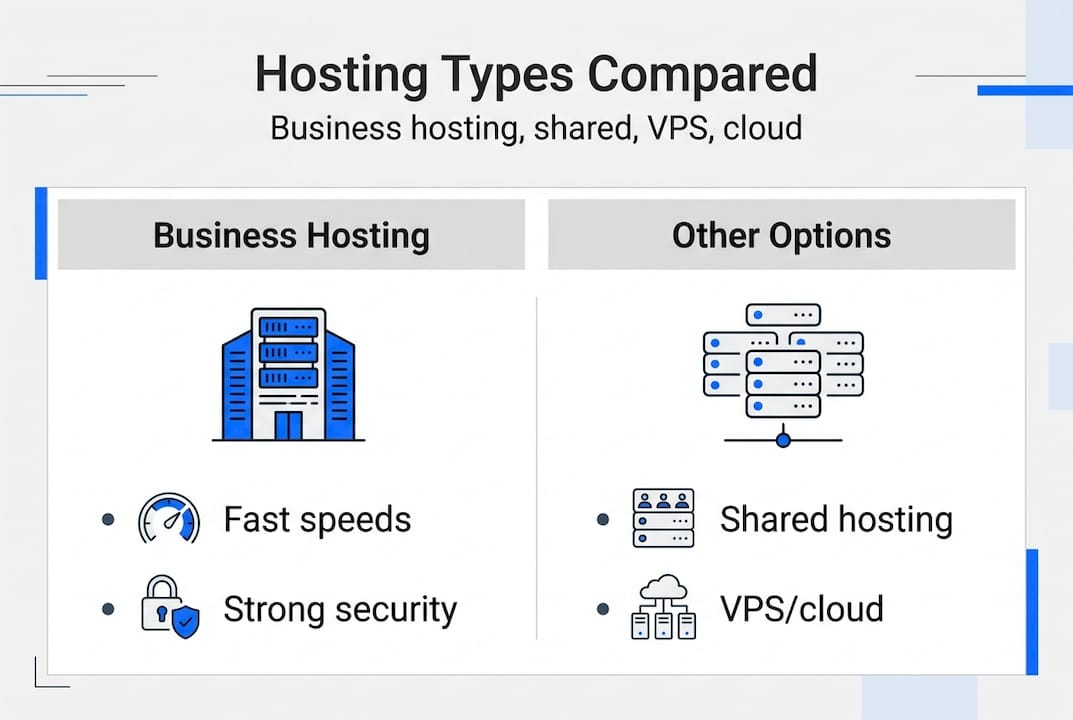
Here is a quick comparison across the most common SMB hosting options:
| Hosting type | Best for | Avg. cost/mo | Traffic ceiling |
|---|---|---|---|
| Shared | Personal sites, early startups | $2 to $5 | ~10,000 visits |
| Business | Growing SMBs, e-commerce | $5 to $20 | ~100,000 visits |
| VPS | Custom apps, traffic spikes | $20 to $80 | Scalable |
| Cloud | Enterprise, elastic needs | $30+ | Elastic |
Shared hosting is the cheapest entry point, but it comes with real trade-offs. Resource isolation in business hosting eliminates the noisy neighbor problem that plagues shared environments, where one overloaded account can drag down everyone on the same server.
For most growing SMBs, premium business plans at $5 to $20 per month are justified by 2 to 4x speed improvements and significantly lower downtime costs compared to shared hosting. The ROI math is straightforward when your site generates revenue.
Here is how to think through your decision:
- Under 10,000 monthly visits: Shared hosting may be fine for now, but plan your upgrade path
- 10,000 to 100,000 visits: Business hosting is the right fit for performance and cost balance
- Unpredictable traffic spikes: Consider shared vs VPS hosting to understand when elastic scaling becomes necessary
- Custom software or root access needs: VPS or dedicated is the only real option
- Strict compliance requirements: Dedicated or isolated cloud environments are worth the premium
If you are still learning the fundamentals, reviewing shared hosting basics and the dedicated vs shared hosting comparison will help you map your current needs to the right tier.
How to choose business hosting for your needs
Having compared your options, let's focus on the checklist and smart questions you should ask before choosing your business hosting provider.
Start with traffic and growth. Do not just plan for today's visitor count. Estimate where you will be in 12 months and choose a plan that handles that load without requiring an emergency migration.
Here is what to check before signing up:
- Uptime SLA: Look for 99.99% guarantees, not just 99.9%
- Storage type: NVMe SSDs are the standard for WP-optimized business plans in 2026
- Security stack: Free SSL, WAF, DDoS protection, and malware scanning should all be included
- WordPress tools: Staging, automatic backups, and one-click installs save hours of manual work
- Migration support: A good provider moves your existing site for free
- Renewal pricing: Renewal rates often jump 2 to 4x after the promotional period ends
That last point catches a lot of business owners off guard. A plan advertised at $3.99 per month may renew at $14.99. Always calculate the total cost of ownership over two to three years, not just the first-year promo price.
For compliance-heavy industries or businesses handling sensitive customer data, review the security tips for small businesses before committing to any plan. And if your team relies on professional email, SMB email hosting is worth factoring into your overall hosting decision.
For a technical deep dive into what separates fast WordPress sites from slow ones, the WordPress performance guide is a solid reference.
Pro Tip: Compare total cost of ownership across two to three years, not just the introductory price. Factor in renewal rates, add-on costs for security tools, and the value of included features like free migrations and staging environments.
When business hosting isn't enough: Edge cases and upgrades
Even the best business hosting has limits. Here is when you may hit the ceiling and need to explore more robust solutions.
Business hosting is a high-performance baseline, not an unlimited resource. Certain scenarios push beyond what even the best business plans can handle:
- Rapid ecommerce growth or viral traffic: A sudden spike from a press mention or seasonal sale can overwhelm a business hosting plan. High-traffic spikes need VPS or cloud with elastic scaling to absorb demand without crashing
- Custom web applications: If your site runs custom software that requires root server access or specific software configurations, VPS or dedicated hosting is the only viable path
- Strict industry compliance: Businesses in healthcare, legal, or finance often face regulations that require fully isolated server environments. Shared infrastructure, even business-grade, may not satisfy those requirements
- Multi-region performance needs: If your customers are spread across continents and latency matters, cloud hosting with distributed nodes outperforms a single-server business plan
"Think of business hosting as the right tool for 80% of SMB use cases. The remaining 20% need VPS, cloud, or dedicated infrastructure, and knowing which camp you fall into saves you from both overpaying and underperforming."
If you are approaching that ceiling, exploring dedicated server solutions gives you a clear picture of what the next tier looks like and what it costs.
Explore business hosting solutions with inSave
Now that you know what to look for, the next step is finding a provider that actually delivers on these promises without overcharging for features you do not need.
At inSave, our business hosting plans are built around the exact features SMBs need: LiteSpeed servers, NVMe SSD storage, free SSL certificates, one-click WordPress installs, and 99.9% uptime backed by real support. Whether you are launching your first business site or migrating an existing one, we handle the technical heavy lifting so you can focus on running your business. Our WordPress hosting plans include staging environments, automatic updates, and free migration. And every plan comes with SSL certificates included, so your site is secure from day one. No hidden fees. No surprise renewal shocks.
Frequently asked questions
Is business hosting worth it for small businesses?
Yes, especially if your site generates revenue. Premium business plans at $5 to $20 per month deliver 2 to 4x speed gains and significantly lower downtime risk compared to basic shared hosting.
Can I upgrade from business hosting if I outgrow it?
Absolutely. Most providers let you scale to VPS or cloud hosting as your traffic grows. Elastic scaling through VPS or cloud is the standard upgrade path for businesses hitting their business plan limits.
How is business hosting different from shared hosting?
Business hosting gives you dedicated resources, stronger security, and better uptime guarantees. Resource isolation in business hosting means other users on the server cannot slow your site down the way they can in a shared environment.
What security features should I look for in business hosting?
Prioritize plans that include free SSL, WAF, and DDoS protection as standard, along with malware scanning and automatic security patches. These should not be paid add-ons.
Is managed WordPress hosting included in business hosting?
Many business hosting plans include managed WordPress with auto-updates and staging environments built in, which makes site management significantly easier for non-technical business owners.