
Most small business owners believe that choosing a secure hosting provider means their website is fully protected from cyber threats. The reality is more nuanced. No hosting service blocks 100% of exploits, with industry benchmarks showing only about 26% effectiveness against sophisticated attacks. Secure hosting is a critical foundation for your online presence, but it's just one piece of a comprehensive security strategy. This article explores why secure hosting matters for small businesses, what it can and cannot do, and how to build layered defenses that actually protect your website and customer data.
Table of Contents
- Key Takeaways
- Understanding why secure hosting is important for SMBs
- Exploring the differences: managed hosting vs shared hosting security
- The cost of breaches and the ROI of investing in secure hosting
- Implementing a defense-in-depth strategy alongside secure hosting
- Explore secure hosting options with inSave Hosting
- FAQ
Key Takeaways
| Point | Details |
|---|---|
| Secure hosting foundation | Secure hosting forms the foundational layer of your website defense but cannot block every threat and must be paired with additional protections. |
| Limited threat blocking | Even the best hosting stops only about 26 percent of sophisticated attacks, so extra measures are essential. |
| Managed strengthens isolation | Managed hosting provides better resource isolation and control over security configurations compared to shared hosting. |
| Defense in depth essential | A layered security approach that combines hosting, application protections, and user training reduces risk and downtime. |
Understanding why secure hosting is important for SMBs
Secure hosting refers to web hosting services that implement protective measures at the server and infrastructure level to reduce cybersecurity risks. These measures typically include firewalls, malware scanning, intrusion detection, and regular security updates. For small and medium-sized businesses, secure hosting serves as the foundation of your website's defense system, protecting against common attacks like DDoS attempts, malware injections, and unauthorized access.
SMBs face unique vulnerabilities that make secure hosting particularly valuable. Cybercriminals often target smaller businesses because they typically have fewer security resources than large enterprises but still handle valuable customer data and financial transactions. Your website represents your brand, processes payments, and stores sensitive information. A successful attack can devastate your reputation, trigger regulatory fines, and drive customers to competitors.
However, it's crucial to understand the limits of hosting security. Research shows that no hosting blocks 100% of exploits, with even the best providers stopping only about 26% of sophisticated attacks. This doesn't mean secure hosting is useless, but rather that it must work alongside other security measures. Managed hosting typically offers better isolation and performance than shared hosting, reducing risks from neighboring websites and providing more control over security configurations.
Pro Tip: Think of secure hosting like the locks on your business's front door. They're essential and deter many threats, but you still need alarm systems, cameras, and employee training to truly protect your assets.
Secure hosting provides several critical benefits for SMBs:
- Automated security updates that patch vulnerabilities without requiring technical expertise
- Professional monitoring that detects and responds to threats faster than you could alone
- Better uptime and performance, which directly impact your revenue and customer experience
- Compliance support for regulations like GDPR and PCI DSS that govern data protection
The key is recognizing that hosting security is your foundational layer, not your complete solution. It protects the infrastructure your website runs on, but application-level vulnerabilities, weak passwords, and outdated plugins require additional defenses. Understanding email hosting benefits for SMBs can also strengthen your overall security posture by protecting communication channels that attackers often exploit.
Exploring the differences: managed hosting vs shared hosting security
Managed hosting and shared hosting represent two fundamentally different approaches to web hosting, each with distinct security implications for your business. Shared hosting places multiple websites on a single server, sharing resources like CPU, memory, and disk space. Managed hosting provides dedicated or isolated resources with professional administration and enhanced security controls.
Shared hosting offers affordability and simplicity, making it attractive for startups and small websites. However, it introduces security risks through resource sharing. If one website on your shared server gets compromised, attackers can potentially access neighboring sites through vulnerabilities in the shared environment. You also have limited control over security configurations, relying on the hosting provider's baseline protections.
Managed hosting delivers superior isolation and control. Your website operates in a more protected environment, either on dedicated resources or with strong containerization that prevents cross-site contamination. Research confirms that managed hosting offers superior isolation and performance compared to shared environments, but emphasizes that you must still layer application security measures on top of hosting protections.
| Feature | Shared hosting | Managed hosting |
|---|---|---|
| Server isolation | Low (shared resources) | High (dedicated or containerized) |
| Security control | Limited (provider-managed) | Extensive (customizable policies) |
| Performance impact | Variable (affected by neighbors) | Consistent (protected resources) |
| Cross-site risk | Higher (shared environment) | Lower (isolated environment) |
| Cost | Lower ($3-15/month) | Higher ($25-150/month) |
| Technical expertise required | Minimal | Low to moderate |
Pro Tip: Choose hosting based on your business stage and risk tolerance. If you're just starting with a brochure website and limited budget, quality shared hosting with good security features is reasonable. Once you're processing payments or handling customer data, managed hosting becomes worth the investment.
Neither hosting type eliminates the need for comprehensive security practices. Both require you to:
- Keep your CMS and plugins updated to patch application vulnerabilities
- Use strong, unique passwords and implement two-factor authentication
- Install SSL certificates to encrypt data transmission
- Perform regular backups to enable quick recovery from incidents
- Monitor your website for suspicious activity and unauthorized changes
The distinction matters most when you consider your growth trajectory and risk exposure. A small blog faces different threats than an e-commerce site processing credit cards. Understanding what shared hosting offers helps you make informed decisions about when to upgrade to managed solutions as your business scales.
The cost of breaches and the ROI of investing in secure hosting
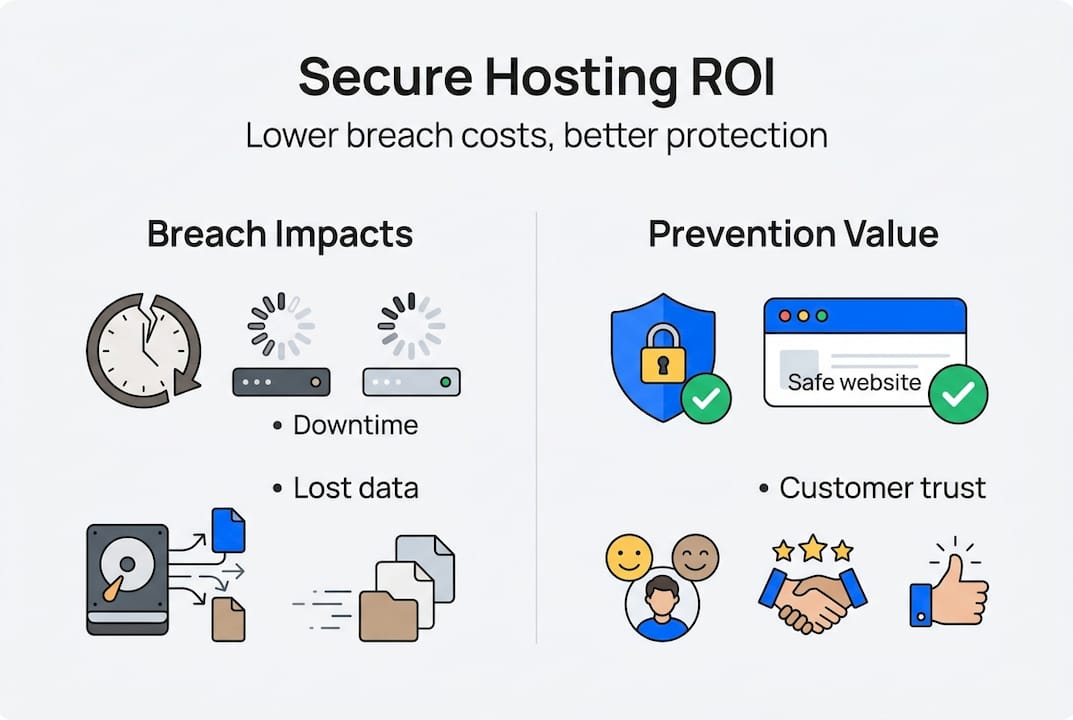
Cybersecurity breaches inflict severe financial and operational damage on small businesses. Recovery typically takes 24-72 hours and costs between $25,000 and $750,000, depending on the breach scope and your industry. These figures include immediate response costs like forensic investigation, legal fees, and emergency IT support, plus indirect damages from lost revenue during downtime.
The financial impact extends far beyond initial recovery expenses. Your business faces reputational damage that drives customers away, often permanently. You may incur regulatory fines for data protection violations, especially if customer payment information or personal data was compromised. Lost productivity compounds the problem as your team spends days or weeks dealing with the breach instead of serving customers and growing the business.
| Cost category | Typical range (SMB) | Prevention cost | ROI ratio |
|---|---|---|---|
| Breach recovery | $25,000-$750,000 | $3,000-$8,000/year | 7-11x |
| Average downtime | 24-72 hours | Minimal with prevention | N/A |
| Customer churn | 15-30% post-breach | <2% with strong security | 7-15x |
| Regulatory fines | $5,000-$100,000 | Included in prevention | 10-20x |
Investing in secure hosting and prevention strategies delivers exceptional returns. Prevention ROI ranges from 7 to 11 times the investment, meaning every dollar spent on security saves you seven to eleven dollars in breach costs. This calculation becomes even more favorable when you factor in avoided reputational damage and customer retention.
To maximize your prevention effectiveness and ROI, follow these steps:
- Start with secure hosting that provides baseline infrastructure protection and professional monitoring.
- Implement SSL certificates across your entire website to encrypt data transmission and build customer trust.
- Establish automated backup systems that create daily copies of your website and store them securely offsite.
- Keep all software updated, including your CMS, plugins, themes, and server operating system.
- Deploy web application firewalls that filter malicious traffic before it reaches your website.
- Train your team on security basics like recognizing phishing attempts and using strong passwords.
The upfront expense of comprehensive security might seem significant for a small business, but it's dramatically cheaper than recovering from a breach. Consider that 60% of small businesses that suffer a major cyber attack close within six months. Your survival depends on prevention, not just response capabilities. Understanding how hosting impacts SMB success helps you see security as a growth investment rather than a cost center.
Secure hosting forms the foundation of this prevention strategy by addressing infrastructure vulnerabilities that you can't fix at the application level. When combined with other security layers, it creates a resilient defense that protects your business, your customers, and your reputation.
Implementing a defense-in-depth strategy alongside secure hosting
Defense-in-depth is a cybersecurity approach that layers multiple protective measures to create redundancy in your security system. If one layer fails or gets bypassed, others continue protecting your website and data. This strategy is essential because no hosting blocks all exploits, with even the best providers stopping only about 26% of sophisticated attacks.
Your defense-in-depth strategy should include these critical layers:
- Network firewalls that filter traffic before it reaches your server, blocking known malicious sources
- SSL certificates that encrypt data transmission between your website and visitors, protecting sensitive information
- Regular automated backups stored securely offsite, enabling quick recovery if other defenses fail
- Timely software patching for your CMS, plugins, and themes to close known vulnerabilities
- Email filtering and authentication to prevent phishing attacks that target your team and customers
- Web application firewalls that analyze and block malicious requests at the application layer
- Access controls and strong authentication that limit who can modify your website
Pro Tip: Many SMBs make the mistake of assuming their hosting provider handles all security. Even with excellent hosting, you must actively manage application security, user access, and software updates. Set calendar reminders for monthly security reviews and quarterly password rotations.
"Roughly 74% of exploits succeed when businesses rely solely on hosting security without implementing layered defenses. Defense-in-depth isn't optional anymore; it's the minimum standard for protecting your online presence."
Layered security supports business continuity by reducing both the likelihood and impact of successful attacks. When one layer detects a threat, it can trigger alerts and automated responses across your entire security stack. If attackers do breach one layer, they encounter additional obstacles that slow their progress and increase the chances of detection before they cause serious damage.
The practical benefit is faster recovery and less downtime. Businesses with comprehensive layered security typically restore operations within hours rather than days because their backup and monitoring systems enable quick incident response. This speed directly translates to retained revenue, preserved customer relationships, and protected reputation.
Implementing defense-in-depth doesn't require enterprise-level budgets. Start with secure hosting as your foundation, then add website security solutions that address application vulnerabilities. Deploy SSL certificates to encrypt traffic and build customer trust. Establish backup routines and update schedules. Each layer adds protection without requiring extensive technical expertise, especially when you choose managed security services that handle complexity for you.
The key is recognizing that cybersecurity is a system, not a single product. Your hosting protects infrastructure, SSL protects data transmission, firewalls protect against network attacks, and backups protect against data loss. Together, these layers create resilient defenses that adapt as threats evolve.
Explore secure hosting options with inSave Hosting
Protecting your small business website requires more than good intentions. It demands reliable infrastructure and security tools that work together seamlessly. inSave Hosting offers a range of secure hosting products specifically designed for SMBs that need professional protection without enterprise complexity or cost.
Our hosting solutions include managed security features, free SSL certificates, and automated backups that form the foundation of your defense-in-depth strategy. Whether you're launching your first website or scaling an established online presence, we provide the infrastructure security that lets you focus on growing your business instead of fighting cyber threats.
Explore our shared hosting plans if you're starting small but want robust baseline security. For businesses handling sensitive customer data or running e-commerce operations, our WordPress hosting solutions deliver enhanced isolation and performance with managed security updates.
Pro Tip: Combine your hosting selection with SSL certificates and automated backup services for comprehensive protection. This layered approach maximizes your security ROI while minimizing the complexity you need to manage.
FAQ
What is secure hosting and why does it matter?
Secure hosting implements protection measures at the server and infrastructure level to reduce cybersecurity risks for your website. It matters because small business websites face frequent attacks from cybercriminals seeking to steal data, disrupt operations, or damage your reputation. Without reliable hosting security, you're vulnerable to threats that can cost tens of thousands of dollars to remediate and potentially force your business to close.
How does managed hosting improve website security compared to shared hosting?
Managed hosting offers better server isolation and control, reducing risks of cross-site attacks that are common in shared hosting environments. It provides dedicated or containerized resources that prevent attackers from accessing your website through vulnerabilities in neighboring sites. Managed hosting also includes professional security administration, faster patching, and customizable security policies that adapt to your specific business needs and risk profile.
What are the financial benefits of investing in secure hosting for small businesses?
Secure hosting dramatically reduces costly breach recovery times and damages that average $25,000 to $750,000 for small businesses. Prevention ROI ranges between 7 to 11 times your investment, meaning comprehensive security saves you seven to eleven dollars for every dollar spent. This calculation improves further when you account for avoided reputational damage, retained customers, and prevented regulatory fines that often accompany data breaches.
What additional security measures should I use with secure hosting?
Implement defense-in-depth by adding multiple protective layers: firewalls that filter malicious traffic, SSL certificates that encrypt data transmission, automated backups that enable quick recovery, regular software patching that closes vulnerabilities, and email filtering that blocks phishing attempts. Explore website security solutions and deploy SSL certificates to complement your hosting foundation. Layered security minimizes breach risks and reduces impact if attacks succeed by creating redundancy in your defenses.