
TL;DR:
- MariaDB is a free, open-source database that is fully compatible with MySQL and offers improved performance. It supports various storage engines for different workloads and is trusted by industries like banking and e-commerce. Most migrations from MySQL are straightforward, making it a practical choice for scalable, enterprise-grade applications.
MariaDB is defined as a free, open-source relational database management system (RDBMS) built as a drop-in replacement for MySQL, designed to deliver stronger performance and full community transparency. If you run a website, manage business data, or evaluate hosting options, understanding what is MariaDB gives you a direct advantage when choosing the right database engine. MariaDB powers critical systems across web hosting, e-commerce, banking, and telecom. inSave Hosting includes MariaDB as a core technology in its hosting stack, alongside LiteSpeed, PHP8, and HTTP/2, because it delivers measurable speed and reliability for real-world applications.
What is MariaDB and where did it come from?
MariaDB is an open-source relational database management system forked from MySQL in 2009, launched on October 29, 2009. The fork happened directly after Oracle acquired Sun Microsystems, which owned MySQL. The original MySQL developers feared Oracle would restrict MySQL's open-source availability, so they created MariaDB to preserve community control.
The name "MariaDB" comes from Maria, the daughter of Michael Widenius, one of MySQL's original creators. That personal connection reflects the project's community-first philosophy. The development team built MariaDB to stay fully open-source under GPL v2, avoiding the dual-licensing model that concerned many developers.
Key milestones in MariaDB's development include:
- 2009: MariaDB 5.1 released as the first public version, maintaining full MySQL compatibility
- 2012: MariaDB Foundation established to govern community development independently
- 2013: Wikimedia Foundation migrated from MySQL to MariaDB, signaling enterprise credibility
- 2023: MariaDB Corporation completed an IPO, confirming active commercial investment
- 2024: New ownership secured, ensuring continued development and long-term support
The community-driven development philosophy means every major decision goes through open discussion. No proprietary licensing restricts access. That transparency is the core reason enterprises in regulated industries trust it.
What are the key features of MariaDB?
MariaDB's technical depth goes well beyond what most people expect from a free database. Its feature set covers everything from storage engine flexibility to enterprise-grade security, making it suitable for a wide range of workloads.

Storage engines built for different workloads
MariaDB supports multiple specialized storage engines, each designed for a specific type of workload:
- Aria: A crash-safe replacement for MyISAM, used for internal MariaDB tables and general read-heavy workloads
- ColumnStore: Designed for analytical processing and business intelligence, storing data in columns rather than rows for faster aggregation queries
- MyRocks: Optimized for high-write volume applications, using a log-structured merge tree to reduce write amplification on solid-state drives
- InnoDB: The default transactional engine, fully ACID-compliant and battle-tested for web applications
The strategic use of multiple storage engines lets you match the engine to the workload rather than forcing every use case through one solution. That flexibility is a genuine differentiator.
Performance and compatibility features
MariaDB supports native JSON data types, allowing semi-structured data storage without a separate document database. It uses the same port (3306) and authentication protocols as MySQL, which means most applications connect to MariaDB without any code changes. It also supports a rich plugin ecosystem, multiple operating systems including Linux, Windows, and macOS, and major programming languages including PHP, Python, Java, and Ruby.
Security features include data-at-rest encryption, role-based access control, and audit logging. These capabilities meet the requirements that IT security professionals look for in enterprise database deployments.
Pro Tip: Enable MariaDB's audit plugin from day one on any production server. It logs all queries and connections, giving you a complete record for compliance reviews without any third-party tools.
What are the benefits of using MariaDB?
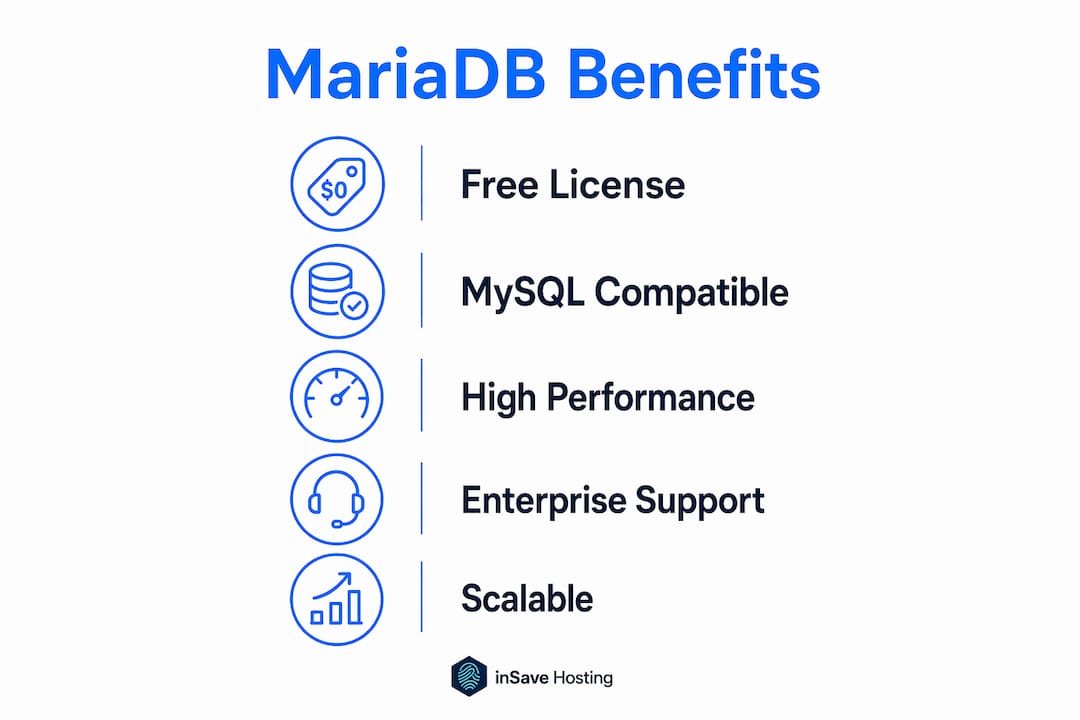
The benefits of using MariaDB fall into four clear categories: cost, compatibility, performance, and support.
Zero licensing cost with full enterprise capability
MariaDB is completely free to download, install, and use in production. The GPL v2 license means you can run it on any number of servers without per-seat fees. For small businesses and startups, that cost difference is significant compared to commercial database solutions that charge based on CPU cores or user counts.
Effortless migration from MySQL
Switching from MySQL to MariaDB typically requires no code changes. The wire compatibility, shared port, and identical SQL syntax mean most applications treat MariaDB as a transparent upgrade. The one critical step is backing up your data and reviewing configuration file mappings before the switch. Advanced users know that careful configuration review preserves both performance and security settings during migration.
Performance that scales with your workload
MariaDB handles transactional, analytical, and semi-structured data within a single system. That versatility means you can run your WordPress site, your reporting queries, and your JSON-based product catalog on one database engine. Galera cluster technology enables multi-master replication with high availability, which is the architecture enterprises use when downtime is not an option.
A support ecosystem that covers every level
MariaDB offers three tiers of support:
- Community forums and documentation: Free, maintained by an active global contributor base
- MariaDB SkySQL: A managed cloud database service for teams that want MariaDB without the operational overhead
- Commercial support contracts: Available through MariaDB Corporation for enterprises that need guaranteed response times
The combination of free community resources and paid enterprise support means businesses at every stage can find the right level of help. That range is rare in the database market.
What are the most common MariaDB use cases?
MariaDB powers a wider range of applications than most people realize. Its use cases span from small personal websites to large-scale enterprise systems.
Web hosting and content management
MariaDB is the default database engine for WordPress installations on many hosting platforms, including inSave Hosting. WordPress relies on a relational database to store posts, users, settings, and plugin data. MariaDB handles those read-heavy workloads efficiently, and its MySQL compatibility means every WordPress plugin works without modification. You can read more about MariaDB in web hosting and how it specifically benefits small and medium-sized businesses.
E-commerce and transactional systems
E-commerce platforms like WooCommerce and Magento depend on fast, reliable transactional processing. MariaDB's InnoDB engine handles concurrent orders, inventory updates, and payment records with ACID compliance. That means every transaction either completes fully or rolls back cleanly, protecting data integrity under high traffic.
Business intelligence and analytics
The ColumnStore engine makes MariaDB a practical choice for analytical workloads. Teams running sales reports, customer behavior analysis, or financial summaries can query millions of rows quickly without a separate analytics database. That consolidation reduces infrastructure complexity and cost.
Enterprise and cloud deployments
MariaDB powers critical systems in banking, telecom, and large-scale web hosting environments. Its Galera cluster technology supports geographically distributed deployments where data must stay consistent across multiple data centers. Cloud providers offer managed MariaDB services, making it accessible to teams that want the database without managing the server.
Pro Tip: For high-traffic sites, pair MariaDB with a caching layer like LSCache or Redis. MariaDB handles the writes and complex queries; the cache handles repetitive reads. That combination dramatically reduces database load during traffic spikes.
Key Takeaways
MariaDB is the most practical open-source relational database for businesses that need MySQL compatibility, zero licensing cost, and the flexibility to scale from a single website to a distributed enterprise system.
| Point | Details |
|---|---|
| MariaDB definition | A free, open-source RDBMS forked from MySQL in 2009, fully compatible with MySQL APIs and commands. |
| Storage engine flexibility | Engines like Aria, ColumnStore, and MyRocks let you match the database to the specific workload. |
| Migration from MySQL | Most migrations require no code changes; back up data and review configuration files before switching. |
| Enterprise use cases | Powers banking, telecom, e-commerce, and web hosting with Galera cluster for high availability. |
| Cost and licensing | Completely free under GPL v2 with community support and optional commercial contracts available. |
MariaDB's staying power in a crowded database market
I've watched the database market shift considerably over the past decade. NoSQL solutions got a lot of attention, and proprietary cloud databases attracted serious enterprise budgets. MariaDB kept growing through all of it, and I think the reason is straightforward: it solves the right problem for the largest group of users.
Most businesses don't need a document database or a distributed key-value store. They need a reliable relational database that handles structured data, runs on affordable hardware, and doesn't require a specialized DBA to maintain. MariaDB fits that description better than any other option I've seen at its price point, which is zero.
The open-source governance model matters more than people give it credit for. When Oracle controls MySQL's roadmap, enterprise users have limited influence over the direction of the product. With MariaDB, the Foundation and the community shape development. That's not just idealism. It produces faster security patches, more transparent release notes, and features that reflect actual user needs rather than vendor priorities.
My advice for any business evaluating database options: start with MariaDB unless you have a specific technical requirement that rules it out. The performance and hosting integration you get from a well-configured MariaDB setup will handle the vast majority of real-world workloads without any additional cost or complexity.
— Ihor
MariaDB hosting made simple with inSave Hosting
inSave Hosting includes MariaDB as a standard component in its shared hosting plans, alongside LiteSpeed, LSCache, PHP8, and free CDN integration. Every plan comes with 99.9% uptime, free SSL certificates, and one-click WordPress installation backed by a MariaDB database.
For businesses running WordPress, WooCommerce, or custom PHP applications, inSave Hosting's environment is pre-configured to get the most out of MariaDB without any manual tuning. Free migration means your existing database moves over without downtime. If you're ready to run your site on a fast, reliable MariaDB-powered platform, explore inSave Hosting's WordPress hosting plans and see which option fits your workload.
FAQ
What is MariaDB in simple terms?
MariaDB is a free, open-source database system that stores and retrieves structured data for websites and applications. It works as a direct replacement for MySQL with added performance features.
Is MariaDB free to use?
MariaDB is fully free under the GPL v2 license. You can use it in personal and commercial projects without licensing fees, though paid commercial support contracts are available.
How does MariaDB differ from MySQL?
MariaDB adds storage engines like ColumnStore and MyRocks, native JSON support, and more frequent security updates compared to MySQL. Both systems share the same SQL syntax and port, so most applications run on either without changes.
Can I migrate from MySQL to MariaDB easily?
Most migrations require no code changes because MariaDB uses the same port, authentication protocols, and SQL commands as MySQL. Backing up your data and reviewing configuration file differences before switching is the critical preparation step.
What industries use MariaDB?
MariaDB powers systems in banking, telecom, e-commerce, and web hosting. Its Galera cluster technology makes it a standard choice for enterprises that require high availability across multiple servers.