
DNSSEC is a set of DNS protocol extensions that cryptographically sign DNS data to guarantee origin authentication and integrity. In plain terms, it lets a resolver confirm that the answer it received for a domain lookup actually came from the legitimate authoritative server and wasn't altered along the way. It does this through digital signatures, not encryption, so it stops spoofing and cache poisoning but does nothing to hide what you're looking up. Validation happens at the recursive resolver, and when a signature fails to check out, the resolver refuses the answer and returns a SERVFAIL instead of quietly serving forged data.
What DNSSEC actually delivers:
- Data origin authentication: proof the response came from the real authoritative source, per RFC 4033.
- Data integrity: proof the response wasn't tampered with in transit.
- No confidentiality: anyone watching the network can still see what you queried.
- No DDoS protection: signature checks add load, they don't stop floods.
Key Takeaways
DNSSEC authenticates DNS responses and guarantees their integrity through cryptographic signatures, but it only protects visitors whose resolver actually validates those signatures.
| Point | Details |
|---|---|
| Definition and scope | DNSSEC proves DNS data is authentic and unaltered; it does not encrypt queries or stop DDoS attacks. |
| Chain of trust | Validation climbs from the root through DS and DNSKEY records at each parent zone down to your domain. |
| Resolver dependency | Protection only reaches visitors whose recursive resolver validates, which is why public resolvers like 1.1.1.1 matter. |
| Biggest operational risk | Mismatched DS records or failed key rollovers cause full outages (SERVFAIL), not soft warnings. |
| Practical deployment path | inSave Hosting's DNS management supports signing and DS submission workflows so domain owners aren't handling keys manually. |
Table of Contents
- What Is DNSSEC's Chain of Trust and How Does It Work?
- What Are the Key DNSSEC Records and Key Types?
- Where Does DNSSEC Validation Actually Happen?
- How Do You Deploy DNSSEC for a Domain?
- What Are the Limitations and Risks of DNSSEC?
- Why Is My Domain Unreachable After Enabling DNSSEC?
- A Practical DNSSEC Checklist for Website Owners
- How Did DNSSEC Develop and Why Was It Created?
- DNSSEC vs. DNS-over-HTTPS: What's the Difference?
- Does DNSSEC Slow Down DNS Lookups?
- What Attacks Does DNSSEC Stop, and What Slips Through?
- What Comes Next for DNSSEC Standards?
- Balancing DNSSEC's Benefits Against the Operational Cost
- Get DNS Support Built for Signing, Not Just Hosting
- Sources
- FAQ
What Is DNSSEC's Chain of Trust and How Does It Work?
Every signed zone in DNSSEC gets vouched for by its parent, forming an unbroken chain that runs from the root down to the domain you're querying. The root zone acts as the trust anchor baked into validating resolver software. From there, each parent zone publishes a DS (Delegation Signer) record pointing to its child's signing key, and ICANN describes this exact parent-to-child handoff as the backbone of the whole system. Break one link and validation for everything beneath it collapses.
Here's how a validating lookup actually plays out:
- A resolver asks for
www.example.comand receives an answer plus an RRSIG (the signature covering that record set). - It fetches
example.com's DNSKEY record to get the public key needed to check that signature. - It confirms the DNSKEY itself is legitimate by comparing it against the DS record published in the
.comzone. - It walks that same DS/DNSKEY check up through
.comto the root, closing the chain. - If every link validates, the resolver marks the response with the AD (Authenticated Data) flag. If not, it returns SERVFAIL.
That last step matters more than most explanations admit: a client can also set the CD (Checking Disabled) flag to skip validation deliberately, which is exactly what engineers do when diagnosing whether a break is happening at the resolver or the zone itself.
One more piece rounds out the system: authenticated denial of existence. If you query a name that doesn't exist, DNSSEC still needs a signed way to say "no record here" without letting an attacker forge that "no" for a name that actually does exist. NSEC and NSEC3 records handle that job, and they work differently enough to matter for your zone's privacy, which the next section covers.
Historical CERT reporting on probable cache poisoning of mail-handling domains is the kind of incident DNSSEC was built to prevent: an attacker injecting forged DNS answers so mail or web traffic gets silently redirected.
What Are the Key DNSSEC Records and Key Types?
DNSSEC introduces four new record types, and RFC 4034 defines exactly what each one carries and how resolvers use it. Getting these straight makes every later section, deployment, troubleshooting, key rollover, click into place.
- DNSKEY: holds the public key for a zone. Every signed zone publishes at least two: a Key Signing Key (KSK) and one or more Zone Signing Keys (ZSK).
- RRSIG: the actual digital signature covering a specific record set (an RRset), generated with the private half of a ZSK.
- DS: sits in the parent zone and contains a hash of the child zone's KSK, which is what lets a resolver climb the chain of trust one level at a time.
- NSEC: proves a name doesn't exist by listing the next name alphabetically in the zone, in plaintext.
- NSEC3: does the same job but hashes the names first, so an attacker can't simply walk the records to enumerate your entire zone.
The split between KSK and ZSK isn't bureaucratic overhead. The ZSK signs day-to-day records and rotates often, sometimes every few months, because it's used constantly and a shorter lifespan limits damage if it leaks. The KSK signs the DNSKEY set itself and changes far less frequently since rolling it requires updating the DS record at the registrar, a slower, more coordinated process.
Pro Tip: If your zone has any subdomains you don't want easily discoverable through zone walking, insist on NSEC3 over plain NSEC. The trade off is slightly bigger responses and marginally more complex tooling, but it closes a real information leak.
Where Does DNSSEC Validation Actually Happen?
Validation happens at the recursive resolver, never in your browser and never on your own device. This is the detail that trips up most people learning DNSSEC: signing your domain protects visitors only if whatever resolver they're using bothers to check the signatures.
- If a visitor's ISP resolver doesn't validate, signing your zone gives them zero protection, no matter how carefully you configured it.
- Public resolvers close that gap. Cloudflare's 1.1.1.1 and several other major public resolvers validate DNSSEC by default, which the Internet Society's deployment tracking confirms extends protection to users whose own network operator skips validation entirely.
- A validating resolver that hits a broken signature chain returns SERVFAIL rather than an unverified answer, and it tags successful checks internally with the AD flag so downstream software can confirm validation occurred.
That dependency is worth sitting with: DNSSEC's protection is only as strong as the weakest resolver in the path, which is exactly why encouraging validating public resolvers matters as much as signing your own domain.
How Do You Deploy DNSSEC for a Domain?
Rolling out DNSSEC is mostly a coordination problem between your DNS host and your registrar, not a cryptography problem. Here's the sequence that avoids most of the pain:
- Confirm support on both ends. Your DNS hosting provider needs to support signing, and your registrar needs to accept DS record submission for your TLD. Most mainstream combinations do, but always check before committing.
- Decide who signs. Some hosts sign automatically and manage KSK/ZSK rotation for you; others expect you to generate and manage keys yourself. Host-managed signing removes the sharpest edges for smaller teams.
- Sign the zone. This publishes DNSKEY and RRSIG records for every RRset in the zone.
- Submit the DS record. Log in to your registrar's control panel and publish the DS record, or use automated CDS/CDNSKEY signaling if both your host and registrar support it, which ICANN notes many managed DNS providers now offer as a near one-click option.
- Verify the chain completes. Use an online DNSSEC validator or
dig +dnssecto confirm the DS at the parent matches your published DNSKEY. - Schedule key rollovers. Set a recurring calendar reminder for ZSK rotation and plan KSK rollovers well in advance, since those require re-touching the DS record at the registrar.
Pro Tip: Test the entire signing and DS-publication sequence on a staging or test subdomain before touching your production zone. A broken DS record on a live domain means real visitors start getting SERVFAIL, and there's no quiet way to fix that.
What Are the Limitations and Risks of DNSSEC?
DNSSEC solves one specific problem well and leaves several others completely untouched. It authenticates and verifies integrity; it does not hide anything. If confidentiality matters to you, and it usually should, pair DNSSEC with DNS-over-HTTPS or DNS-over-TLS for the stub-to-resolver hop, since DNSSEC signatures do nothing to stop someone from watching the query itself.
- It does not defend against DDoS. Signature validation actually adds computational overhead to resolvers and authoritative servers, the opposite direction you want under a flood attack.
- Misconfiguration is the real operational cost. A mismatched DS record, an expired RRSIG, or a botched key rollover doesn't just weaken security, it takes your domain offline for every validating resolver.
- DNSSEC only helps end to end when both the zone is signed and the resolver validates. One without the other yields little practical benefit, a point researchers studying deployment gaps have raised repeatedly.
Security practitioners consistently flag key management as DNSSEC's sharpest edge: incorrect rollovers or mismatched DS records can render an otherwise healthy domain completely unreachable to any resolver that validates, turning a security upgrade into a self-inflicted outage.
Why Is My Domain Unreachable After Enabling DNSSEC?
SERVFAIL after signing almost always traces back to one of three causes: an expired RRSIG, a DNSKEY that no longer matches the published DS, or a DS record that was never correctly submitted at the registrar.
- Run
dig +dnssec yourdomain.comand check whether the RRSIG's expiration has passed, an easy miss if automated re-signing quietly failed. - Confirm the DNSKEY currently published in your zone actually matches the DS record sitting at the parent, then cross-check both against an online DNSSEC validator.
- If you need the domain back online immediately, remove the DS record at the registrar first, that breaks the chain safely without you touching the zone, then fix signing and republish DS once resolved.
Pro Tip: Always document your rollback steps before you touch a live DS record. When a domain suddenly goes dark, you want a five-minute fix, not an investigation.
A Practical DNSSEC Checklist for Website Owners
Treat DNSSEC as a five-step cycle, not a one-time setting: verify support, sign in staging, submit the DS record, confirm the chain validates, then monitor continuously.
- Confirm both your DNS host and registrar support DS submission before you start.
- Sign a staging or test subdomain first, never your production zone.
- Publish the DS record and verify the full chain with a validator before calling it done.
- Set calendar reminders for ZSK and KSK rollovers, and keep a documented rollback procedure.
- Monitor signature expiration and DS/DNSKEY match on an ongoing basis, not just at launch.
For the surrounding pieces, registering or transferring a domain cleanly, choosing a DNS host with signing support, and managing records without breaking a chain mid-transfer, inSave Hosting's guides on safe domain transfers walk through the parts that most commonly go wrong.
How Did DNSSEC Develop and Why Was It Created?
DNSSEC exists because the original DNS protocol, designed in the early 1980s, trusted every answer it received without any way to verify where it actually came from. That worked fine until researchers demonstrated how trivially an attacker could forge responses and redirect traffic, cache poisoning wasn't a theoretical risk, it was a design gap baked into the protocol from day one.
The IETF began serious work on a cryptographic fix through the 1990s, but early versions proved difficult to deploy at internet scale. The turning point came with RFC 4033, 4034, and 4035, published in 2005, which rebuilt the specification around the chain-of-trust model still in use today. That redesign is what finally made large-scale deployment realistic.
Root zone signing didn't happen until 2010, a full five years after the modern RFCs landed, because getting every top-level domain operator and registrar coordinated took real institutional effort. Since then, adoption has climbed steadily but unevenly. Some country-code TLDs and government domains reach near-universal signing, while huge swaths of the commercial web remain unsigned. The gap isn't really technical anymore, it's operational: signing a zone requires ongoing key management that many smaller domain owners never prioritize, which is exactly why host-managed signing options matter for adoption going forward.
DNSSEC vs. DNS-over-HTTPS: What's the Difference?
DNSSEC and encrypted transport protocols like DNS-over-HTTPS (DoH) and DNS-over-TLS (DoT) solve different problems, and confusing them is one of the most common mistakes people make when researching DNS security. DNSSEC proves the answer you received is authentic and unaltered. DoH and DoT hide the query itself from anyone watching the network between your device and the resolver.
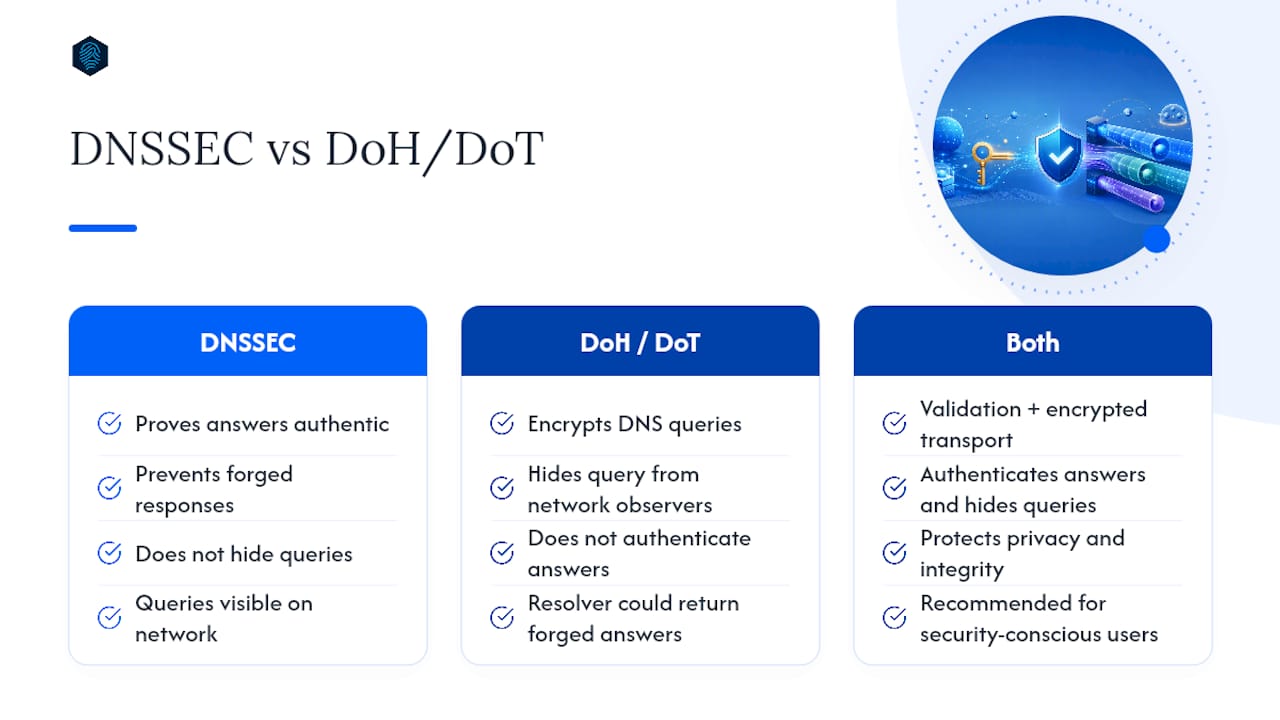
Neither one replaces the other, and running only one leaves a real gap. Query only over DoH without DNSSEC, and your ISP can no longer see what you're looking up, but a compromised or malicious resolver could still hand you a forged answer with nobody the wiser. Run only DNSSEC without DoH or DoT, and your queries are authenticated but still fully visible to any network observer between you and the resolver, including your ISP.
The strongest setup layers both: DNSSEC validation on the resolver side confirming what you get back is genuine, and DoH or DoT on the transport side keeping the query itself private from network eavesdroppers. Several major public resolvers, including Cloudflare's 1.1.1.1, support both simultaneously, which is precisely why the Internet Society treats validating, encryption-capable public resolvers as the practical baseline for privacy-conscious users today. If your priority is keeping your domain from being spoofed for visitors, sign it with DNSSEC. If your priority is keeping your own browsing private from your network operator, configure DoH or DoT on your device or router. Most security-conscious setups end up wanting both.
Does DNSSEC Slow Down DNS Lookups?
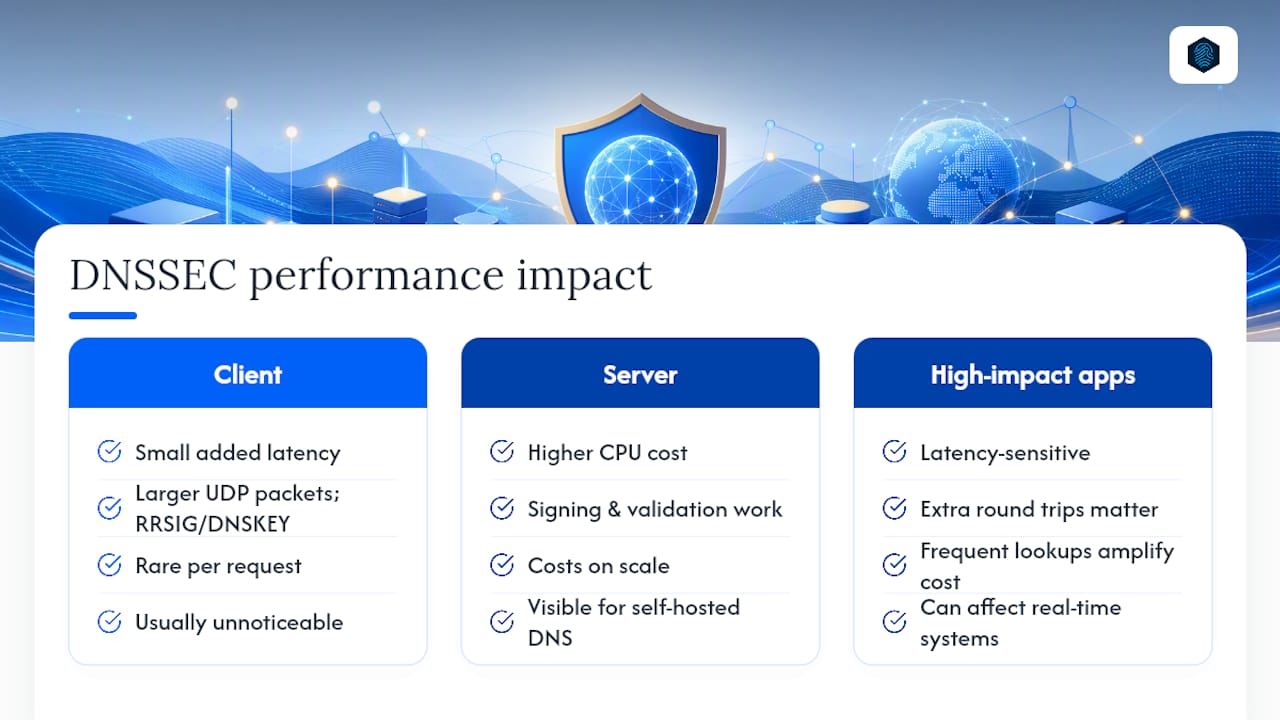
DNSSEC does add measurable overhead, but it's smaller than most people assume, and it's rarely the bottleneck in a slow website. Signed responses carry RRSIG and DNSKEY records on top of the normal answer, which means larger packet sizes and occasionally a shift from UDP to TCP when responses exceed standard packet limits. That's why DNSSEC requires EDNS0 support, an extension that allows larger UDP messages before the fallback to TCP kicks in.
The bigger cost sits on the server side, not the client side. Signing operations and validation checks consume more CPU cycles than a standard unsigned lookup, which matters if you're running your own authoritative or recursive infrastructure at scale but is essentially invisible to an individual site owner using a managed DNS host. Most of that computational cost, key generation, signature creation, chain validation, happens once during signing or once per resolver cache miss, not on every single request a visitor makes.
For a typical small-to-medium website, the latency difference between a signed and unsigned domain is generally not something a visitor will notice in normal browsing conditions. The added round trips and slightly larger payloads matter far more for high-frequency, low-latency applications, real-time bidding systems, certain gaming infrastructure, than for a standard business website or blog. If you're already using a performance-focused DNS host with caching and modern protocol support, DNSSEC's overhead is close to a rounding error next to your actual page load time.
What Attacks Does DNSSEC Stop, and What Slips Through?
DNSSEC's entire design targets one category of attack: forged or tampered DNS responses. That covers more ground than it sounds like. Cache poisoning, where an attacker injects a fake record into a resolver's cache so every subsequent visitor gets redirected, is the textbook case DNSSEC was built to close, and the kind of incident CERT documented in real mail-handling domain compromises. Man-in-the-middle DNS injection, where an attacker on the network path swaps in a forged answer mid-transit, falls into the same category DNSSEC is designed to defeat, as UpGuard's overview of DNSSEC protections lays out clearly.
What DNSSEC does not touch is just as important to understand. It offers no defense against DDoS attacks aimed at overwhelming your authoritative servers with traffic volume, if anything, validation adds a small amount of extra processing load that works against you during a flood. It does nothing against phishing domains that are technically legitimate and correctly signed but designed to deceive, a lookalike domain like "yourbank-secure.com" validates perfectly under DNSSEC because the forgery is in the name, not the DNS response. It also doesn't protect against compromised credentials, malware, or vulnerabilities at the application layer; DNSSEC's job stops entirely at confirming the DNS answer itself is authentic.
What Comes Next for DNSSEC Standards?
The core specification hasn't changed dramatically in years, but the tooling and ecosystem around it keep maturing. Automated key rollover through CDS and CDNSKEY signaling, where a child zone can automatically notify the parent when a key changes, is steadily replacing manual DS record updates at the registrar. That single shift addresses the most common source of DNSSEC outages: human error during key rotation.
Post-quantum cryptography is the bigger question mark on the horizon. The signature algorithms DNSSEC relies on today assume certain problems remain computationally hard, an assumption quantum computing eventually threatens. Standards bodies are already evaluating quantum-resistant signature schemes for DNSSEC, though a full transition is a multi-year undertaking given how many resolvers and zones would need to support new algorithms simultaneously.
On the adoption side, expect continued pressure from registrars and hosting providers to make signing closer to automatic. The technical case for DNSSEC has been settled for two decades; what's shifted is the tooling finally catching up to make deployment less of a specialist task and more of a checkbox during domain setup.
Balancing DNSSEC's Benefits Against the Operational Cost
DNSSEC is worth deploying, but not by flipping a switch and walking away. The technology is sound and the protection it offers against spoofing is real, yet the failure mode when something goes wrong is total unreachability, not a gentle security warning. I'd rather see a site owner stage the rollout on a test subdomain, verify the chain validates cleanly, and only then push to production, than rush a signed zone live and discover a mismatched DS record at 2 a.m. If your DNS host offers managed signing with automated rollovers, take it. That single choice removes most of the operational risk this article spends so much time warning about.
— Ihor
Get DNS Support Built for Signing, Not Just Hosting
Plenty of domain owners get stuck at the DS submission step because their registrar's interface buries it or their DNS host doesn't support automated signing at all. inSave Hosting's DNS management tools are built to handle DNSSEC workflows without forcing you to hand generate keys or hunt through documentation to find where DS records live. If privacy on top of authentication matters to you, pairing DNSSEC with proper TLS encryption closes the gap DNSSEC alone leaves open, since one confirms authenticity and the other keeps the connection itself private.

Whether you're signing an existing domain or registering a new one with DNSSEC support built in from the start, inSave Hosting's platform walks you through zone signing and DS publication as part of standard DNS management, not as a separate add-on you have to configure manually. Check your domain's current setup and see what's needed to get it signed properly through the inSave Hosting dashboard.
Sources
- RFC 4033 — DNS Security Introduction and Requirements
- DNSSEC – What Is It and Why Is It Important? — ICANN
- DNSSEC deployment maps and guidance — Internet Society (Deploy360)
FAQ
Should DNSSEC Be Enabled on My Domain?
Yes, for most domain owners, especially anyone handling sensitive traffic like login pages or financial data, since it closes a real spoofing and cache-poisoning gap at little practical cost when your DNS host supports automated signing.
What Are the Disadvantages of DNSSEC?
It adds operational complexity, key rollovers, DS record maintenance, and monitoring, and a misconfiguration can take your domain completely offline (SERVFAIL) for validating resolvers rather than just degrading performance.
Does 1.1.1.1 Validate DNSSEC?
Yes, Cloudflare's 1.1.1.1 performs DNSSEC validation by default, which means it protects users even when their own ISP resolver doesn't validate.
Does Cloudflare Support DNSSEC for Hosted Domains?
Cloudflare supports DNSSEC signing for domains using its DNS service, though how you enable it depends on the specific product and setup; check your provider's DNS management panel for the signing option and DS submission steps, similar to what inSave Hosting offers for domains hosted on its platform.