
Most small sites run on $5 to $15 a month once you're past the introductory teaser rate. Shared hosting starts near $2 to $15 a month, VPS plans run $20 to $60, cloud hosting spans $10 to $200 depending on how much compute you actually use, and dedicated servers start around $200 a month and climb from there. Managed WordPress hosting generally costs more than basic shared hosting, reflecting the additional management services included.
For most people launching a first site or running a small business, a reputable shared plan or an entry-level managed WordPress plan is the right starting point. You get enough resources for normal traffic without paying for headroom you won't use in year one.
Here's the part that trips people up: the sticker price you see on a pricing page is rarely the price you'll pay in year two. Promotional pricing is standard practice across the industry, and renewal rates commonly run two to three times higher than the first-year rate once the introductory term ends.
- Shared hosting: $2 to $15/month (renewal often $8 to $20/month)
- Managed WordPress: $8 to $50/month
- VPS: $20 to $60/month for typical small-business configurations
- Cloud hosting: $10 to $200+/month, scaling with usage
- Dedicated servers: $200+/month
Add-ons matter too. A domain name typically costs $10 to $20 a year, SSL is often free, and backups, email, and migration fees can add anywhere from nothing to a meaningful chunk of your annual budget depending on the plan you pick.
Key Takeaways
The real cost of web hosting is not the advertised sticker price. It is the renewal-year total once promotional pricing, add-ons, and domain fees are factored in.
| Point | Details |
|---|---|
| Shared hosting range | Expect $2 to $15/month, with renewal often landing at $8 to $20/month after promotional pricing ends. |
| Domain renewal traps | Domains typically cost $10 to $20/year but often renew at a higher rate than the first-year promo price. |
| Managed hosting trade-off | Managed plans cost more upfront but bundle SSL, backups, and security that would otherwise add up separately. |
| Budget for year two | Build sample budgets around renewal pricing, not the promotional rate, to avoid year-two surprises. |
| inSave Hosting fit | inSave Hosting bundles free SSL, one year of free domain, and 99.9% uptime into starter shared and managed WordPress plans. |
Table of Contents
- What Does Web Hosting Cost by Type?
- Why Do Similar Hosting Plans Cost So Differently?
- How Much Do Domains, SSL, and Other Add-Ons Cost?
- Sample Budgets for Hobby Sites, Small Business, and Starter E-Commerce
- When Does Paying for Managed Hosting Make Sense?
- How Do You Cut Hosting Costs Without Cutting Reliability?
- What Questions Should You Ask Before You Buy Hosting?
- Sources
- FAQ
What Does Web Hosting Cost by Type?
The type of hosting you choose sets the entire shape of your budget, because it determines how much of the server you're actually renting versus sharing.
Shared hosting puts your site on a server with dozens or sometimes hundreds of other accounts, splitting CPU, RAM, and storage among everyone. It's the cheapest option and the right fit for blogs, portfolios, and small brochure sites without heavy traffic. Promotional pricing frequently advertises rates near $1 to $5 a month, but that's a first-term hook. Once you renew, expect $5 to $15 a month for a plan with reasonable storage and email allowances. Some comparison guides note that "starting at $1 to $3" pricing is common in marketing, while realistic ongoing costs for a usable starter tier sit closer to $3 to $10 a month.
VPS (Virtual Private Server) hosting carves out a dedicated slice of a physical server just for you, with guaranteed CPU cores and RAM instead of a shared pool. A basic VPS with 1 to 2 vCPUs, 2GB to 4GB of RAM, and 40GB to 80GB of SSD storage typically runs $20 to $40 a month. Step up to 4 vCPUs and 8GB of RAM for a growing e-commerce site or a busy WordPress install, and you're looking at $40 to $60 a month. VPS plans commonly range from roughly $5 on the low end to $100 or more depending on configuration, so the spread within "VPS" is almost as wide as the spread across hosting types entirely.
Cloud hosting bills you for actual resource consumption rather than a flat monthly allotment. That flexibility is valuable for sites with unpredictable traffic spikes, but it also means your bill can swing from $10 a month during a quiet stretch to $200 or more during a viral moment or a big sale. Cloud pricing bands run $10 to $200+ a month for basic instances, and enterprise-grade cloud infrastructure goes well beyond that.
Dedicated servers give you the entire physical machine, no sharing at all. That's overkill for a five-page business site, but it makes sense for high-traffic applications, large databases, or compliance-sensitive workloads that can't share hardware with anyone else. Dedicated plans commonly start in the hundreds of dollars per month, and managed dedicated configurations for enterprise use can run well past $200.
Managed WordPress hosting and website builders bundle maintenance, security patching, and backups into the plan price. You pay more upfront, but you eliminate a chunk of the DIY server administration that eats hours every month. Managed plans and builders raise the sticker price specifically because they fold in services you'd otherwise buy separately, which is worth weighing against your own time.
| Hosting Type | Typical Monthly Range | Best Fit |
|---|---|---|
| Shared hosting | $2 to $15 | Blogs, portfolios, small brochure sites |
| Managed WordPress | $8 to $50 | WordPress sites wanting less maintenance |
| VPS | $20 to $60 | Growing sites needing dedicated resources |
| Cloud | $10 to $200+ | Variable-traffic sites, apps, seasonal spikes |
| Dedicated | $200+ | High-traffic, compliance-heavy, or enterprise sites |
If you're still deciding which category fits your project, this breakdown of types of web hosting for WordPress walks through the practical trade-offs in more depth. Readers weighing VPS specifically against dedicated Windows infrastructure might also look at AceRDP's Windows RDP and VPS options for a sense of how pricing shifts once you need guaranteed remote desktop access.
Why Do Similar Hosting Plans Cost So Differently?
Two plans that look nearly identical on a pricing page can produce very different bills once you factor in what's actually included versus what gets billed as an extra. The gap usually comes down to five things.
Resource allocation is the biggest driver. A shared plan promising "unlimited storage" still caps CPU and RAM usage somewhere in the fine print, and hitting that ceiling either throttles your site or triggers an upsell to a pricier tier. VPS and dedicated plans price resources explicitly, so you can compare vCPU counts, RAM, and SSD storage directly across providers.
Bandwidth limits and overage fees catch people off guard, especially on cloud and VPS plans billed by usage. A plan that looks cheap at $15 a month can quietly become $60 a month if your traffic doubles and you're billed per gigabyte transferred beyond an included allowance.
Managed services, backups, and security are where the biggest price gap between "cheap" and "reasonable" hosting shows up. A bare-bones plan might not back up your database automatically, leaving you exposed if something breaks. A managed plan folds daily backups, malware scanning, and patching into the price, which is why it costs more but often saves money in the long run.
Support SLAs vary more than most buyers expect. Some hosts guarantee a response within an hour on live chat; others route you through a ticket queue with a 24 to 48 hour turnaround. That difference matters a lot the day your site goes down during a sales promotion.
Contract length and renewal behavior shape your real annual cost more than any other single factor. Longer terms (one, two, or three years) usually lock in a lower monthly rate, but they also lock you into a provider before you know if the support and uptime match the marketing.
- Resource caps (CPU, RAM, storage, I/O throughput)
- Bandwidth allowances and per-gigabyte overage charges
- Backup frequency, security monitoring, and patch management
- Support SLA and guaranteed response time
- Contract length and the gap between promo and renewal pricing
- Performance add-ons like CDN, server-side caching, and premium DNS
Pro Tip: Ask any host directly what happens if you exceed your bandwidth or storage allowance before you sign up. Some will simply throttle your site; others will auto-upgrade you to a pricier plan without asking first.
Performance add-ons deserve a specific mention because they cut both ways on cost. A CDN and a caching layer add a line item to your bill, but they can also reduce how much raw server power you need, which is why tools like PageSpeed Insights are often cited when hosts justify premium stack pricing. The trade-off is real: pay a little more for performance infrastructure, and you may avoid paying a lot more for a resource upgrade later.
How Much Do Domains, SSL, and Other Add-Ons Cost?
Hosting is rarely the only line item on your bill. Domains, security certificates, email, and backups add up fast, and renewal pricing on several of these is where budgets quietly blow past year-one estimates.
A standard domain name typically costs $10 to $20 a year for common TLDs like .com, .net, and .org. Registrars frequently advertise a low first-year price and then raise the renewal rate, sometimes by a wide margin, which means the domain you bought for $9.99 might renew at $18.99 or more. Premium domains (short, brandable, or high-demand names) can run into the hundreds or thousands of dollars, and transferring a domain between registrars sometimes carries its own fee, typically comparable to a one-year renewal cost.
WHOIS privacy protection, which hides your personal contact information from the public domain registry, used to be a paid add-on almost everywhere. Many registrars now bundle it free, but it's still worth confirming before checkout since some hosts charge separately for it.
SSL certificates have gotten dramatically cheaper industry-wide thanks to Let's Encrypt, a free certificate authority that most hosts now integrate automatically. A standard SSL certificate for a small business site or blog should cost you nothing at most modern hosts. Paid SSL still makes sense for e-commerce sites that want extended validation or a warranty backing the certificate, and those typically run $20 to $200+ a year depending on the validation level.

Email hosting is often bundled into hosting plans at a basic tier, but dedicated business email (think a professional inbox tied to your domain with more storage and better spam filtering) commonly adds $1 to $6 per mailbox per month if it's not already included. If your plan doesn't bundle it, a dedicated guide to web host email setup covers what to look for.
Backups and migration round out the common extras. Some hosts include daily backups free; others charge $1 to $5 a month for automated backup service, or a flat fee if you need a one-time restore. Migration fees for moving an existing site to a new host range from free (many hosts offer this as an incentive to switch) to $100 or more for complex multi-site migrations.
- Domain registration: $10 to $20/year, renewal often higher
- Domain transfer: typically comparable to one year of renewal
- SSL (standard): free at most hosts via Let's Encrypt
- SSL (extended validation): $20 to $200+/year
- Business email: $1 to $6 per mailbox/month if not bundled
- Backup service: $1 to $5/month, or included in managed plans
- Migration: often free as a switching incentive, up to $100+ for complex sites
Sample Budgets for Hobby Sites, Small Business, and Starter E-Commerce
Real numbers help more than ranges when you're trying to plan an actual budget, so here's what three common site types look like across a full year, both in year one and after renewal pricing kicks in.
1. Hobby or personal site. A domain at roughly $12 for the year, a basic shared hosting plan at $5 a month ($60 a year), and free SSL. That's about $72 for year one. In year two, domain renewal and hosting renewal prices typically increase, resulting in a higher annual total than the first year.
2. Small business brochure site. A domain at $15, a managed entry-level hosting plan at $12 a month ($144 a year), basic business email included, and automated backups included. Year one lands around $159. Year two, with hosting renewing at $18 a month ($216) and the domain at $18, comes to roughly $234.
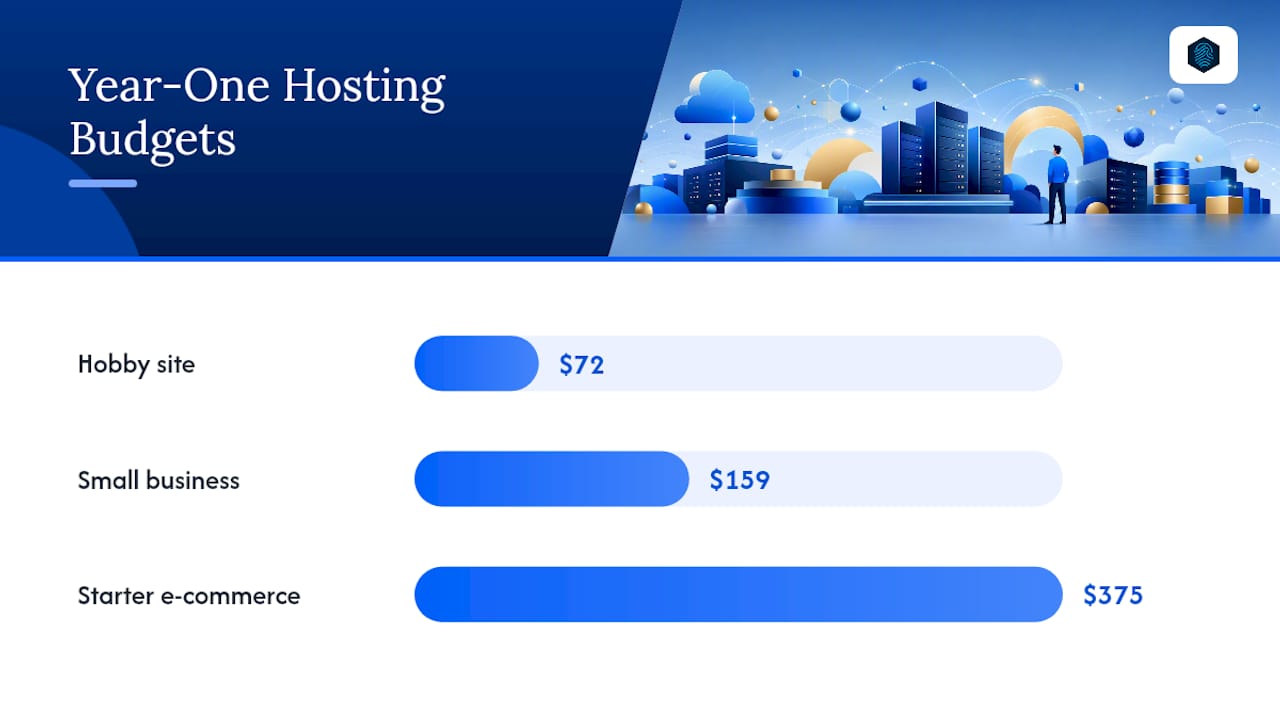
**3. Hosting and domain costs alone run about $375 for year one, before transaction fees.
Three things to build into any budget:
- Always plan around the renewal price, not the promotional price, since business guides consistently flag first-year promo pricing as the top cause of year-two budget surprises.
- Separate hosting costs from transaction and payment processing costs when budgeting for e-commerce, since those are billed by different companies entirely.
- Build a small buffer, roughly 20% above your year-one total, into your year-two projection so a renewal increase doesn't catch you flat-footed.
When Does Paying for Managed Hosting Make Sense?
Managed hosting costs more than a bare-bones shared plan, and it should. What you're actually buying is a shift of technical labor from you to the host, and for most small business owners, that trade is worth the extra few dollars a month.
Here's what a managed plan typically bundles and why each piece matters:
- 99.9% uptime commitment means your site is realistically online essentially all the time, which matters directly for revenue if you run any kind of storefront or lead-generation page.
- Free SSL certificates remove a setup step and an ongoing renewal task that unmanaged hosting often leaves entirely on you.
- One-year free domain registration removes one line item from your first-year budget outright, which is a real number, not a marketing gesture.
- Automated backups mean a plugin conflict or a bad update doesn't turn into a full rebuild from scratch.
- Staging environments let you test theme or plugin changes on a copy of your site before pushing them live, which prevents the classic "I updated a plugin and now the site is down" scenario.
- Managed security (malware scanning, firewall rules, automatic patching) closes off a category of problems that otherwise require either your own vigilance or a separate paid security service.
inSave Hosting builds its plans around a performance stack designed to reduce how much raw server power a small site needs in the first place. LiteSpeed as the web server, paired with LSCache for page caching, MariaDB for the database layer, HTTP/2 for faster connection handling, PHP8 for faster script execution, and a free CDN for distributing static assets closer to visitors. The practical effect is that a site can often stay comfortably on a lower-tier plan longer than it would on a stack without those optimizations, which is consistent with performance testing that shows caching and CDN use reducing server resource demand.
The honest calculation for most small business owners isn't "cheap hosting versus expensive hosting." It's "who pays for the maintenance work, me or the host." Managed hosting shifts that cost into the monthly bill instead of into your own unpaid hours fixing things at 11 p.m.
Managed hosting is not the cheapest line item on a pricing page, and it shouldn't be sold that way. It's the option that tends to reduce your total cost of ownership once you count the hours a DIY approach eats up.
Author note from Ihor
I've spent years watching small business owners get burned by the gap between a hosting plan's advertised price and what they actually pay by month thirteen. My take: for most non-technical site owners, a bundled managed plan beats piecing together hosting, SSL, backups, and security separately, purely on total cost and time saved. Use the checklist further down before you buy anything.
inSave Hosting: A Practical Starting Point for Budget-Conscious Sites
If the sample budgets above sound close to your situation, inSave Hosting's starter shared and managed WordPress plans are built for exactly that math. The LiteSpeed and LSCache stack underneath is aimed at keeping small sites fast without forcing an early upgrade to a pricier tier.
For a hobby site or a small business brochure site, the entry shared plan matches the budget outlined earlier almost exactly, with the domain and SSL costs already absorbed. Sites planning for growth, or running WordPress specifically, fit better on a WordPress hosting plan built around the same performance stack with added management tools like staging and automated updates.
If you're ready to see current plan pricing and pick a starting tier, check inSave Hosting's shared hosting plans and compare them against the budget you just built.
How Do You Cut Hosting Costs Without Cutting Reliability?
Saving money on hosting isn't about finding the absolute cheapest plan. It's about not paying twice for things a better-structured plan would already include, and not getting burned by fees you didn't see coming.
- Choose a plan that bundles the essentials. SSL, backups, and a reasonable email allowance included in the base price beat a slightly cheaper plan that charges for each one separately.
- Invest in caching and image optimization before you invest in a bigger server. A CDN and proper image compression frequently solve the performance problem that a resource upgrade was about to solve at three times the monthly cost.
- Lock in your domain for multiple years, or note the renewal date on your calendar. Multi-year domain registration sometimes secures a lower average rate and always protects you from a surprise renewal jump.
- Read the renewal and overage terms before you buy, not after. The promotional price on the checkout page is not the number that matters. The number twelve months from now is.
- Watch for red flags during the sales process: no mention of backups anywhere on the plan page, vague or absent renewal pricing, no published uptime SLA, or a support team that takes days to answer a pre-sale question. Any one of these tends to predict a rough year with that provider.
Pro Tip: If a provider won't tell you the renewal price before you buy, that's the answer. A host confident in its pricing will show it upfront.
If you're comparing budget options broadly rather than committing to a single plan type, this roundup of affordable web hosting alternatives is a useful side-by-side starting point.
What Questions Should You Ask Before You Buy Hosting?
A short checklist before checkout saves you from the most common budgeting mistakes, and it takes about five minutes of reading or one email to a sales team.
Confirm these five things before entering payment information:
- What is the exact renewal price, and how does the billing cadence work (monthly, annual, multi-year)?
- Are SSL, email, backups, and CDN included, or are they billed as separate add-ons?
- Is there a migration fee if you're moving an existing site, and what are the resource limits (storage, bandwidth, visitors) before overage charges apply?
- What is the published uptime SLA, and what is the guaranteed support response time?
- What does your total cost look like in year one versus year two, once promotional pricing expires?
- Request the exact renewal price in writing or from the pricing page, not just the promotional rate.
- Ask specifically what's bundled versus billed separately, item by item.
- Confirm migration costs and resource ceilings before you commit any content to the new host.
- Get the uptime SLA and support response commitment in writing if it's not already published.
- Calculate your realistic year-one and year-two totals side by side before you check out.
Sources
- How much does a domain name cost? — Cloudflare
- Website Hosting Cost Guide 2026 — Forbes Advisor
- 12 Best Web Hosting Prices Compared (June 2026) — HostingAdvice
- Web hosting costs and how much you should pay — Wix Blog
- PageSpeed Insights — web.dev
FAQ
How much should it cost to host a website?
Most small sites run $5 to $15 a month on shared hosting, or $8 to $50 a month for managed WordPress hosting, depending on how much support and automation you want included.
How much is a typical web hosting fee, all in?
Once you add a domain (roughly $10 to $20 a year), hosting, and basic SSL, a small hobby site typically totals about $70 to $120 for the first year, with the second year often running higher due to renewal pricing.
How much does it cost to develop and host a website?
Hosting and a domain together commonly run from low double digits up to several hundred dollars for the first year depending on plan type, while site development costs vary separately based on whether you build it yourself, use a builder, or hire a developer.
Can I host a website for free?
Free hosting exists but usually comes with ads, limited storage, no custom domain support, and weak uptime guarantees, which makes it a poor long-term fit for any business site. A low-cost entry-level shared plan, like inSave Hosting's starter tier, is usually a better trade for a small amount of monthly spend.
Why did my hosting renewal price go up so much?
Most hosts advertise a discounted first-term rate and renew at a higher standard rate, which is why comparing the promotional price against the renewal price matters more than the number on the checkout page.