
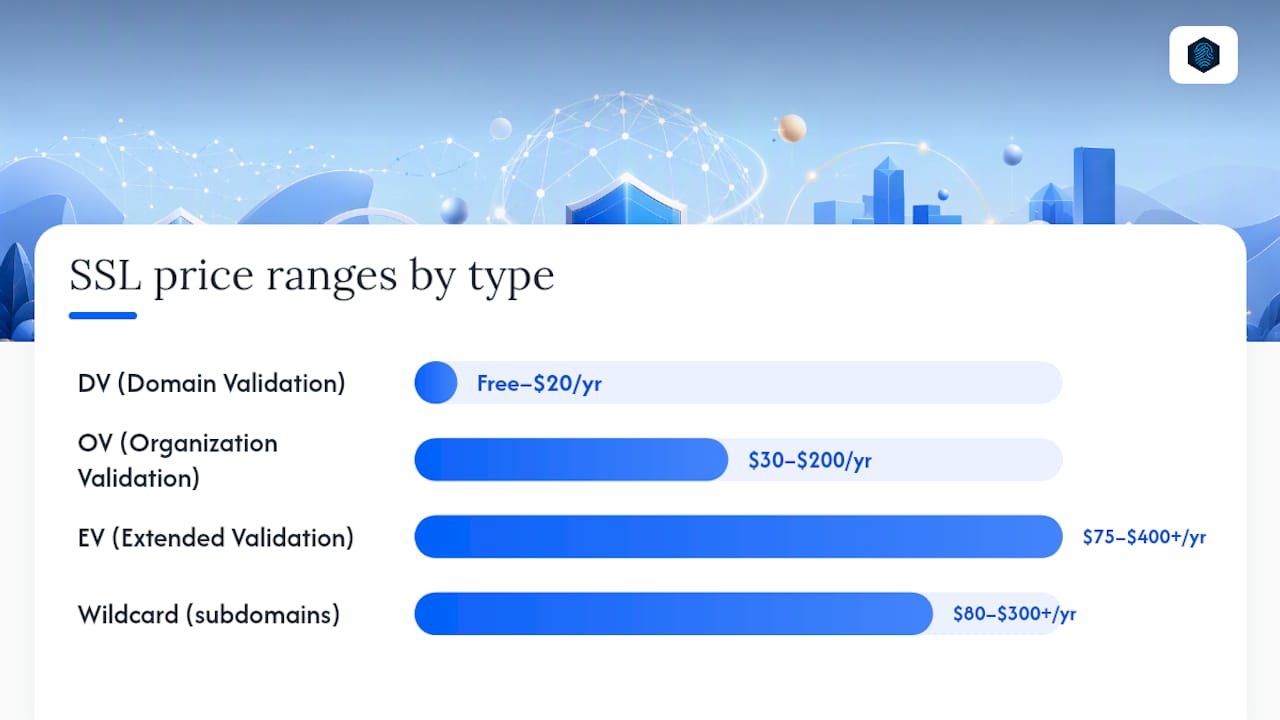
Most websites can secure a domain for $0 a year using a free DV certificate from Let's Encrypt or a host's auto-SSL tool, and that's the right call for a blog, portfolio, or small brochure site. Once you move into business territory, prices climb fast: budget paid DV runs roughly $7 to $20 a year, OV certificates land between $30 and $200, and EV certificates run $75 to $400 or more. Wildcard coverage for multiple subdomains typically starts around $80 and climbs from there depending on the certificate authority (CA).
Here's the quick version:
- Personal blog or portfolio: free DV, no reason to pay
- Small business or brochure site: free DV works, OV adds a credibility bump
- E-commerce store: DV is often enough, but check what your payment processor requires
- Regulated or financial site: EV or OV, paired with a compliance review
The CA/Browser Forum sets the validation rules every certificate authority follows, and that standardization is exactly why a free certificate encrypts traffic just as strongly as a $400 one. The price difference is about identity verification and support, not encryption strength.
Key Takeaways
Free DV certificates cover most personal and small-business sites at no cost, while OV and EV pricing rises with the identity verification and warranty coverage they add.
| Point | Details |
|---|---|
| Free DV works for most sites | Let's Encrypt and host auto-SSL provide encryption identical to paid options, at $0. |
| Paid tiers scale with verification | OV runs $30 to $200/year and EV runs $75 to $400+/year, reflecting deeper identity checks. |
| Wildcard consolidates subdomains | Coverage for unlimited subdomains typically starts around $80/year instead of buying certificates separately. |
| Renewal price matters more than year one | Check the second-year rate before buying to avoid a discount trap. |
| inSave Hosting includes SSL by default | Every plan bundles free, auto-renewing SSL, with wildcard and SAN options for growing sites. |
Table of Contents
- How Much Does an SSL Certificate Cost by Type?
- What Factors Drive SSL Certificate Cost?
- Is a Free SSL Certificate Good Enough?
- Where Should You Buy an SSL Certificate?
- How Do You Choose the Right Certificate for Your Budget?
- How Does inSave Hosting Handle SSL for Customers?
- Get Free, Auto-Renewing SSL With Your Hosting Plan
- Sources
- FAQ
How Much Does an SSL Certificate Cost by Type?
The single biggest lever on SSL certificate cost is the validation level, and the gap between tiers is bigger than most people expect. A domain-validation (DV) certificate just confirms you control the domain, which is why it's cheap or free. Organization-validation (OV) and extended-validation (EV) certificates require a CA to verify your business exists and check its legal standing, which takes staff time and drives the price up.
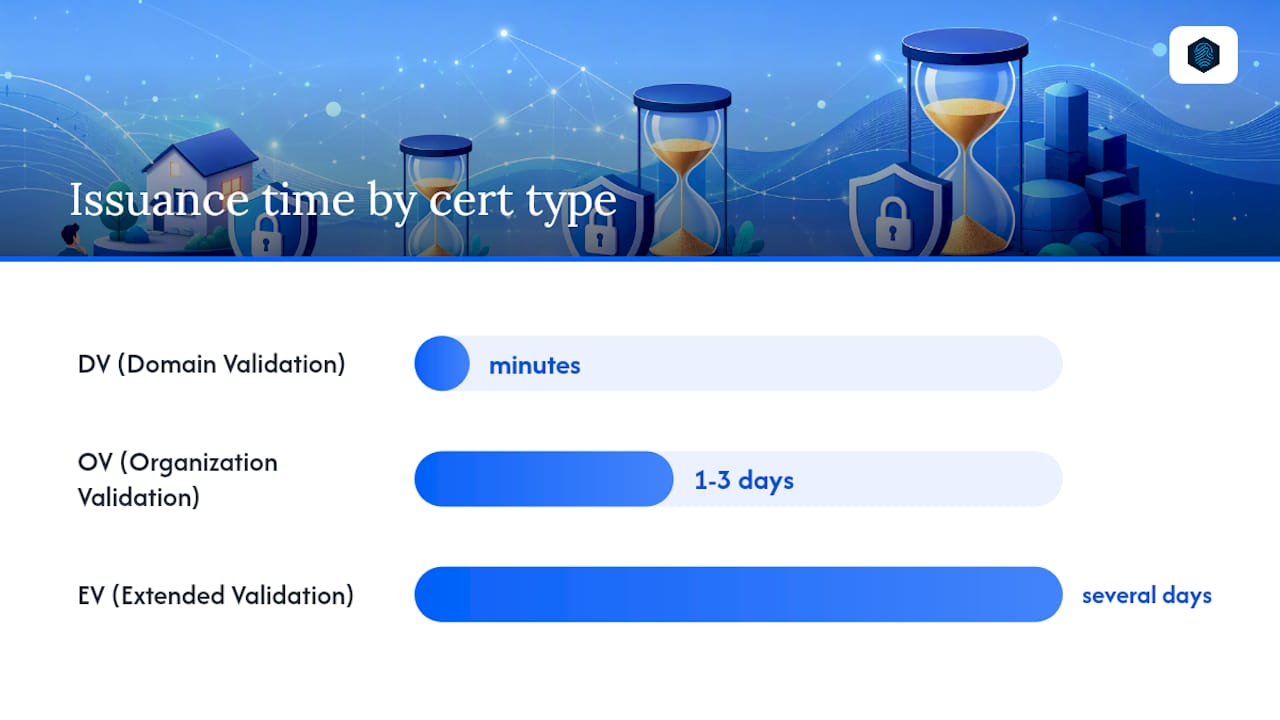
Domain Validation (DV): Free through Let's Encrypt or a hosting provider's auto-SSL, or roughly $6 to $66 a year if purchased directly from a paid provider. Issuance takes minutes once automated. This is the right fit for personal sites, blogs, and most small-business pages that don't process sensitive data directly.
Organization Validation (OV): Typically $30 to $200 a year. The CA checks your business registration before issuing the certificate, which takes one to three days. OV signals legitimacy to visitors who check certificate details, which matters more for B2B services and client portals than for a coffee shop's homepage.
Extended Validation (EV): Costs range from mid tens to several hundreds per year, with issuance stretching several days to a week because the CA runs a deeper legal and operational check. Banks, insurers, and larger e-commerce platforms lean toward EV, though modern browsers no longer display the green address-bar treatment that once made EV visually distinct.
Wildcard and multi-domain (SAN): A wildcard certificate covers unlimited subdomains under one name (like *.yoursite.com) and commonly starts around $80 a year, with premium CA brands pushing that well past $200. Ssl show single-domain certificates from roughly $36.75 a year and wildcard options starting near $224.25, which gives you a sense of how much brand and coverage choice moves the number. Multi-domain (SAN) certificates price per additional domain, so a site running shop., app., and blog. subdomains might do better with a single wildcard than three purchases.
| Type | Validation | Typical Price Range | Best For |
|---|---|---|---|
| DV | Domain only | Free to ~$20/year | Blogs, portfolios, small business sites |
| OV | Domain + business ID | $30 to $200/year | B2B services, client portals |
| EV | Domain + legal review | $75 to $400+/year | Banks, insurers, large e-commerce |
| Wildcard | Varies by CA | $80 to $300+/year | Sites with many subdomains |
One quirk worth knowing before you shop: EV wildcard certificates don't exist. The CA/Browser Forum's own rules prohibit issuing a wildcard under EV validation, so a business that needs both extended validation and multi-subdomain coverage has to buy an EV SAN certificate instead, listing each subdomain individually.
What Factors Drive SSL Certificate Cost?
Validation level explains most of the spread, but it's not the whole story. A handful of other variables can double or triple your SSL certificate cost even within the same tier.
- Domain coverage: A single-domain certificate is cheapest. Wildcard and SAN certificates multiply the price, either through a flat wildcard premium or a per-domain fee.
- CA brand and warranty: Established certificate authorities often bundle a warranty (a payout if the certificate fails and causes a loss) into the price. Higher warranty amounts, sometimes $1 million or more on premium EV products, come with a higher sticker price even though the underlying encryption is identical.
- Reseller and host markup: Buying through a reseller or bundled hosting plan can be cheaper than going straight to a CA, but pricing structures vary. Some resellers offer steep first-year discounts followed by much higher renewal pricing, so always check the renewal rate before signing up.
- Management fees: Certificate lifecycle management (CLM) tools that automate renewals across many certificates can add a service fee, though they cut the labor of tracking expiration dates manually.
- Hidden one-time charges: Watch for reissue fees (if you need a new certificate after a key compromise), revocation fees, and per-SAN add-on charges that aren't obvious in the sticker price.
Pro Tip: Before comparing quotes, ask each provider for the year-two renewal price in writing. A cheap first-year rate that doubles or triples on renewal is one of the most common ways buyers overpay for SSL certificate cost long term.
Is a Free SSL Certificate Good Enough?
For most personal and small-business sites, yes. Free DV certificates from Let's Encrypt or a host's auto-SSL system use the same TLS encryption standard as those in $400 EV certificates. Browsers trust them identically, and the padlock icon looks the same either way. The primary trade-off isn't security, it's identity verification and support.
Free DV certificates typically renew every 90 days, which sounds like a hassle until you realize automation handles it invisibly on most managed hosting plans. The catch is that a free certificate confirms only that you control the domain, not that your business is who it claims to be, and support is usually self-service rather than a phone line.
Here's when free DV is genuinely enough, and when it isn't:
- Personal blog or portfolio: Free DV is all you need. There's no reason to pay.
- Small business brochure site: Free DV works fine unless you want the organizational credibility bump OV provides.
- E-commerce store: Free DV usually satisfies your payment processor's TLS requirements, but confirm with the processor directly, since some enforce their own certificate standards.
- Sites with dozens of subdomains: A free single-domain certificate won't scale. Look at a paid wildcard instead.
Ask yourself four quick questions before deciding: Do you need to prove your organization's legal identity to visitors? Do you manage more than a couple of subdomains? Do you require a warranty for liability coverage? Does your industry or processor mandate a specific validation level? If you answered no to all four, a free SSL setup will carry you a long way.
Where Should You Buy an SSL Certificate?
You've got three real channels, and each fits a different comfort level with technical maintenance.
Host-included, automatic: Most modern hosting plans issue and renew a free DV certificate for you with zero manual steps. This is the lowest-effort option and the one most small-business owners should default to unless they have a specific reason not to.
Direct from a certificate authority: Buying straight from a CA gives you the most control over validation level, warranty, and brand, but you'll manage installation, renewal, and support requests yourself.
Through a reseller: Resellers often undercut CA list prices and bundle installation help, though Sectigo's own buying guide recommends checking exactly what support and automation come with the reseller price before committing.
The buying and installing process follows the same basic sequence no matter which channel you pick:
- Decide on validation level and coverage (single domain, wildcard, or SAN).
- Generate a certificate signing request (CSR), or let your host's setup wizard handle it automatically.
- Complete domain or organization validation, which the CA verifies by email, DNS record, or file upload.
- Install the certificate on your server and test it with your browser's padlock or a free SSL checker.
- Turn on auto-renewal or set a calendar reminder if you're managing it manually.
Timing varies by type: DV issues in minutes once automated, OV takes one to three days for the business check, and EV can run several days to a week because of the deeper legal review. If you'd rather follow a written walkthrough, this step-by-step SSL setup guide covers the installation piece in more detail.
How Do You Choose the Right Certificate for Your Budget?
Run through this checklist before you buy anything, whether you're comparing a $0 host-provided certificate or a $300 EV wildcard.
- How many domains and subdomains does your site actually have today, and how many will it have in a year?
- Do you need to prove organizational identity to visitors, or is domain ownership enough?
- What's the warranty amount, and does it matter for your industry?
- What does the certificate cost to renew, not just to buy the first year?
- Does the provider support auto-renewal, or will someone need to remember to do it manually every 90 days to a year?
Watch for a few red flags while you shop: pricing that's only available after you "request a quote," warranty terms that are vague or missing entirely, and unusually aggressive first-year discounts that don't disclose the renewal rate. If a provider won't show you next year's price today, that's worth asking about directly before you commit.
Three common paths cover most readers: a personal blog goes free DV every time, a small e-commerce shop does well with a DV or OV certificate through host-managed auto-renewal, and a financial or regulated business should budget for OV or EV alongside a compliance review specific to its industry. For a deeper breakdown of which validation level fits which business type, our SSL certificate guide for small businesses walks through the decision in more detail.
Pro Tip: If you're quoted a price with no renewal figure attached, assume the renewal will cost more. Ask for it in writing before you buy, not after your first year expires.
How Does inSave Hosting Handle SSL for Customers?
Every hosting plan through inSave Hosting includes free SSL by default, installed and renewed automatically so you're never stuck watching an expiration date. Customers who need more than a single-domain certificate can add wildcard coverage for sites with multiple subdomains, and SAN support is available for setups spanning several distinct domains.
- Free SSL included on every hosting plan, no manual purchase required
- Automated installation and validation, typically live within minutes of enabling it
- Auto-renewal handled in the background, no expired-certificate scrambles
- Wildcard and SAN options available for sites that outgrow single-domain coverage
For a small business, this typically means skipping a separate SSL purchase altogether. The usual flow: you enable SSL from your dashboard, the system validates the domain and installs the certificate automatically, and renewal is set to recur without any further action from you. That's the same automation logic behind certificate lifecycle management tools that larger enterprises pay extra for, built into the hosting price instead of billed separately.
A quick note on cost versus convenience
For nearly every small site, automation and low cost beat premium branding. A free, auto-renewing DV certificate does the job better than a manually managed paid one that lapses because nobody remembered the renewal date. The exception is genuine regulatory or financial work, where the identity verification behind OV or EV is worth the added expense. The most expensive certificate isn't the one with the highest price tag. It's the one that expires because nobody was watching it.
Get Free, Auto-Renewing SSL With Your Hosting Plan
Buying and managing a standalone SSL certificate means tracking renewal dates, generating CSRs, and troubleshooting installation errors on your own. inSave Hosting skips that entirely: every plan comes with SSL built in, activated automatically, and renewed without you lifting a finger.
That means no separate SSL certificate cost to budget for on a standard hosting plan, no expiration surprises, and no manual CSR generation. If your site has grown past a single domain, wildcard SSL covers every subdomain under one certificate instead of juggling several. And if you're running WordPress, WordPress-optimized hosting pairs that same automated SSL with one-click setup so security isn't something you have to think about after launch.
Check inSave Hosting's shared hosting plans to see current pricing and get free SSL running on your site today.
Sources
- SSL Certificate Cost in 2026: DV, OV, EV & Wildcard Prices
- Ssl
- How Much Does an SSL Certificate Cost? Pricing Guide
- How to purchase an SSL certificate & how much they cost | Sectigo® Official
FAQ
How Much Does a Basic SSL Certificate Cost?
A basic DV certificate is free through Let's Encrypt or most hosting providers, or roughly $7 to $20 a year if purchased directly from a paid CA.
Is an SSL Certificate Free or Paid?
Both options exist: free DV certificates cover most sites, while paid OV and EV certificates ($30 to $400+ a year) add business identity verification and warranty coverage.
Do I Really Need an SSL Certificate?
Yes. Browsers flag unencrypted sites as "not secure," and TLS encryption protects any data your visitors submit, which is why virtually every modern hosting plan, including inSave Hosting's, includes it by default.
Can I Get an SSL Certificate for Free?
Yes, through Let's Encrypt or a hosting provider's auto-SSL tool, and it provides the same encryption strength as a paid certificate, just without organizational identity verification.