
TL;DR:
- An uptime guarantee is a contractual promise that a website will stay accessible for a set percentage of time each month.
- Providers often limit coverage through exclusions like scheduled maintenance and force majeure events, making actual protection limited.
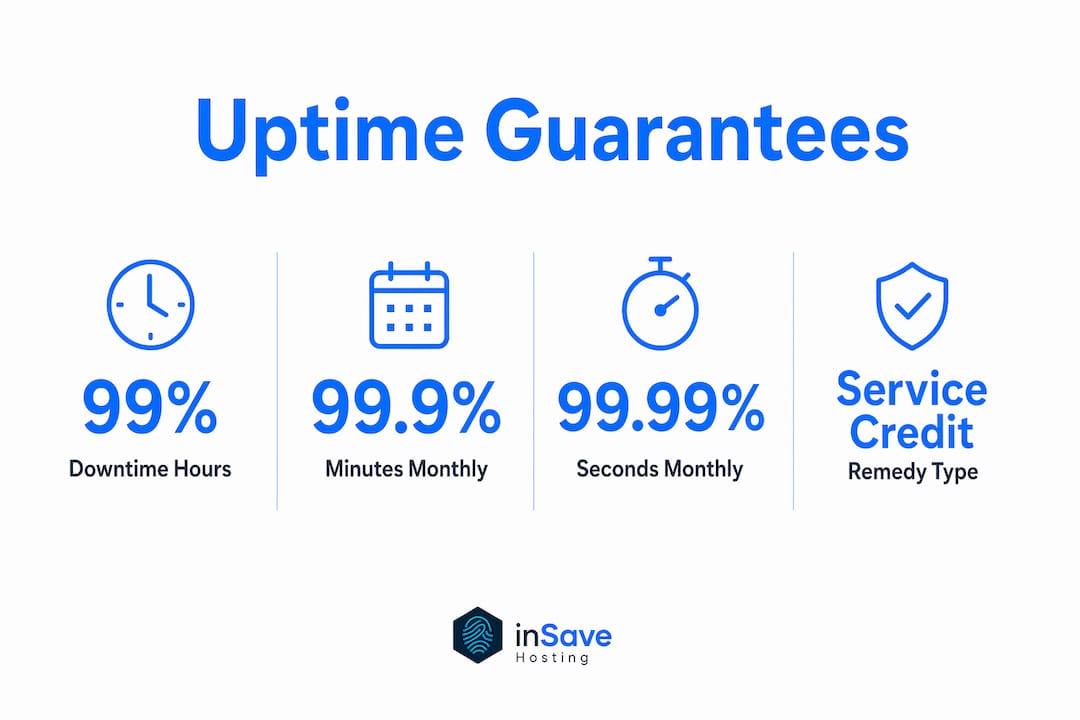
An uptime guarantee is a provider's formal contractual commitment to keep your website or online service accessible for a specified percentage of time, typically expressed in an SLA (Service Level Agreement). The industry standard sits at 99.9%, which sounds impressive until you do the math: that still allows roughly 43 minutes of downtime every month. For business owners and site administrators, understanding the uptime guarantee meaning goes far beyond reading a single percentage. It means knowing how uptime is measured, what exclusions apply, and what compensation you actually receive when things go wrong.
What is uptime guarantee and how is it measured?
An uptime guarantee is calculated as the percentage of time a server or service remains operational within a defined measurement window, almost always a single calendar month. The formula is straightforward: uptime percentage equals total minutes in the period minus downtime minutes, divided by total minutes, multiplied by 100.

The measurement window matters more than most people realize. Uptime is calculated monthly, not annually. A single major outage in January can consume your entire monthly downtime allowance. Perfect performance in February through December does not compensate for that January failure. This is a critical distinction that providers rarely highlight upfront.
The table below shows how dramatically the numbers shift across common uptime tiers:
| Uptime Level | Monthly Downtime Allowed | Annual Downtime Allowed |
|---|---|---|
| 99% | ~7.2 hours | ~3.65 days |
| 99.9% | ~43.8 minutes | ~8.76 hours |
| 99.99% | ~4.3 minutes | ~52.6 minutes |
| 99.999% | ~26 seconds | ~5.26 minutes |
The gap between 99% and 99.999% uptime represents the difference between days of lost access per year and just minutes. For an e-commerce store processing orders around the clock, that gap is the difference between a minor inconvenience and a serious revenue event.
Exclusions are where most business owners get surprised. Providers routinely exclude scheduled maintenance windows, emergency security patches, and outages caused by customer actions or third-party services. Downtime definitions favor providers, often defining a qualifying outage only as a complete inability to access the service or server errors affecting a defined percentage of requests. A slow site that loads in 30 seconds likely does not count as downtime under most SLA definitions.
Pro Tip: Read your SLA's definition of "downtime" before you sign. If the definition requires 100% inaccessibility to qualify, partial outages and severe slowdowns will never trigger compensation regardless of their business impact.
What are typical remedies and limits of uptime guarantees in SLAs?
When a provider misses its uptime target, the standard remedy is a service credit, not a cash refund. Service credits typically scale from 5–50% of your monthly fee, depending on how far the provider fell below the guaranteed threshold. A minor breach might earn you a 5–10% credit. A severe or repeated failure might reach 50%. None of it lands in your bank account.
The claim process is where many customers lose their compensation entirely. Google Cloud's SLA, for example, requires customers to file validated claims within 30 days of the incident. Miss that window and the credit is forfeited, regardless of how clear the outage was. Most hosting providers follow similar or stricter timelines.
Common SLA clauses that limit your actual protection include:
- Scheduled maintenance exclusions: Planned downtime windows, often announced with minimal notice, do not count toward your downtime total.
- Force majeure clauses: Natural disasters, DDoS attacks, and internet infrastructure failures are typically excluded entirely.
- Customer-induced outage exclusions: If your code, plugin, or configuration caused the issue, the provider owes you nothing.
- Credit caps: Total credits are usually capped at one month's fee, regardless of how much revenue you lost.
- Claim deadlines: Most providers require written claims within 15–30 days of the incident.
- Narrow downtime definitions: GitLab defines a downtime minute as one where 5% or more of valid requests fail or time out. Anything below that threshold does not count.
The most important thing to understand: an uptime guarantee is not insurance. It does not cover lost sales, damaged reputation, or customer churn caused by an outage. It covers a fraction of your hosting bill.
Pro Tip: Set a calendar reminder the moment you experience a significant outage. Document timestamps, error messages, and screenshots immediately. Filing a claim without supporting logs is the fastest way to get it rejected.
Examples of uptime guarantees and how to verify them
The phrase "three nines" refers to 99.9% uptime, the most common standard in shared and managed hosting. "Four nines" (99.99%) appears in enterprise cloud contracts and dedicated server agreements. "Five nines" (99.999%) is reserved for mission-critical infrastructure like financial platforms and healthcare systems.
Knowing the guarantee on paper is only half the job. Verifying it in practice requires independent monitoring. Provider dashboards report their own uptime, which creates an obvious conflict of interest. External monitoring tools detect outages that provider reports may not capture, including regional failures that affect your users but not the provider's internal checks.
Practical verification methods include:
- External uptime monitors: Tools like UptimeRobot check your site from multiple global locations at regular intervals, typically every 1–5 minutes, and alert you immediately when access fails.
- Status page comparison: Cross-reference your monitoring data against your provider's public status page. Discrepancies reveal whether the provider is reporting all incidents.
- Historical uptime reports: Most monitoring tools generate monthly reports. Keep these on file. They are your evidence if you need to file a credit claim.
- Response time tracking: Monitoring average load times alongside availability catches performance degradation that technically stays within uptime thresholds but still harms user experience.
A comparison of uptime monitoring tools like UptimeRobot, pingping.io, and TrackSSL shows meaningful differences in check frequency, alert channels, and reporting depth. For most small business sites, a free or low-cost external monitor provides enough data to hold a provider accountable.
Pro Tip: Run at least two independent monitoring tools simultaneously. If both flag the same outage, your claim becomes nearly impossible to dispute.
Benefits of uptime guarantees and how to use them for your business
An uptime guarantee does more than promise availability. It signals the quality of a provider's infrastructure and creates a contractual accountability mechanism you can enforce. High uptime directly protects revenue and reputation, since every minute your site is down is a minute customers cannot reach you, buy from you, or trust you.
Here are five steps to get real value from your uptime guarantee:
- Read the SLA before you commit. Compare the downtime definition, exclusion list, credit scale, and claim deadline across providers. A 99.9% guarantee with broad exclusions is worth less than a 99.5% guarantee with narrow ones.
- Set up independent monitoring on day one. Do not rely on your provider's dashboard. Deploy an external tool immediately after launch so you have a clean baseline of performance data.
- Document every incident in real time. Timestamps, screenshots, and error logs are your evidence. Without them, most providers will reject a credit claim.
- File claims promptly. Most SLAs require claims within 30 days. Build a process so outage documentation triggers an automatic reminder to file.
- Use uptime data in renewal negotiations. If your monitoring shows consistent performance below the guaranteed threshold, you have leverage to negotiate a better rate, a higher-tier plan, or a more favorable SLA at renewal.
Understanding the importance of uptime for business goes beyond the hosting contract itself. Pair your uptime guarantee with regular backups, a content delivery network, and a staging environment so that even when something goes wrong, recovery is fast and your visitors experience minimal disruption.
Key takeaways
An uptime guarantee is a contractual availability commitment measured monthly, compensated through service credits, and limited by narrow downtime definitions that business owners must understand before signing.
| Point | Details |
|---|---|
| Monthly measurement window | A single major outage can consume your entire monthly allowance; annual averages do not apply. |
| Credits, not cash | Compensation is capped service credits, typically 5–50% of your monthly fee, never lost revenue. |
| Exclusions reduce real coverage | Scheduled maintenance, force majeure, and customer-caused issues are almost always excluded. |
| Independent monitoring is required | External tools like UptimeRobot verify actual uptime against provider claims. |
| Claim deadlines are strict | Most providers require written claims within 30 days or the credit is forfeited. |
Why I stopped trusting uptime numbers at face value
I have reviewed a lot of hosting contracts for clients over the years, and the pattern is always the same. A business owner sees "99.9% uptime guarantee" on a pricing page and treats it as a promise that their site will almost never go down. Then an outage hits, they try to claim a credit, and they discover the outage was excluded because it happened during a maintenance window they were never notified about.
The real gap is not between providers. It is between what the guarantee says and what it actually covers. Most SLAs are written to protect the provider, not the customer. The downtime definition is narrow, the exclusions are broad, and the credit cap means the maximum you can recover is one month's hosting fee, often less than $30, while your business may have lost hundreds or thousands in sales.
My honest advice: treat the uptime percentage as a floor, not a ceiling. Use it to filter out obviously unreliable providers, but do not stop there. Read the exclusion list. Check the claim deadline. Then set up your own monitoring so you have independent data. A provider that consistently hits 99.95% actual uptime with a transparent status page is worth more than one that promises 99.99% but buries five pages of exclusions in the contract.
The web hosting uptime basics matter, but the contract details matter more. Know both before you commit.
— Ihor
How inSave Hosting delivers on its uptime commitment

inSave Hosting backs its plans with a 99.9% uptime guarantee built on LiteSpeed servers, free CDN integration, and MariaDB databases, giving your site the infrastructure to stay online when traffic spikes or demand grows. Every plan includes real-time performance monitoring, free SSL certificates, and managed security features so your uptime is protected at the server level, not just promised on a pricing page. Whether you run a WordPress site or a growing e-commerce store, inSave Hosting's shared hosting plans are built to keep your business accessible around the clock. Start with a plan that matches your needs and hold your provider to a standard that actually protects your business.
FAQ
What does uptime guarantee mean for a website?
An uptime guarantee is a contractual promise from a hosting provider that your website will remain accessible for a specified percentage of time, typically 99.9%, within a monthly measurement window. It defines the allowed downtime, exclusions, and compensation if the provider falls short.
How do I measure my hosting uptime guarantee?
Use an external monitoring tool like UptimeRobot to track your site's availability independently from your provider's dashboard. Compare your monitoring data against your SLA's downtime threshold to determine whether a credit claim is warranted.
What are examples of uptime guarantees in hosting?
Common examples include 99.9% ("three nines"), which allows about 43.8 minutes of downtime per month, and 99.99% ("four nines"), which allows roughly 4.3 minutes. Enterprise platforms like Google Cloud offer 99.95% with financial credits capped at 50% of the monthly fee.
Are uptime guarantees worth anything if my site goes down?
Uptime guarantees provide service credits, not cash compensation for lost revenue. Credits are typically capped at a percentage of your monthly fee and require a formal claim filed within 30 days of the incident, so their practical value depends on how quickly you act.
What is excluded from most uptime guarantees?
Most SLAs exclude scheduled maintenance, emergency security patches, force majeure events like DDoS attacks, and outages caused by customer actions or third-party services. These exclusions mean a provider can meet its uptime guarantee on paper even when your site was inaccessible to real users.