
TL;DR:
- Uptime impacts revenue, reputation, security, and customer trust for small businesses.
- Technical factors like data center quality and monitoring influence actual uptime performance.
- Active monitoring and transparent providers are essential for ensuring reliable website availability.
Not all web hosting services deliver on their uptime promises, and that gap matters more than most small business owners realize. Many hosts advertise the same 99.9% uptime guarantee, but the real-world experience can vary dramatically depending on infrastructure, monitoring, and support. Hosting reliability is a critical metric that shapes whether your customers can reach you at any given moment. This article breaks down what uptime really means, how it affects your business performance, and how to use that knowledge to make smarter hosting decisions.
Table of Contents
- What is web hosting uptime?
- How uptime impacts your website's performance and reputation
- Factors that influence web hosting uptime
- Comparing hosting providers by uptime guarantees and real-world results
- The truth about uptime: What most businesses overlook
- Get reliable uptime with trusted hosting solutions
- Frequently asked questions
Key Takeaways
| Point | Details |
|---|---|
| Uptime equals reliability | Even small drops in uptime can mean hours of lost access for your visitors. |
| Trust but verify | Don’t rely on just published guarantees—use monitoring tools to track real uptime yourself. |
| Choose transparent hosts | Opt for providers who share independent uptime reports and respond quickly to any downtime. |
| Business impacts | High uptime directly boosts customer trust, revenue, and search ranking. |
What is web hosting uptime?
Uptime refers to the percentage of time your website is accessible and functioning online. When a hosting provider says they offer 99.9% uptime, they mean your site should be live and reachable for 99.9% of any given time period. Uptime is measured as a percentage of time a site is online over a set period, and even small drops from that number translate into real downtime your visitors will notice.
Understanding web hosting basics helps put this into perspective. Think of uptime like electricity in your store. When the power is on, everything works. When it goes out, customers leave and don't come back.
Here's why uptime matters for your business:
- Revenue: Every minute your site is down, potential customers can't buy from you.
- Reputation: Frequent outages signal unreliability to both visitors and search engines.
- Security: Some downtime is caused by attacks, meaning poor uptime can hint at weak defenses.
- Customer trust: A site that loads consistently builds confidence; one that drops builds frustration.
Now, look at what different uptime guarantees actually mean in practice:
| Uptime guarantee | Downtime per year | Downtime per month |
|---|---|---|
| 99% | ~87.6 hours | ~7.3 hours |
| 99.9% | ~8.76 hours | ~43.8 minutes |
| 99.95% | ~4.38 hours | ~21.9 minutes |
| 99.99% | ~52.6 minutes | ~4.4 minutes |
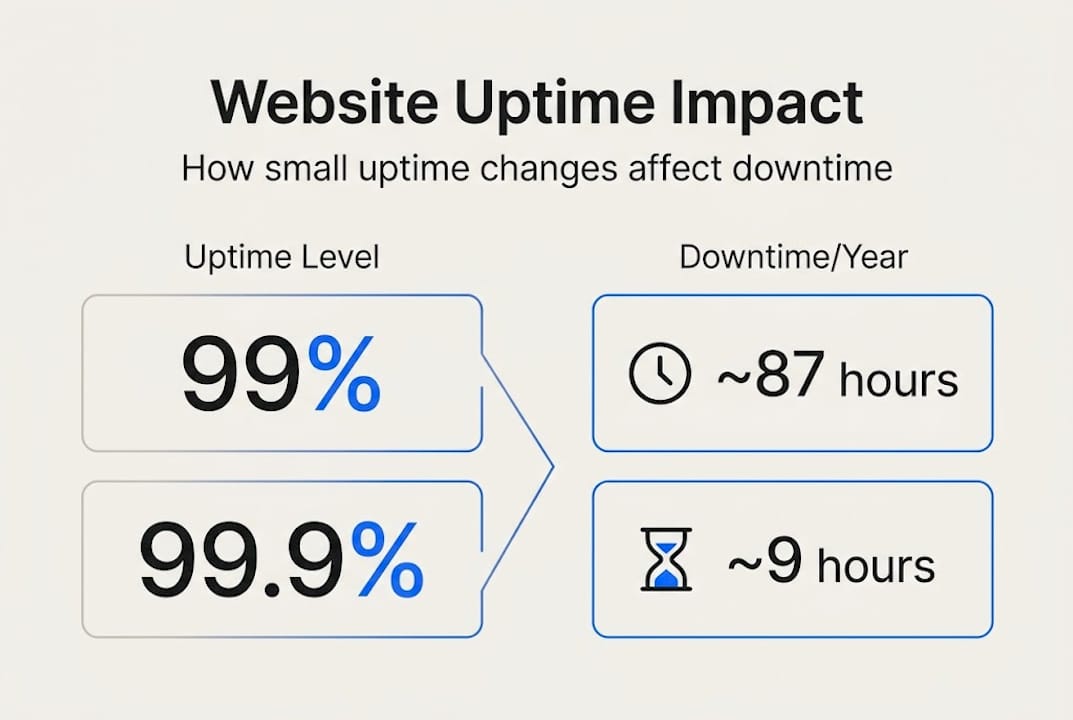
For a small business, the difference between 99% and 99.9% isn't just a decimal point. It's the difference between 87 hours of lost business and under 9 hours. If your site sells products, books appointments, or generates leads, every hour offline costs you something real. Choosing a host based purely on price without checking uptime history is a common and costly mistake.
How uptime impacts your website's performance and reputation
Understanding what uptime means is just step one. The real question is what those numbers feel like when your site goes down at the wrong time.
When your website experiences downtime, it sets off a chain reaction. Visitors land on an error page and leave immediately. That behavior signals to search engines that your site may not be reliable, which can chip away at your rankings over time. Downtime frustrates users and can hurt search rankings, making the damage double-sided: you lose current traffic and future visibility.
Here's a look at the direct business impacts tied to uptime levels:
- High uptime (99.9%+): Consistent page loads, better user retention, stronger SEO signals.
- Medium uptime (99% to 99.9%): Occasional frustration, some lost conversions, potential ranking slips.
- Low uptime (below 99%): Frequent errors, serious revenue loss, damaged credibility.
"For small businesses, uptime and reliability are not just technical concerns. They are directly tied to customer experience and sales performance."
Consider a practical example. A local service business running appointment bookings through their website experiences downtime every few weeks, each time for about 30 to 45 minutes. Over a year, that adds up to several hours where potential clients hit an error page and simply contact a competitor instead. The business owner never notices because there's no monitoring in place. The losses are invisible but real.

That 0.01% difference in uptime between 99.9% and 99.99% may sound minor, but it translates to roughly 4 additional hours of availability per year. When your busiest sales window is a Saturday afternoon, those hours matter. Improving speed and reliability across your hosting setup directly reduces the frequency and length of these gaps. Uptime is not just a stat on a sales page. It is your storefront door, and it needs to stay open.
Factors that influence web hosting uptime
With business impacts clear, let's look at what actually determines whether your site stays online. Uptime isn't just about a hosting provider's promise. It depends on a combination of technical and operational factors working together.
Multiple elements, from server infrastructure to monitoring, affect real uptime performance. Here are six key factors that make the biggest difference:
- Data center quality: Tier-3 and Tier-4 data centers offer redundant power, cooling, and network connections that keep servers stable during outages or hardware failures.
- Redundancy systems: Failover infrastructure means that if one server goes down, traffic is rerouted automatically to another, keeping your site live.
- Software updates and maintenance: Outdated server software creates vulnerabilities and instability. Regular, controlled updates are essential for consistent performance.
- DDoS protection: Distributed denial-of-service attacks flood your server with fake traffic. Without protection, even a short attack can bring your site down entirely.
- Technical support quality: When something breaks, response time matters. Hosts with 24/7 expert support reduce downtime from hours to minutes.
- Uptime monitoring: Consistent monitoring tools and robust infrastructure enhance uptime by catching issues before they escalate into full outages.
External events also play a role. Power failures, fiber cuts, natural disasters, and even scheduled maintenance windows all count against your uptime total. Some hosts are transparent about maintenance schedules; others are not. That transparency is worth asking about before you sign up.
Pro Tip: Before committing to a host, ask whether they publish live uptime status pages or historical performance reports. Providers that share this data openly are far more likely to actually deliver on their guarantees. If a host can't show you real numbers, that tells you something.
Checking reliable hosting examples from other small businesses can also help you gauge which providers back up their claims with real-world consistency.
Comparing hosting providers by uptime guarantees and real-world results
Knowing what influences uptime is helpful, but you still need to make a practical choice. Here's how to compare providers without getting fooled by marketing language.
Most hosts advertise 99.9% uptime, but advanced hosting tech and verification tools are what separate genuine performance from sales copy. Independent monitoring services like UptimeRobot or StatusCake track real availability, and some hosts publish their own public dashboards. Always cross-reference both.
Here's a sample comparison to show how guarantees and real results can differ:
| Provider type | Stated guarantee | Verified real uptime | Transparent reporting |
|---|---|---|---|
| Budget shared hosting | 99.9% | ~98.5% | Rarely |
| Mid-tier managed hosting | 99.9% | ~99.7% | Sometimes |
| Premium cloud hosting | 99.99% | ~99.95% | Often |
| Performance-focused host | 99.9% | ~99.9% | Yes |
The gap between stated and actual uptime is common in the budget tier. A host promising 99.9% but delivering 98.5% means roughly 131 hours of downtime per year, far above what anyone would accept if they saw it written out plainly.
Pro Tip: Favor providers with transparent service-level agreements (SLAs) that define what compensation you receive when uptime falls below the guarantee. A host willing to back their promise with a real credit policy is one that takes uptime seriously.
When evaluating options, look for hosts that combine strong guarantees with key hosting features like LiteSpeed technology, built-in CDN, and proactive security tools. These features work together to keep your site fast and accessible, not just theoretically online.
The truth about uptime: What most businesses overlook
Here's what we've seen time and again: business owners spend more energy comparing percentage points than building habits that actually protect their site. The jump from 99.9% to 99.99% is worth having, but it means very little if you have no way to know when downtime happens or how long it lasts.
The real advantage goes to website owners who monitor actively, not passively. Setting up alerts, reviewing monthly uptime logs, and knowing your host's support response time matters more than an extra decimal in a guarantee. We've spoken with small business owners who discovered weeks of intermittent downtime only after a customer complained.
The contrarian reality is this: even premium hosts occasionally underdeliver. Hosting reliability for SMBs isn't something you set and forget. It's something you actively verify and manage. Don't treat uptime as a feature you receive automatically. Treat it as a standard you hold your provider to, with tools and data to back it up.
Get reliable uptime with trusted hosting solutions
Ready to put reliable uptime into action? Choosing a host that combines transparency with proven performance changes the experience entirely.

At inSave Hosting, we back our uptime commitment with real monitoring tools, 24/7 support, and infrastructure built for small business needs. Whether you're exploring shared hosting plans for a new site or need WordPress hosting with built-in performance features, we have options that keep your site accessible around the clock. Our plans include free SSL, CDN integration, and LiteSpeed technology, giving you not just uptime, but fast, secure uptime. Don't leave your website's availability to chance.
Frequently asked questions
What does 99.9% uptime mean for my website?
99.9% uptime means your site may be down for up to about 8.76 hours per year, which is considered highly reliable for most small business websites.
How can I monitor my web hosting uptime?
Use your host's built-in monitoring tools or a third-party service to track availability and receive real-time alerts the moment your site goes offline.
Are all uptime guarantees by hosting providers accurate?
Not always. Verify uptime claims using public reports and independent monitoring tools rather than relying solely on what a host advertises.
How does downtime affect my website's success?
Even brief downtime can reduce search rankings and trust, leading to lost sales and a weaker reputation with both users and search engines.