
Unmetered bandwidth means you pay one flat monthly price for a hosting connection at a fixed port speed, with no charge based on how much data you actually transfer. The real limit isn't a data cap. It's the size of the pipe (measured in Mbps or Gbps) you're connected through.
That has a few concrete effects on your bill and your site's ceiling:
- Your invoice stays the same whether you push 200GB or 20TB in a given month.
- Your maximum throughput is capped by the port speed you're assigned, typically 1Gbps or 10Gbps.
- Providers still hold you to a fair-use or acceptable-use policy, so "unmetered" isn't a blank check. Read that clause before you sign.
Key Takeaways
Unmetered bandwidth means a flat monthly rate with no per-GB billing, where port speed, not a data cap, sets your real throughput ceiling.
| Point | Details |
|---|---|
| Core definition | Unmetered bandwidth charges a flat rate for a fixed port speed instead of billing per gigabyte transferred. |
| Port speed is the ceiling | A 1Gbps or 10Gbps port defines your maximum throughput, regardless of how the plan is billed. |
| Unlimited needs scrutiny | "Unlimited" is a marketing term usually backed by the same fair-use restrictions as unmetered, just less transparent about them. |
| Match model to traffic | Steady, heavy traffic favors unmetered; low or bursty traffic is often cheaper on a metered plan. |
| Verify terms in writing | Confirm port speed, SLA guarantees, and fair-use thresholds before signing, a step inSave Hosting supports with clearly stated port speeds on its higher-tier plans. |
Table of Contents
- How Bandwidth, Speed, and Throughput Actually Work
- Metered vs Unmetered vs Unlimited Bandwidth: What's the Real Difference
- What Are the Advantages and Limitations of Unmetered Bandwidth?
- Port Speed vs Monthly Data Transfer: The Technical Reality
- How Do Providers Enforce Fair-Use Policies on Unmetered Plans?
- Who Actually Benefits From Unmetered Bandwidth?
- Buying Checklist: Questions to Ask Before You Sign
- Sources
- FAQ
How Bandwidth, Speed, and Throughput Actually Work
People use "bandwidth" loosely, and that's where confusion starts. Three distinct things get lumped together: monthly data transfer (the total volume you move in a billing cycle), port speed or throughput (the rate you can move data at any given instant, measured in Mbps or Gbps), and latency (how long a single request takes to get a response). Data transfer is a running total. Throughput is a speed limit. They're not interchangeable, and mixing them up is why "unmetered" confuses so many first-time buyers.
Here's a simple way to picture it: think of port speed as the diameter of a pipe and monthly transfer as the total water that flows through it over 30 days. A wider pipe lets more water through per second, but the total for the month still depends on how long the tap stays open.
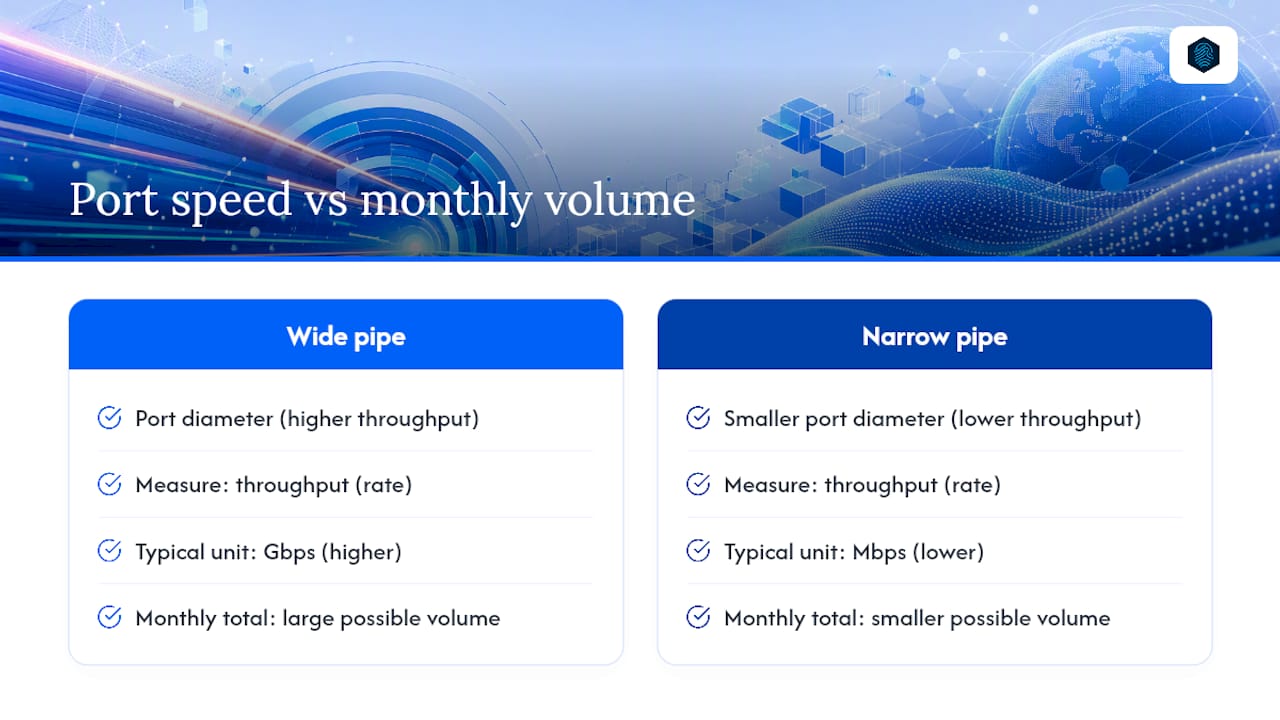
Quick math: A 1Gbps port, running flat out with zero downtime, could theoretically move a very large amount of data in a month. Nobody hits that number in practice. Real-world traffic is bursty, not constant, and ATAL Networks notes the port speed itself is the practical ceiling on unmetered plans, not some hidden data quota.
Metered vs Unmetered vs Unlimited Bandwidth: What's the Real Difference
These three terms get used almost interchangeably in hosting ads, and that's precisely the problem. Each one describes a different billing philosophy, and picking the wrong one either overpays for capacity you don't need or exposes you to surprise fees.
- Metered: You're billed per gigabyte, often with a set allowance and overage charges past that line. It fits low, predictable traffic, like a static portfolio site or an internal tool with a small user base.
- Unmetered: One flat rate for a given port speed, no per-GB math. Your only ceiling is that port speed, and providers enforce it through fair-use policy rather than a meter. Liquid Web frames this as trading a variable bill for a fixed one, in exchange for accepting the fair-use terms.
- Unlimited: Mostly a marketing term, not a technical spec. It's frequently backed by the same fair-use restrictions as unmetered, just without the transparency about where the real limit sits.
For a small business with steady or growing traffic, unmetered usually wins on predictability. For a low-traffic blog, metered can be cheaper outright. TechRadar puts it plainly: match the model to your actual traffic pattern, not the label on the plan.
What Are the Advantages and Limitations of Unmetered Bandwidth?
The biggest advantage is financial: you can forecast hosting costs a year out without worrying that a viral post or a big product launch triggers an overage bill. That predictability matters more than most site owners realize until they've been burned once by a metered plan during a traffic spike.
The limitations are just as real, though:
- Port speed is a hard ceiling. No matter how "unmetered" the plan is, you can't exceed the throughput your port allows.
- Base pricing runs higher than entry-level metered plans built for low usage, so light traffic sites may overpay.
- Shared infrastructure can create contention. If your host oversells port capacity across many customers, your actual throughput during peak hours may dip below the advertised number.
- Throttling risk exists if your usage pattern trips a fair-use threshold, even without a formal data cap.
Pro Tip: Ask your host what percentage of the port speed they guarantee versus what's a "best effort" number. That single question separates a serious provider from one hiding behind vague marketing.
Workloads that benefit most: media sites with large file downloads, e-commerce stores running frequent promotions, and any business site where traffic swings are hard to predict month to month.
Port Speed vs Monthly Data Transfer: The Technical Reality
"Unmetered" doesn't mean unmonitored. Hosts still watch total transfer volume closely, even when they're not billing for it, because sustained heavy usage affects network health for every other customer sharing that infrastructure.
The port speed, also called line rate, is the hardware limit built into your server's network connection. Common tiers are 1Gbps and 10Gbps, and that number defines your instantaneous maximum, not your monthly total.
- A 1Gbps port maxes out around 324TB per month in theory, run at full capacity nonstop.
- A 10Gbps port scales that up roughly tenfold, to a theoretical maximum in the multi-petabyte range.
- Real usage lands far below either number because traffic isn't constant and overhead eats into raw throughput.
1gbits walks through this exact port-as-pipe math, and the takeaway holds: the advertised speed tells you what's possible per second, not what you'll actually consume across a full billing cycle. For more on how that port speed shapes real-world page load times, see this breakdown of how hosting affects website speed.
How Do Providers Enforce Fair-Use Policies on Unmetered Plans?
Fair-use and acceptable-use policies are how hosts protect shared infrastructure without billing per gigabyte. Sustained high usage, activity that threatens network stability for other customers, or clear abuse (like running a public file-sharing hub off a basic plan) typically triggers action: throttling your connection, suspending the account, or requiring an upgrade to a dedicated resource tier.
The warning sign to watch for is vague language, phrases like "excessive consumption" or "abnormal usage" with no defined threshold. That vagueness gives the provider discretion to act whenever it wants, which undercuts the whole point of choosing unmetered for predictability.
- Ask directly what usage level counts as a violation.
- Ask what happens first (a warning, throttling, or immediate suspension).
- Get the port speed, SLA terms, and throttling thresholds confirmed in writing before you commit, a step Liquid Web specifically recommends for anyone comparing unmetered offers.
Who Actually Benefits From Unmetered Bandwidth?
Unmetered fits workloads with consistently high or hard-to-predict transfer: video or audio streaming, CDN origin servers, game servers with constant player traffic, large-file mirrors, and sites running frequent full backups. If your traffic is heavy and steady, the flat rate beats tracking gigabytes every month.

It's less useful for a five-page brochure site or a low-traffic blog, where a metered plan's lower base cost wins outright. It's also a poor fit for extremely bursty traffic that's mostly idle except for rare spikes, since you're paying for port capacity you use only occasionally.
A reasonable path: start on a metered or entry-level shared plan, and move to unmetered once your monthly transfer becomes consistent enough that the flat rate pays for itself. This guide on mapping workloads to bandwidth models walks through that transition point in more detail.
Buying Checklist: Questions to Ask Before You Sign
Before you commit to any unmetered plan, get these five things answered, ideally in writing:
- Expected monthly transfer. Estimate your current usage and projected growth over 12 months.
- Port speed. Confirm the exact number, 1Gbps or 10Gbps, not just "unmetered."
- Peak concurrency. Ask how many simultaneous connections or requests the plan comfortably handles.
- SLA on throughput. Find out if the provider guarantees a percentage of that port speed or only offers "best effort."
- Documented fair-use thresholds. Get the specific usage level that triggers throttling or review.
Pro Tip: Request a short trial period or a basic throughput test before committing to an annual contract. A five-minute speed test tells you more than any marketing page.
Model your costs two ways: typical monthly usage and a worst-case spike (a product launch, a viral article). If both numbers fit comfortably under one flat unmetered price, you've found the right plan. For a broader walkthrough of vetting providers, see how to choose web hosting for a small business. Understanding predictable pricing structures also helps outside of hosting specifically, this piece on predictable pricing in web services covers the same principle from a broader angle.
A Practical Note on Choosing Bandwidth
Marketing labels change faster than technical reality. What matters is the port speed you're actually assigned and whether the contract spells out fair-use thresholds in plain numbers. Run a short throughput test before signing anything long-term, and use the checklist above word for word in your next sales call.
How inSave Hosting Handles Bandwidth for Growing Sites
If you've read this far, you already know the trap: a plan advertised as "unlimited" that turns out to be throttled the moment your traffic gets interesting. inSave Hosting's higher-tier plans state port speed directly in the plan details, backed by a 99.9% uptime commitment, so you're not left guessing what "unmetered" covers.
Plans built on LiteSpeed and LSCache infrastructure include free SSL, one-click WordPress installs, and free migration, so moving off a metered plan that's outgrown your traffic doesn't mean rebuilding your site from scratch. For SMB owners running WordPress specifically, the WordPress hosting plans list bandwidth and performance details plan by plan, no fine-print treasure hunt required. If you're ready to compare options against the checklist above, take a look at the shared hosting plans and see which port speed and price actually match your monthly traffic.
Sources
For deeper technical detail, see Liquid Web's bandwidth guide, TechRadar's comparison, 1gbits' technical breakdown, and the Cambridge Dictionary definition of "unmetered."
- What Is Unmetered Bandwidth? Complete Guide 2026 — ATAL Networks
- Unmetered vs metered vs unlimited: A guide to bandwidth hosting — Liquid Web
- Unlimited vs metered vs unmetered bandwidth hosting — TechRadar
- Unmetered vs Unlimited Bandwidth: Which Is Better? — 1gbits
FAQ
What Does Unmetered Bandwidth Mean in Simple Terms?
It means you pay one fixed price regardless of how much data you transfer, with your actual speed limited by the port (line rate) you're connected through, not a data allowance.
What Is the Difference Between Unmetered and Unlimited Bandwidth?
Unmetered is billed flat-rate against a known port speed, while "unlimited" is largely a marketing term often governed by the same fair-use restrictions without stating them clearly upfront.
How Do I Fix a "Bandwidth Limit Exceeded" Error?
That error usually appears on metered or capped plans once you cross your allowance. Contact your host to confirm current usage, then consider upgrading to an unmetered plan like those inSave Hosting offers if the pattern repeats monthly.
What Does Bandwidth Mean in Simple Terms?
Bandwidth is the amount of data that moves between your website and its visitors over a given period, distinct from speed, which measures how fast that data moves at any single moment.
Is Unmetered Bandwidth Worth It for a Small Business?
It's worth it if your traffic is steady or growing and you want predictable monthly costs; if your site gets light, occasional traffic, a metered plan is often the cheaper choice.