
TL;DR:
- Feature-rich hosting significantly improves site speed, uptime, security, and reliability.
- Basic hosting often leads to slower load times, errors, and potential costly downtimes.
- Investing in premium hosting offers better long-term value by reducing management effort and risk.
Most small business owners treat web hosting like a utility bill — pick the cheapest option, set it, forget it. But here's what that mindset costs you: TTFB differences between premium and basic hosts can range from 89ms to 580ms, a gap wide enough to send your visitors straight to a competitor. Feature-rich hosting is not just a technical preference. It is a business decision that shapes your site speed, your uptime, your security posture, and ultimately your revenue. This guide breaks down exactly what separates a feature-rich host from a basic one, and why that distinction matters more than most SMB owners realize.
Table of Contents
- What makes hosting 'feature-rich'?
- How feature-rich hosting boosts website speed and reliability
- How uptime and availability protect your revenue
- Total cost of ownership: Why premium hosting can save money
- Our perspective: Why cheap hosting is rarely worth the risk
- Ready to upgrade? Feature-rich hosting made easy
- Frequently asked questions
Key Takeaways
| Point | Details |
|---|---|
| Feature-rich hosting defined | It's hosting with advanced caching, security, backups, and support, ensuring speed and reliability. |
| Performance advantages | Lower latency and resilient infrastructure help your site stay fast, even under heavy traffic. |
| Minimized downtime risks | Near 100 percent uptime means fewer lost sales and improved customer experience. |
| Long-term cost savings | Managed features and support often reduce IT expenses and emergency costs in the long run. |
What makes hosting 'feature-rich'?
Feature-rich hosting is not a marketing buzzword. It refers to a hosting environment built with multiple layers of performance, reliability, and security tools working together. Think of it as the difference between renting a basic studio apartment and leasing a managed office suite. Both give you space, but only one comes equipped with everything you need to operate professionally.
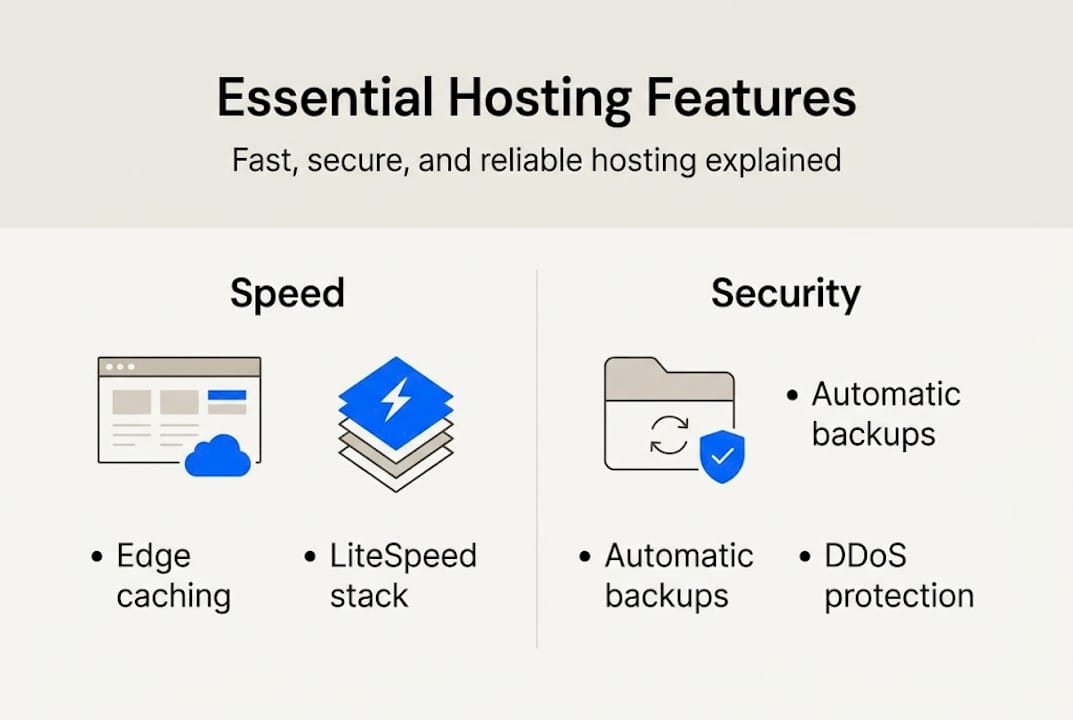
At the core, feature-rich hosting includes technologies like edge caching and LiteSpeed stacks, Redis object caching, NGINX servers, and CDN integration. These components work together to reduce server response time and ensure your pages load fast regardless of where your visitor is located. Basic shared hosting, by contrast, packs hundreds of accounts onto a single server with no isolation between them.
That isolation problem has a name in the industry: the "noisy neighbor" effect. When another website on your shared server spikes in traffic, your site slows down too. You have zero control over it. Feature-rich environments eliminate this through containerized or clustered infrastructure.
Here are the top features to look for when evaluating a hosting provider:
- Advanced caching (LiteSpeed Cache, Redis, Memcached)
- Free CDN integration to serve content from global edge nodes
- Free SSL certificates and automated renewals
- Automatic daily backups with one-click restore
- Managed security scanning and malware removal
- Staging environments to test changes before going live
- PHP8, HTTP/2, and MariaDB for modern performance stacks
- Expert 24/7 support included, not an upsell
For a deeper look at what to prioritize, the SMB hosting features guide breaks down each element by business need.
"The gap between feature-rich and basic shared hosting is not cosmetic. It is architectural. One is built for performance, the other for volume."
How feature-rich hosting boosts website speed and reliability
Numbers tell the clearest story. When benchmarks compare premium hosting to basic shared plans, the results are not marginal. They are dramatic. Premium hosts handle 100+ users simultaneously with 0% error rates, while basic shared hosts often buckle at 50 concurrent users with significant error spikes.
Here is a side-by-side comparison of what that looks like in practice:
| Metric | Feature-rich hosting | Basic shared hosting |
|---|---|---|
| TTFB (Time to First Byte) | ~89ms | ~580ms |
| Concurrent users (no errors) | 100+ | ~50 |
| Error rate under load | 0% | High |
| Uptime SLA | 99.9% to 99.99% | 99% or less |
| CDN included | Yes | Rarely |
For a small business running a flash sale or seasonal promotion, the difference between 0% errors and a crashed server is the difference between a profitable campaign and a PR nightmare. Your customers do not know or care about server architecture. They just know your site would not load.
The performance technology benefits driving these numbers include LiteSpeed's built-in caching layer, which bypasses PHP processing for cached pages entirely. That means your server responds in milliseconds instead of seconds. Edge CDN nodes serve static assets from locations closest to your visitor, cutting latency without any extra effort on your end.
Pro Tip: Always ask for real-world benchmark data before committing to a hosting plan. Marketing promises like "lightning fast" mean nothing without actual TTFB and load test numbers to back them up.
For businesses serious about speed and reliability optimization, investing in modern infrastructure is one of the highest-leverage moves you can make.
How uptime and availability protect your revenue
Speed matters, but availability is what keeps your business running. One hour of downtime during peak traffic can cost an e-commerce business hundreds or thousands of dollars depending on your conversion rate. The difference between 99.9% and 99.99% uptime sounds tiny until you do the math.
"99.99% uptime means roughly 52 minutes of downtime per year. Basic hosting at 99% uptime means over 8 hours offline annually."
High availability via clustered infrastructure and automatic failover is what makes that 99.99% figure possible. Instead of relying on a single server, your site runs across multiple nodes. If one fails, another takes over instantly with no manual intervention needed.

Here is how the numbers compare across hosting tiers:
| Uptime SLA | Downtime per year | Revenue risk |
|---|---|---|
| 99.99% | ~52 minutes | Very low |
| 99.9% | ~8.7 hours | Moderate |
| 99% | ~87.6 hours | High |
| Basic shared (no SLA) | Unpredictable | Severe |
So how do feature-rich hosts actually achieve this? Here are the concrete steps they take:
- Proactive monitoring around the clock, not just reactive alerts
- Instant failover to redundant servers when a node goes down
- Distributed storage so data is never tied to a single physical drive
- Regular infrastructure audits to catch vulnerabilities before they cause outages
- DDoS mitigation to prevent traffic attacks from taking your site offline
For businesses that want to see how this plays out in practice, reliable hosting case studies show real-world outcomes across different SMB scenarios. If you are also weighing scalability options, understanding cloud uptime advantages can help clarify which tier of hosting best fits your growth stage.
Total cost of ownership: Why premium hosting can save money
Here is where most SMBs get the math wrong. They compare the monthly sticker price of a $3/month shared plan to a $30/month premium plan and stop there. But that comparison ignores every dollar spent on consequences.
Premium hosting costs 5 to 10 times more upfront, but it bundles in managed updates, security monitoring, and expert support. That bundle replaces a significant portion of what you would otherwise handle yourself or pay a freelancer to manage.
Here is what a premium plan typically includes that basic hosting charges separately or does not offer at all:
- Automatic core and plugin updates managed by the host
- Malware scanning and removal without extra fees
- 24/7 expert support that actually knows your stack
- Daily backups with fast restore options
- Security patches applied proactively, not after a breach
- Staging environments so updates do not break your live site
Think about what happens when a basic hosting site gets hacked. You pay for a security professional, spend hours on cleanup, potentially lose customer data, and damage your brand reputation. That one incident can cost more than two years of premium hosting.
Pro Tip: Calculate your total cost of ownership (TCO) by adding your monthly hosting fee to the estimated hours you spend managing, troubleshooting, or recovering from hosting-related issues. Multiply those hours by your hourly rate. The real cost surprises most business owners.
For a full breakdown of what business hosting explained actually covers at different tiers, or to understand why secure hosting matters beyond just a padlock in your browser bar, both resources are worth your time.
Our perspective: Why cheap hosting is rarely worth the risk
We understand the appeal of low-cost hosting. When you are bootstrapping a business or watching every dollar, a $2.99/month plan feels responsible. We have seen it dozens of times, and we get it.
But here is what we have observed repeatedly with businesses that start cheap and scale up later. The transition is almost never smooth. By the time the pain becomes obvious, data has been lost, a site has been compromised, or a critical product launch has failed because the server went down under load. These are not edge cases. They are common outcomes.
The uncomfortable truth is that cheap hosting is cheap for a reason. Providers make their margins by overselling server capacity and minimizing support investment. You get what you pay for, and what you pay for with bargain hosting is a shared resource under-maintained by a team stretched too thin.
Think in terms of continuity, not just cost. Your website is often the first interaction a potential customer has with your business. Hosting that undermines your reliability is not saving you money. It is costing you customers quietly, one slow page load and one brief outage at a time.
Ready to upgrade? Feature-rich hosting made easy
If everything in this article resonates, the next step is straightforward. InSave Hosting delivers precisely the stack we have been describing: LiteSpeed servers, free CDN, automatic backups, managed security, free SSL, and expert support included at every tier.
If you are ready to stop firefighting and start growing, explore inSave Hosting to find the plan that fits your business. For WordPress-powered sites, the WordPress hosting plans are purpose-built for performance and ease. And if you want to lock down your site's credibility and security from day one, browse the available SSL protection options to get covered immediately. No technical jargon, no surprise fees.
Frequently asked questions
What are the core features that define feature-rich hosting?
Feature-rich hosting typically includes advanced caching, CDNs, robust security, clustered infrastructure, automatic backups, and expert support. Specifically, it leverages edge caching and LiteSpeed stacks to reduce latency significantly compared to standard shared environments.
How does feature-rich hosting improve website speed?
It uses advanced caching layers, CDNs, and optimized servers so pages load faster even during traffic spikes. These superior performance technologies result in dramatically lower TTFB compared to basic shared plans.
Is the higher cost of feature-rich hosting justified for small businesses?
Yes, because the bundled managed support, security, and reliability reduce your total cost of ownership over time. Premium hosting's managed value often costs less than a single IT emergency or data breach recovery.
How does better uptime impact business revenue?
Fewer outages mean more transactions complete successfully and fewer customers bounce to competitors. Near-zero downtime via failover infrastructure means your site stays available during the moments that matter most.
Recommended
- How advanced hosting tech boosts website performance
- Reliable hosting examples for small business success
- Business hosting explained: fast, secure solutions for SMBs
- How to choose web hosting: smart steps for small businesses
- Web design's role in boosting business growth in 2026
- Webhosting für KMU: Effizient und Sicher in der Ostschweiz