
Most small business owners don't think twice about domain registration until something goes wrong. A surprise renewal bill, a domain that expired while you were busy, or a competitor who snagged your ideal name first. Initial registration can cost as little as $8-15 per year, but renewal fees, redemption penalties, and hidden charges can turn a simple process into a costly headache. This guide walks you through exactly how domain registration works, what it costs, and how to protect your business name online from day one.
Table of Contents
- What is domain registration?
- How domain registration works: Step-by-step process
- Key factors to consider before choosing and registering a domain
- Domain costs, renewal fees, and common pitfalls
- What happens if you forget to renew? Redemptions and retrieval costs
- Smart strategies for small business domain management
- Simplify your domain registration and website hosting together
- Frequently asked questions
Key Takeaways
| Point | Details |
|---|---|
| Domain registration basics | Registering a domain gives your business a unique web address and online identity. |
| Real costs and renewals | Initial prices may be low, but renewal fees and redemption costs can be much higher. |
| Protect your domain | Enable auto-renew, track renewal dates, and use trustworthy registrars to retain control. |
| Smart choices save money | Pick a .com if available, value transparent pricing, and consider bundling with hosting or email. |
What is domain registration?
Domain registration is how you claim your spot on the internet. Think of it like renting a street address for your business, except the address is your website URL. Domain registration is the process of choosing a unique web address and securing it through a registrar for an annual fee. Without a registered domain, your website simply can't exist in any recognizable form online.
Your domain name is more than just a web address. It's the foundation of your brand online. Customers type it into browsers, share it on social media, and use it to find you in search results. Understanding domain name basics before you register helps you avoid names that are hard to spell, too long, or already trademarked.
A domain registrar is an accredited company authorized to sell and manage domain registrations. When you register a domain, the registrar records your ownership in a global registry database maintained by ICANN, the organization that oversees internet naming systems.
Here's what a domain name is made of:
- Second-level domain: The unique name you choose (example: "yourbusiness")
- Top-level domain (TLD): The extension that follows, like .com, .org, or .net
- Full domain: The combination, such as yourbusiness.com
- Registrar: The company you use to register and manage your domain
- Registry: The central database that stores all registered domain records globally
You don't own a domain outright. You license it for a set period, usually one to ten years, and renew it to keep it active.
How domain registration works: Step-by-step process
The process is straightforward once you know what to expect. Here's exactly what happens when you register a domain for your business.
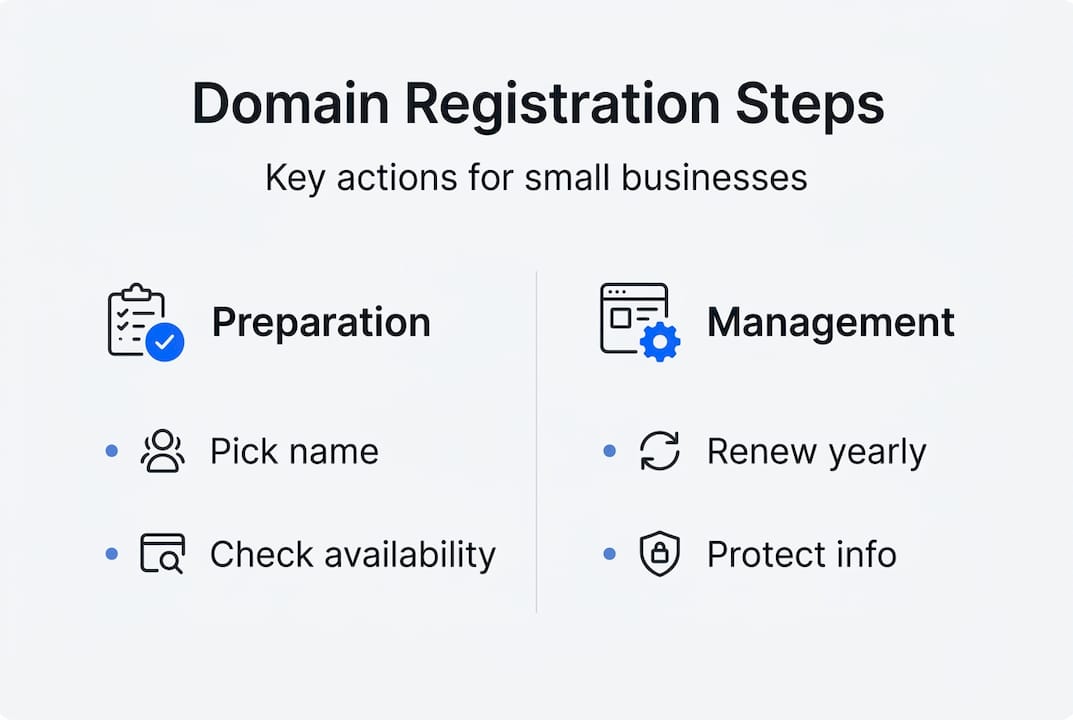
- Search for availability. Use a registrar's search tool to check if your desired domain is available. If it's taken, the tool usually suggests alternatives.
- Choose your domain and TLD. Select the name and extension that best fits your brand. .com is still the most trusted option for businesses.
- Provide your contact information. You'll enter your name, business address, email, and phone number. This info goes into the WHOIS database unless you add privacy protection.
- Select your registration term. You can register for one to ten years. Longer terms often come with small discounts and reduce the risk of accidental expiration.
- Pay the registration fee. Typical fees run $8-15 per year for a .com, though promotional pricing can be much lower for the first year.
- Receive confirmation and DNS setup. Your registrar sends a confirmation email. You then point your domain to your hosting server using DNS (Domain Name System) settings.
- Domain goes live. Once DNS propagates, your domain is active and accessible worldwide.
Pro Tip: Before you commit to a name, spend time learning how to choose the best domain name for long-term brand growth. A name that's easy to say out loud is easier for customers to remember and share.
Here's a quick look at typical domain registration costs in 2026:
| TLD | First-year registration | Annual renewal |
|---|---|---|
| .com | $8 to $15 | $10 to $20 |
| .net | $10 to $15 | $12 to $18 |
| .org | $9 to $14 | $11 to $17 |
| .co | $25 to $35 | $25 to $35 |
| .io | $35 to $60 | $35 to $60 |
Renewal pricing is often higher than the initial registration fee, especially with registrars that use promotional pricing to attract new customers.
Key factors to consider before choosing and registering a domain
Not all domain decisions are equal. The choices you make at registration can affect your brand, your search visibility, and your budget for years to come.

.com domains are preferred for trust and neutrality, and most customers instinctively type .com when they try to find a business online. If your ideal .com is taken, consider a creative variation before settling for a less familiar TLD.
Here are the most important factors to evaluate before you register:
- Memorability: Short names with no hyphens or numbers are easier to type and share.
- Brand alignment: Your domain should reflect your business name or core service.
- TLD choice: .com is the gold standard. .org works for nonprofits. Niche TLDs like .shop or .tech can work but carry less inherent trust.
- Auto-renewal: Always enable this. A lapsed domain can be gone within weeks.
- Privacy protection: Without it, your personal contact info is publicly visible in the WHOIS database.
- Bundled services: Registrars that offer hosting and email together simplify your setup and often reduce costs.
- Transparent renewal pricing: A $0.99 first-year deal means nothing if the renewal jumps to $20.
Pro Tip: Review domain selection best practices before locking in your name. Changing your domain later is possible but disruptive and can hurt your search rankings.
When you're ready to search, use a registrar that shows you the renewal price upfront, not just the promotional rate. You can find the right registrar by comparing total costs over three years, not just the first year.
Domain costs, renewal fees, and common pitfalls
This is where many small business owners get burned. The registration fee is just the beginning.
Promotional prices can start as low as $0.99 but often jump to $15-20 on renewal, with GoDaddy renewals reaching up to $19.99 per year and budget registrars like Porkbun and Namecheap hovering around $10. That gap adds up fast if you're managing multiple domains.
| Registrar | First-year .com price | Annual renewal | Redemption fee |
|---|---|---|---|
| GoDaddy | $0.99 to $12.99 | Up to $19.99 | $80 to $160 |
| Namecheap | $6.98 to $9.98 | Around $10 | $80 to $100 |
| Porkbun | $7.48 to $9.73 | Around $10 | $80 to $100 |
The real cost of a domain isn't what you pay to register it. It's what you pay to keep it, recover it, or transfer it when things go wrong.
Common pitfalls to watch out for:
- Renewal rate shock: Promo pricing expires after year one. Always check the renewal rate before registering.
- Missed renewal emails: Spam filters catch these. Use a reliable email address and check your registrar dashboard regularly.
- Incorrect registrant info: If your contact email is outdated, you won't receive renewal notices. Update it every time your info changes.
- Transfer lock-in: Some registrars make it difficult or expensive to move your domain. Check transfer policies before committing.
- Upsells at checkout: Privacy protection, SSL certificates, and email hosting are often added automatically. Review your cart carefully.
Understanding the features affecting renewals and how bundling with email services can reduce your overall costs helps you make smarter decisions from the start. You can also check current renewal prices to compare options before you commit.
What happens if you forget to renew? Redemptions and retrieval costs
Missing a renewal deadline isn't just inconvenient. It can be expensive, and in some cases, you can lose your domain entirely.
After expiration, there's a grace period of 30-45 days, then a redemption period of 30 days with fees ranging from $100 to $220, followed by a pending delete phase of 5 days before the domain is released to the public. Here's the full timeline:
- Expiration date: Your domain stops working or enters a holding state.
- Grace period (0 to 45 days): You can renew at the standard rate. Your site may go offline but the domain is still yours.
- Redemption period (45 to 75 days): You can still recover the domain, but fees jump to $100 to $220 on top of the renewal cost.
- Pending delete (75 to 80 days): The domain is queued for deletion. You cannot recover it at this stage.
- Released to public: The domain becomes available for anyone to register.
Redemption fees by registrar in 2026:
| Registrar | Redemption fee | Total recovery cost (approx.) |
|---|---|---|
| GoDaddy | $80 to $160 | $100 to $180 |
| Namecheap | $80 to $100 | $90 to $110 |
| Porkbun | $80 to $100 | $90 to $110 |
| Network Solutions | $100 to $220 | $120 to $240 |
To protect yourself, review understanding grace periods and consider pairing your domain management with automated website backups so your entire online presence stays protected.
Smart strategies for small business domain management
The best protection against domain loss and fee surprises is prevention. Here's how to manage your domain like a pro.
Enable auto-renewal and review all registrar fees and bundled options before committing. This single step eliminates the most common cause of domain loss for small businesses.
Your domain management checklist:
- Enable auto-renewal on day one. Don't rely on remembering manually.
- Add privacy protection to keep your personal contact info out of the public WHOIS database.
- Keep registrant info current. Your email address must be active and checked regularly.
- Register under the business name, not an employee's personal account. If that person leaves, you could lose access.
- Set calendar reminders 60 and 30 days before your renewal date as a backup to auto-renewal.
- Bundle with hosting and email where possible to reduce the number of vendors you manage.
- Document everything: Store your registrar login, renewal dates, and DNS settings in a secure shared location.
Pro Tip: If an employee manages your domain, make sure the registrar account is tied to a company email address you control. Ownership disputes after staff changes are more common than you'd think, and they're entirely preventable.
Bundling your domain with hosting and email through a single provider makes life significantly easier. You get one dashboard, one renewal cycle, and one support team. You can manage domains with ease, combine domain and email under one account, and explore integrated hosting platforms that handle everything in one place.
Simplify your domain registration and website hosting together
You've now got a clear picture of how domain registration works, what it costs, and how to avoid the pitfalls that catch so many small business owners off guard. The next step is putting that knowledge into action with a provider that makes the process simple and transparent.
At InSave Hosting, we offer domain name options with transparent renewal pricing, no surprise fees, and a free domain included with qualifying hosting plans. Our shared hosting plans bundle your domain, SSL certificate, and email hosting together so you manage everything from one place. Whether you're launching your first site or consolidating a messy setup, our all-in-one website solutions are built for small business owners who want reliability without the complexity.
Frequently asked questions
Is domain registration the same as buying a website?
No. Domain registration and web hosting are separate services with distinct roles. Registering a domain gives you the web address, but you still need hosting to make a website live and accessible.
How soon will my domain be active after registration?
Your domain is usually active within minutes of registration, but full DNS propagation across the internet can take up to 24 to 48 hours depending on your hosting setup.
Can I change my domain registrar later?
Yes. You can transfer your domain to a different registrar after 60 days. Transferring a domain adds a renewal year and costs $9-20 depending on the registrar you're moving to.
What happens if my domain expires?
You enter a grace period where renewal is still possible at standard rates. After that, redemption fees of $100-220 apply, and eventually the domain is released to the public for anyone to register.
Should I bundle my domain with hosting and email?
Bundling domains with hosting and email saves time and reduces admin headaches. For most small business owners, a single provider for all three services is the most practical and cost-effective approach.