
Choosing the right domain name can feel overwhelming when you're launching a new website. Many business owners pick names too quickly, only to discover later that their choice hurts brand recognition, confuses customers, or even triggers legal problems. This guide delivers a proven, step-by-step process to help you select a domain name strategically, avoid costly mistakes, and build a strong foundation for your online presence with confidence.
Table of Contents
- Why A Strategic Domain Name Matters
- Preparation: Research And Planning For Your Domain Name
- Execution: Choosing The Ideal Domain Name And Extension
- Verification And Securing Your Domain Name
- Explore InSave Hosting Solutions For Your Domain And Website
Key takeaways
| Point | Details |
|---|---|
| Strategic process prevents mistakes | Following a clear naming framework saves time, money, and protects your brand from confusion. |
| Short and memorable wins | Easy-to-spell, concise domains boost recall and reduce customer errors. |
| Extension choice builds trust | Securing the right TLD, usually .com, enhances credibility and user confidence. |
| Legal checks avoid conflicts | Trademark searches prevent expensive disputes and protect your business legally. |
| Flexibility supports growth | Versatile names scale with your business and adapt to future expansion. |
Why a strategic domain name matters
Your domain name is far more than a web address. It embodies your brand identity, shapes first impressions, and influences how customers perceive your business. Choosing the right company name is the single most important branding decision, setting the foundation for reputation, marketing, and bottom line. A strong name builds instant recognition, while a weak choice creates confusion and lost opportunities.
Consider how famous companies leverage memorable names to drive growth. Recognizable and trusted names fuel investor confidence and drive performance, directly impacting market valuation and competitive positioning. Brands like Apple, Amazon, and Google demonstrate how strategic naming creates lasting market dominance.
A poorly chosen domain drags down your marketing effectiveness. When customers struggle to remember, spell, or find your site, you lose leads before they even arrive. Your domain name affects search visibility, word-of-mouth referrals, and email deliverability. Strategic naming transforms your domain into a marketing asset that works 24/7, building trust and driving conversions without ongoing costs.
A domain name is your digital storefront. Make it welcoming, memorable, and aligned with the experience you promise.
Investing time upfront to choose strategically pays dividends throughout your business lifecycle. The right name grows with you, supports brand consistency across platforms, and positions your company for long-term success in competitive markets.
Preparation: research and planning for your domain name
Before brainstorming names, you need a clear strategy. Diving straight into brainstorming without a plan is a common mistake. A naming strategy is needed to align your domain with brand personality, target audience, and business goals. Define your brand values, voice, and positioning first. Are you professional and corporate, or casual and innovative? Your domain should reflect this identity instantly.
Research is your shield against legal headaches and branding disasters. Thorough internet and trademark searches are crucial to ensure a business name's uniqueness and legal availability. Check federal trademark databases, state registrations, and social media platforms to confirm your chosen name is truly available. Missing this step can lead to cease-and-desist letters, costly rebranding, or losing your domain altogether.
Avoid these common naming pitfalls that sabotage discoverability:
- Hyphens and numbers confuse users and make verbal sharing nearly impossible
- Overly complex spellings force customers to guess and often land on competitor sites
- Geographic limitations restrict expansion into new markets
- Trendy terms that age poorly and feel dated within months
Think long term when evaluating name options. Your domain should accommodate business evolution, new product lines, and market expansion. A name tied too closely to a single service or location becomes a liability when you diversify. Choose flexibility over narrow specificity to avoid expensive rebranding as your company grows.

Check social media availability for consistent branding across platforms. Securing matching handles on Facebook, Instagram, LinkedIn, and Twitter prevents brand confusion and protects against impersonators. Unified naming strengthens recognition and simplifies marketing campaigns across channels.
Pro Tip: Create a shortlist of 10 to 15 potential names, then test them with real customers. Ask which names are easiest to remember, spell, and associate with your business value. Real feedback reveals issues you might miss on your own.
Execution: choosing the ideal domain name and extension
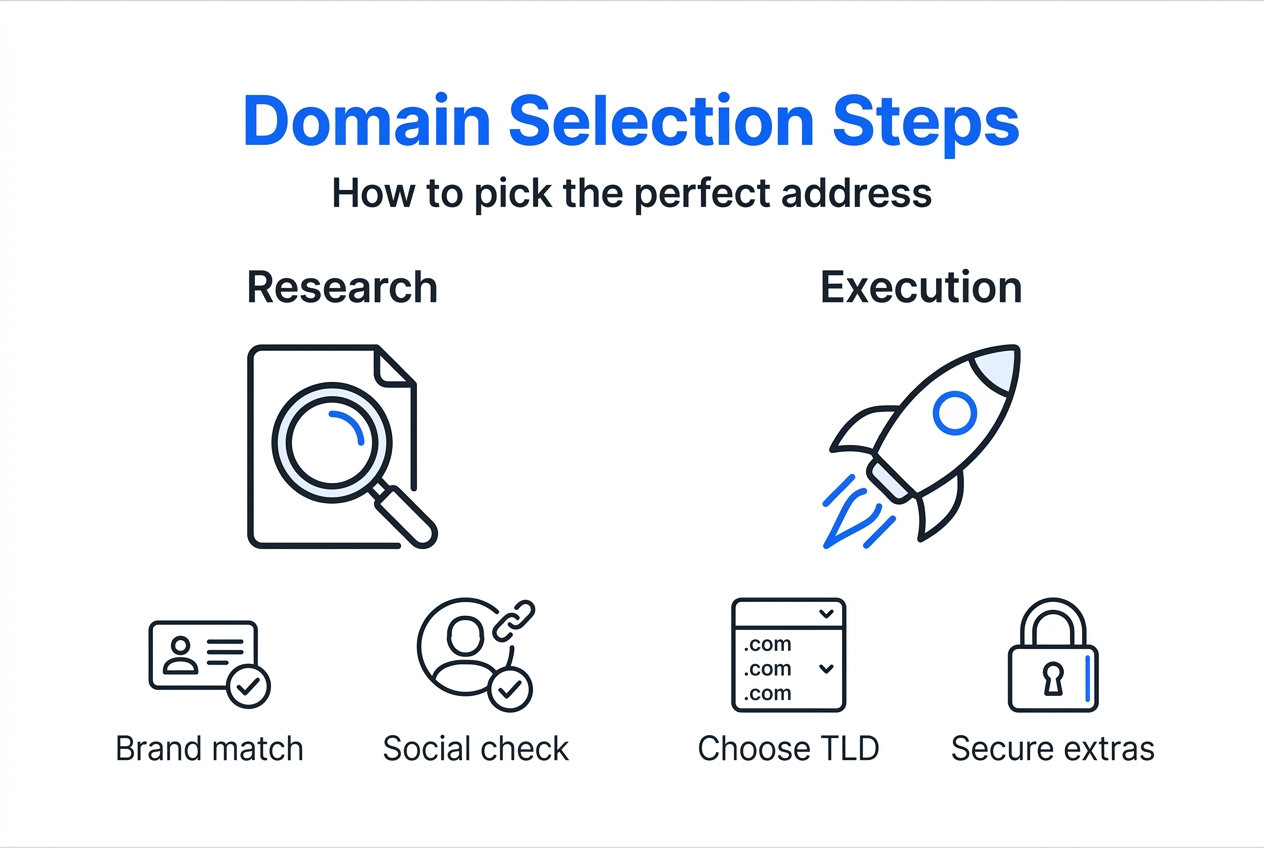
With research complete, follow this proven process to select your final domain name and extension. Each decision point builds on the last, creating a systematic approach that balances creativity with strategic discipline.
-
Prioritize short, memorable names. The ideal domain name should be short, memorable, and easy to spell to enhance brand recall and reduce user errors. Aim for 6 to 14 characters when possible. Shorter names type faster, fit better on mobile screens, and stick in memory longer.
-
Eliminate confusion sources. Skip hyphens, numbers, and unusual spellings entirely. These elements force customers to clarify when sharing your site verbally and increase typo rates. Clean, simple names perform better across all marketing channels.
-
Balance keywords with brandability. Keywords can provide context, but brandable uniqueness trumps exact-match domains in 2026. A distinctive name builds stronger emotional connections than generic keyword strings. Your domain name should sound like a real brand, not a search query.
-
Choose the right extension strategically. Securing a .com domain significantly boosts a business's credibility and trust. While hundreds of TLDs exist, .com remains the gold standard for most businesses. Users default to .com mentally, improving direct traffic and reducing confusion.
-
Understand TLD SEO realities. Google treats all generic TLDs equally for ranking. Your extension choice won't directly impact search position, but it affects user behavior and click-through rates. Trust signals matter more than technical SEO factors here.
| Extension | Best For | Credibility | User Trust | SEO Impact |
|---|---|---|---|---|
| .com | Most businesses, e-commerce, services | Highest | Maximum | Neutral |
| .org | Nonprofits, communities, advocacy groups | High | Strong for nonprofits | Neutral |
| .net | Tech companies, internet services, networks | Moderate | Good | Neutral |
| .io | Tech startups, SaaS platforms, developers | Moderate | Strong in tech circles | Neutral |
| .co | Startups, modern brands, .com alternatives | Moderate | Growing acceptance | Neutral |
| Industry-specific | Niche relevance (e.g., .tech, .store, .agency) | Variable | Context-dependent | Neutral |
Niche extensions like .tech, .store, or .agency can work when they reinforce your industry positioning and the .com is unavailable. However, they carry higher risk of users defaulting to .com out of habit, potentially sending traffic to competitors or parked pages.
Pro Tip: Test your shortlisted names by saying them aloud in various contexts. Can someone hear it once and spell it correctly? Does it sound professional in a phone conversation? Real-world testing reveals pronunciation and clarity issues that look fine on paper.
If your ideal .com is taken but not actively used, consider reaching out to the owner about purchasing it. Many domain owners are willing to sell for reasonable prices, especially if the domain sits unused. Professional domain brokers can negotiate on your behalf if the stakes justify the investment.
For optimal protection, secure common misspellings and the .net or .org versions of your chosen name. Redirect these to your primary .com domain to capture traffic from typos and prevent competitors from capitalizing on confusion. This defensive strategy costs little but prevents significant lost opportunities.
Verification and securing your domain name
Once you've identified your ideal domain, verification and security steps protect your investment and prevent future problems. Moving quickly but carefully through this phase ensures you secure your chosen name before someone else claims it.
Perform comprehensive availability checks across multiple dimensions. Search domain registrars to confirm the exact domain is available for registration. Run federal and state trademark searches to verify no existing legal claims exist. Check business name databases in your jurisdiction to avoid conflicts with registered entities. Approximately 30% of new businesses face legal challenges related to their brand name due to insufficient trademark checks. This preventable risk can derail your launch and drain resources.
Secure your domain following these steps:
-
Register immediately once you've verified availability. Domain names can sell within hours in competitive markets. Delaying gives competitors or domain squatters opportunities to claim your chosen name.
-
Choose a reputable registrar with transparent pricing. Look for clear renewal rates, no hidden fees, and strong customer support. Securing a .com domain is a critical step in establishing credibility and trust, so partner with reliable providers.
-
Enable auto-renewal to prevent accidental expiration. Losing your domain due to a missed renewal notice can be catastrophic. Auto-renewal with backup payment methods provides insurance against this disaster.
-
Register for multiple years if budget allows. Multi-year registration locks in current pricing and signals permanence to search engines and users. It also reduces administrative overhead.
-
Add domain privacy protection to shield personal information. Public WHOIS databases expose your contact details to spammers and scammers. Privacy protection keeps your information confidential while maintaining legal compliance.
Consider defensive registrations to protect your brand comprehensively:
- Common misspellings and typo variants to capture misdirected traffic
- Alternative extensions (.net, .org, .co) to prevent competitor confusion
- Plural and singular versions if both could logically apply
- Hyphenated versions if your name could be interpreted with hyphens
Each defensive registration costs minimal fees but prevents competitors from exploiting your brand equity. Redirect all variants to your primary domain to consolidate traffic and maintain consistent branding.
Implement SSL certificates immediately after domain registration. Secure connections build user trust, improve search rankings, and protect customer data. Many hosting providers, including those offering domain name registration, include free SSL certificates as standard features.
Keep your domain registration contact information current and accurate. Outdated email addresses can cause you to miss critical renewal notices or security alerts. Review and update your details annually or whenever contact information changes.
Pro Tip: Set calendar reminders 60 and 30 days before your domain expiration date, even with auto-renewal enabled. This backup system ensures you catch any payment failures or technical glitches before they become crises.
Explore inSave Hosting solutions for your domain and website
Now that you understand the domain selection process, you're ready to bring your online presence to life. inSave Hosting makes domain name registration simple and affordable, with expert support to guide you through setup and configuration.
Our flexible WordPress hosting options provide the perfect foundation for your new website, combining reliability with performance optimization. Whether you're launching a small business site or scaling an established brand, our shared web hosting plans deliver the speed, security, and uptime your customers expect. Let inSave handle the technical complexities while you focus on growing your business.
FAQ
What makes a domain name good for SEO?
Short, memorable, and easy-to-spell names improve SEO indirectly by enhancing user experience and reducing bounce rates. Keyword relevance provides context but matters far less than brandability and user engagement signals. Focus on names humans love first, then optimize technical elements.
How important is securing a .com domain in 2026?
.com remains the most trusted and recognized TLD, improving click-through rates and user confidence significantly. While some niche extensions offer industry relevance, they typically reduce perceived credibility compared to .com. Secure .com whenever possible to maximize trust and eliminate user confusion.
Can I change my domain name later if needed?
Changing domain names damages brand recognition, confuses existing customers, and loses accumulated search authority. The technical process is straightforward, but the business costs are substantial. Choose a versatile, growth-ready name initially to avoid expensive rebranding down the road.
Should I include keywords in my domain name?
Keywords provide helpful context but shouldn't compromise brandability or memorability. A unique, distinctive name builds stronger brand equity than generic keyword combinations. Prioritize names that sound like real brands rather than search queries for long-term success.
How do I protect my domain from theft or hijacking?
Enable two-factor authentication on your registrar account, use domain locking to prevent unauthorized transfers, and maintain current contact information for security alerts. Choose registrars with strong security track records and 24/7 support to respond quickly if issues arise.