
Yes, in most cases you can still renew an expired domain, but the window shrinks fast and gets more expensive the longer you wait. If your domain expired recently, log in to your registrar account right now, check the payment method on file, and try to renew it at the standard rate. If it has moved past that first window into what registrars call redemption, you can usually still get it back, but expect a much higher fee and a slower process.
TL;DR:
- Domains usually have a renewal grace period lasting up to 45 days, during which renewal at the standard price is still possible in most cases.
- After the renewal grace period, domains enter a 30-day redemption period, where restoring the domain incurs a higher fee and requires registrar intervention.
- If the domain reaches pending delete status, restoration becomes unlikely, and you must rely on backorder services once it is released back into the public pool.
- Costs escalate quickly after expiration, with redemption fees often several times higher than standard renewal fees, especially for high-value or short names.
- Monitoring and managing renewal payments proactively, including setting reminders and consolidating domain and hosting accounts, significantly reduce the risk of accidental domain loss.
Table of Contents
- What Is a Domain Renewal Grace Period, and How Does It Differ From Redemption?
- How Long Is the Grace Period, and Why Does It Vary?
- What to Do Right Now to Recover an Expired Domain
- What Will It Actually Cost to Get a Domain Back?
- What Registrars Are Required to Do Under ICANN Rules
- Preventing This From Happening Again
- If Your Registrar Won't Help
- An Editor's Take on Why Most Domain Losses Are Preventable
- Keep Your Domain and Hosting Under One Roof
- Where to Verify Domain Policy Details
- Sources
- FAQ
What Is a Domain Renewal Grace Period, and How Does It Differ From Redemption?
A domain renewal grace period is the window your registrar provides to renew at the normal price after your domain technically expires. It is a courtesy from the registrar, not a rule imposed by the registry, so its length depends on who you registered with. During this window, your site and email usually keep running, though some registrars pause DNS resolution as soon as the clock starts.
Once the renewal grace period closes without payment, the domain typically drops into the redemption grace period (RGP), a registry-level status. This is a different animal entirely. ICANN requires most gTLD registries to offer a 30-day RGP after deletion, during which the original registrant can still restore the name, but only through the sponsoring registrar and only by paying a redemption fee.
After RGP expires, the domain enters pending delete, a roughly five-day holding status before it's released back into the public pool.
- Renewal grace period: in-account renewal, standard price, DNS often still active
- Redemption grace period: registrar must request restoration from the registry, redemption fee applies, DNS typically down
- Pending delete: no restoration path for the original owner; the name becomes available to anyone once it drops
Transfers are blocked during RGP no matter who initiates them, which is one reason acting during the first grace window matters so much.
How Long Is the Grace Period, and Why Does It Vary?
There's no single answer, and that's the part that trips people up. The renewal grace period set by your registrar can run anywhere from zero days to 45 days, depending on their internal policy and the top-level domain involved. The registry-level redemption period is more standardized but still not universal.
- ICANN requires a 30-day RGP for most generic top-level domains covered by its Redemption Grace Period policy
- Some registries set shorter or different windows entirely; Nic for certain country-code extensions
- Registrar-added grace periods on top of that can range from around 27 to 40 days in practice, based on published registrar help documentation
- Auto-renew failures (an expired card, a blocked charge) don't always trigger the same grace treatment as a manually skipped renewal
30 days is the RGP figure ICANN requires for most gTLDs, but the registrar's own grace period before that, which is what actually determines whether you pay standard price or a redemption fee, is not set by ICANN at all.
The fastest way to know your exact timeline is to pull up WHOIS or RDDS for the domain and check the registrar's own policy page for that specific top-level domain, since country-code and specialty extensions often run their own rules.
What to Do Right Now to Recover an Expired Domain
Work through these steps in order. Speed matters here more than almost anything else.
- Log in to your registrar account and check the domain's status page. Confirm whether it says "expired," "renewal grace period," or "redemption period."
- Verify your payment method. A huge share of expirations trace back to an expired card or a blocked automatic charge, not a forgotten renewal.
- If you're still in the registrar's renewal grace period, renew directly in your account at the standard rate. Confirm the renewal actually processed by rechecking WHOIS after an hour or two.
- If the domain shows a redemptionPeriod status, contact your registrar's support team directly and request restoration. Don't attempt a transfer to another registrar first. Transfers are blocked during RGP, and trying one just wastes time.
- If the domain shows pendingDelete, understand that restoration is very unlikely at this stage. Look into backorder services offered by your registrar, which will attempt to catch the name the moment it's released.
Pro Tip: Screenshot the WHOIS record and any error messages before you call support. Registrars move faster when you can point to the exact status code instead of describing the problem in general terms.
What Will It Actually Cost to Get a Domain Back?
Standard renewal costs whatever your usual annual fee is, typically in the same range as registration. Redemption is a different story.
- Standard renewal: your normal annual registration price, no penalty
- Redemption fee: often several times the standard renewal cost, because it covers the registry's administrative work to reverse a deletion rather than a simple renewal transaction
- Registrar processing fees: some registrars tack on an additional handling charge for redemption requests
- Backorder or auction pricing: if the domain slips into pending delete and gets released, expect competitive bidding, especially for short or brand-relevant names, with costs that can run well past even the redemption fee
The gap between renewal and redemption pricing is the single biggest reason to act inside the first grace window instead of waiting.
What Registrars Are Required to Do Under ICANN Rules
Your registrar isn't just being generous when it warns you about an upcoming expiration. ICANN's Expired Registration Recovery Policy requires:
- At least two renewal reminder notices, generally sent around one month and one week before expiration
- A restored DNS resolution path once you renew or redeem, delivered "immediately or as soon as commercially reasonable"
- Permission to renew or redeem through the sponsoring registrar during any grace period the registry offers
If your registrar skipped the reminder notices or dragged its feet on restoring service after you paid, document the dates, screenshots, and support tickets, then file a complaint with ICANN. That paper trail is what turns a vague complaint into an enforceable one.
Preventing This From Happening Again
Auto-renew helps, but it isn't a guarantee. Cards expire, banks flag charges as fraud, and email reminders land in spam folders. Pair automation with active checking.
- Turn on auto-renew, but check your account every few months to confirm the payment method is still valid
- Keep WHOIS contact emails current, and add a secondary contact address so a bounced notice doesn't mean a missed renewal
- Set calendar reminders 60 and 30 days out, independent of whatever the registrar sends
- Run uptime and DNS monitoring so you catch a lapse within hours instead of weeks
- Keep regular backups of your site and email, so a renewal problem never becomes a data-loss problem too
Pro Tip: Set your reminder for 60 days out, not 30. That gives you a full month of buffer if a card gets declined and you need to sort out a new payment method before the real deadline hits.
If Your Registrar Won't Help
Check the domain's exact EPP status code in WHOIS first. redemptionPeriod means restoration is still possible through your registrar; pendingDelete means it almost certainly isn't.
- Pull WHOIS/RDDS records and save the status code and timestamp
- If your registrar ignored ERRP notice requirements or blocked a valid restoration request, file a complaint with ICANN and attach your documentation
- If the name has already dropped, look at backorder services, or consult a domain broker or attorney for high-value names caught in a dispute
An Editor's Take on Why Most Domain Losses Are Preventable
Most domains that end up in redemption weren't lost because the owner didn't care. They were lost because the owner assumed a payment system would just work. That assumption is the real vulnerability, not ignorance of ICANN policy.
The industry's framing doesn't help. Registrars market auto-renew as a "set it and forget it" fix, and technically it is, right up until a card expires or a bank flags a routine charge as suspicious. At that point the domain doesn't fail loudly. It fails silently, and the first sign of trouble is usually a client asking why the website is down.
The businesses that never end up in this article's later sections tend to do one unglamorous thing: they treat domain renewal like a recurring bill that gets a second set of eyes, not a background process. A calendar reminder that's independent of the registrar's own notices is a five-minute habit that has saved more domains than any legal complaint ever will.
If there's a genuine gap in how this space works, it's that hosting and domain management often live in separate accounts, with separate logins, separate payment methods, and separate points of failure. That fragmentation is where things slip through. Consolidating those pieces isn't a magic fix, but it does remove one entire category of "which account did I use for this" confusion.
— Ihor
Keep Your Domain and Hosting Under One Roof
Split accounts are where renewals quietly fail. When your domain sits with one provider and your hosting with another, a missed notice on either side can take your whole site down, and you won't always catch it in time. Domain registration, renewal, and hosting management are often kept in a single dashboard, so you're checking one account instead of two.

That means one login, one payment method to monitor, and monitoring tools like 360 Monitoring that flag outages before a client calls to ask why the site is down. If you're managing a small-business site and want that kind of setup, whether you're a developer building custom sites for clients or running your own storefront, inSave Hosting's domain registration and transfer tools let you register a new name, move an existing one over, or set up managed renewals in one pass. Check your current domain's renewal date today and see whether consolidating makes sense for your setup.
Where to Verify Domain Policy Details
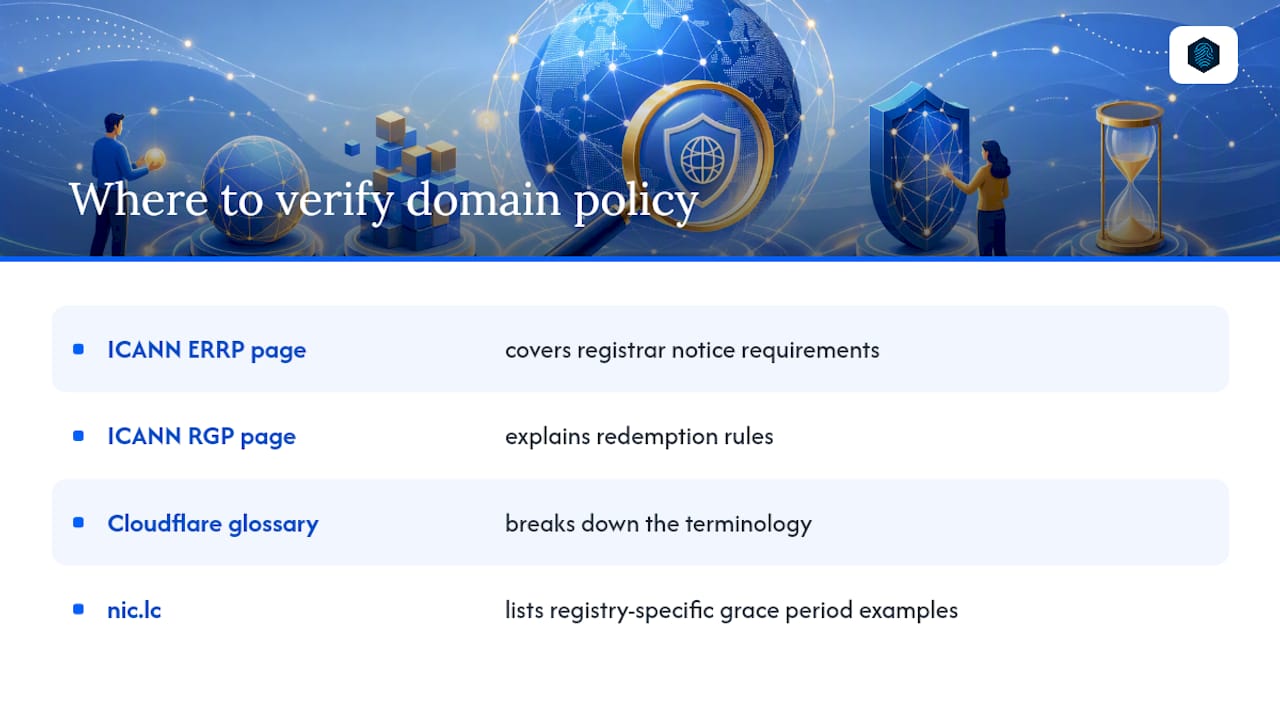
For domain-specific rules, go straight to the source. ICANN's ERRP page covers registrar notice requirements, ICANN's RGP page explains redemption rules, Cloudflare's glossary breaks down the terminology, and nic.lc lists registry-specific grace period examples.
Sources
- About Redeeming a Domain Name in Redemption Grace Period
- What happens to expired domains? — Cloudflare
- Nic
FAQ
What happens if you forget to renew your domain?
Your domain typically enters your registrar's renewal grace period first, where you can usually renew at the standard price, then moves into a 30-day redemption grace period requiring a higher fee if you miss that first window too.
How long after a domain expires can it be bought by someone else?
After any registrar grace period plus the roughly 30-day redemption period, the domain enters a pending delete phase lasting about five days, after which it releases to the public and anyone can register it.
What is the grace period for expired domains?
Most registrars offer a renewal grace period of anywhere from a few days up to about 45 days, followed by a registry-mandated 30-day redemption grace period for most generic top-level domains.
My domain has expired. How do I renew it?
Log in to your registrar account, check the domain's status, and renew directly if it still shows as being within the renewal grace period; if it shows a redemption status, contact your registrar's support team to request restoration.
Does inSave Hosting help with expired domain recovery?
inSave Hosting's domain transfer and registration tools support managed renewals and monitoring, which helps catch a lapsed payment method before a domain slips into redemption.