
TL;DR:
- PHP 8 introduces major features like JIT compilation, union types, and syntax improvements that make PHP faster and more expressive. The upgrade offers real performance gains, especially on CPU-bound workloads, with most web applications seeing up to 40% faster speeds without code changes. Migrating incrementally with thorough testing is recommended to ensure compatibility and maximize benefits.
PHP 8 is defined as a major version release of the PHP scripting language that introduces Just-In-Time (JIT) compilation, union types, named arguments, match expressions, and a range of syntax improvements that make PHP faster and more expressive than any previous version. Released in november 2020, PHP 8 represents the most significant leap in the language's history since PHP 7. For web developers building applications on WordPress, Laravel, or Symfony, understanding what PHP 8 delivers is not optional. It directly affects your site's speed, your code's safety, and your team's productivity.
What is PHP 8 and why does it matter?
PHP 8 is the official major release of PHP that fundamentally modernizes the language's runtime engine and syntax. The core upgrade is the JIT compiler, which compiles PHP bytecode directly to machine code at runtime instead of interpreting it step by step. That single change unlocks performance gains that older PHP versions could never achieve through opcode caching alone.
PHP 8 introduced named arguments, union types, match expressions, constructor property promotion, the nullsafe operator, Fibers, and Enums across its 8.0 through 8.1 releases. Each feature targets a specific pain point developers faced with PHP 7.x code. Together, they shift PHP from a loosely typed scripting language into a modern, expressive tool that competes seriously with Python and Node.js backends.
WordPress, Laravel, and Symfony all support PHP 8. That ecosystem coverage means the upgrade path is well-tested and widely documented. Developers who have not yet moved to PHP 8.x are leaving measurable performance and code quality improvements on the table.
What are the key new features in PHP 8?
PHP 8's language features fall into two categories: syntax improvements that reduce boilerplate and type system additions that prevent bugs before they reach production.
Syntax improvements that reduce boilerplate
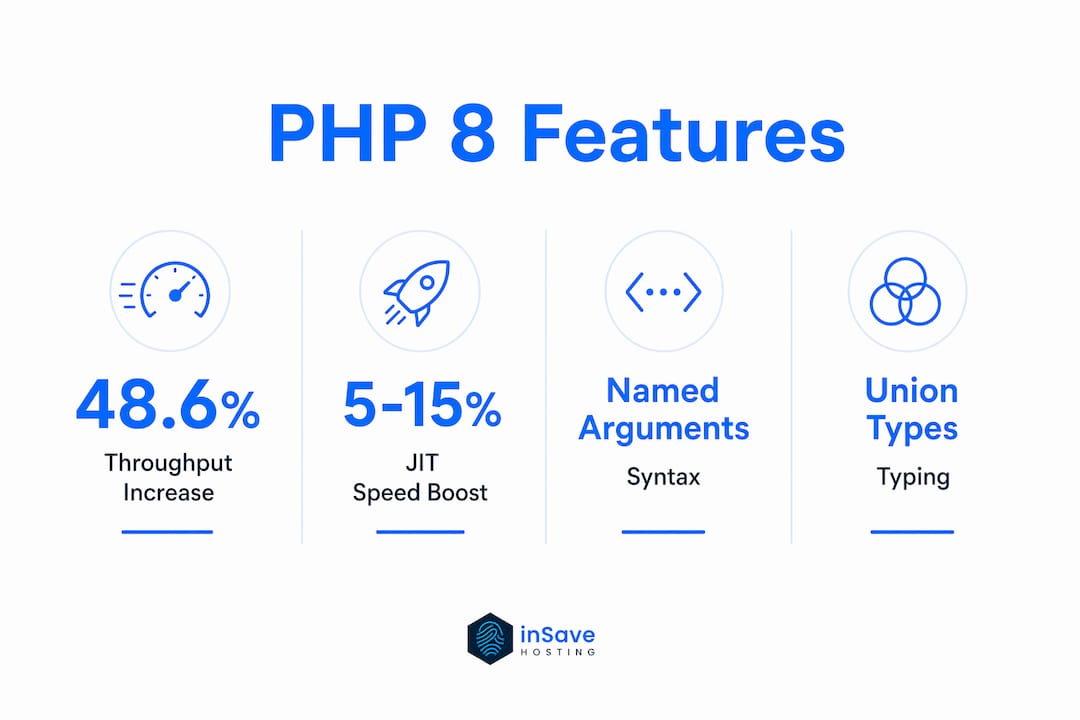
Named arguments let you pass values to a function by parameter name rather than position. That means array_slice(array: $items, offset: 2, length: 5) is now valid, and you no longer need to remember argument order for built-in functions.
Constructor property promotion eliminates the repetitive pattern of declaring a property, listing it as a constructor parameter, and then assigning it manually. You write public function __construct(public string $name, private int $age) and PHP handles the rest.
Match expressions replace verbose switch blocks with a concise, value-returning syntax that also uses strict comparison. A match expression throws an UnhandledMatchError if no arm matches, catching bugs that switch would silently ignore.
The nullsafe operator (?->) chains method calls on potentially null objects without wrapping every call in an if statement. $user?->getProfile()?->getAvatar() returns null at the first null value instead of throwing a fatal error.
Type system additions that prevent bugs
- Union types allow a parameter or return type to accept more than one type, such as
int|string, making function signatures self-documenting. - Enums (introduced in PHP 8.1) replace magic constants and string flags with strongly typed, named values that the IDE and runtime can both validate.
- Attributes provide a native annotation syntax, replacing docblock-based metadata that frameworks like Symfony and Doctrine previously parsed manually.
- Fibers (PHP 8.1) enable cooperative multitasking by allowing code execution to pause and resume, increasing throughput for I/O-heavy applications without requiring a full async runtime.
Pro Tip: Start adopting union types and constructor property promotion first. They require zero configuration changes and immediately reduce the line count in any class-heavy codebase.
How does PHP 8's performance compare to previous versions?
PHP 8's performance gains are real and measurable, but they vary significantly depending on your workload type.

JIT compilation and what it actually does
The JIT compiler in PHP 8 converts frequently executed code paths into native machine instructions. For CPU-bound workloads like image processing, mathematical computation, or data transformation pipelines, JIT delivers the largest gains. For typical web applications that spend most of their time waiting on database queries or file I/O, the gains are more modest.
JIT compilation primarily benefits CPU-bound workloads, offering a 5–15% improvement on I/O-bound web apps like WordPress. That number is still meaningful at scale, but it explains why some developers expected more dramatic results on standard CRUD applications.
Benchmark results across PHP versions
Benchmarks show PHP 8.0 through 8.3 deliver up to 48.6% more throughput than PHP 7.4 due to JIT and engine optimizations. That figure reflects synthetic benchmarks under CPU-intensive conditions. Real-world web apps land closer to the 20–40% range.
| PHP version | Throughput vs PHP 7.4 | Best use case |
|---|---|---|
| PHP 8.0 | Up to ~20% faster | General web apps |
| PHP 8.1 | Up to ~30% faster | Apps using Fibers or Enums |
| PHP 8.2 | Up to ~40% faster | Shared hosting, WordPress |
| PHP 8.3 | Up to 48.6% faster | CPU-bound workloads |
PHP 8.2 reduces memory usage approximately 5% per request compared to PHP 8.1. On shared hosting, that reduction directly translates to more concurrent users handled without additional server resources.
"Upgrading a typical WordPress site to PHP 8.3 results in code execution that is 20–40% faster than on PHP 7.4, requiring no code changes."
That benchmark result is the most practical argument for upgrading. You get a significant speed boost without touching a single line of application code.
How should you migrate to PHP 8?
Safe migration to PHP 8 involves incremental upgrades, updating dependencies, testing comprehensively, and monitoring performance after each step. Rushing the upgrade on a production site is the fastest way to introduce hard-to-debug errors.
A structured upgrade path
- Audit your current PHP version. Identify whether you are on PHP 7.2, 7.3, or 7.4. Each version has different deprecation warnings that predict what will break on PHP 8.
- Update all Composer dependencies first. Many packages released PHP 8-compatible versions before PHP 8.0 launched. Running
composer updatewith PHP 8 compatibility flags catches the majority of dependency conflicts before you change the server runtime. - Enable deprecation warnings on a staging environment. PHP 7.4 surfaces most PHP 8 incompatibilities as
E_DEPRECATEDnotices. Fix those notices before switching the runtime. - Run your PHPUnit test suite against PHP 8.0. Structured migration involves running PHPUnit tests and progressively enabling JIT, recognizing it does not improve all workloads equally.
- Upgrade to PHP 8.0, then to PHP 8.2 or 8.3. Do not skip directly from PHP 7.4 to PHP 8.3 on a complex codebase. Each minor version surfaces new deprecations that the next version turns into errors.
- Enable JIT selectively. For WordPress and standard web apps, focus on OPcache preloading first. For CPU-intensive scripts, enable JIT Tracing mode with at least 64MB
opcache.jit_buffer_size.
Pro Tip: For legacy shared hosting environments, PHP 8.2 offers a safer upgrade path by issuing deprecation warnings on dynamic properties instead of throwing immediate fatal errors. Start there before moving to 8.3.
For a deeper look at how PHP version choices affect your hosting environment, the role of PHP 8 in hosting is worth reading before you plan your migration timeline.
What is the practical impact of PHP 8 on modern web apps?
PHP 8's impact on real-world applications goes beyond raw speed. The language changes affect how you write code every day.
- Less boilerplate means fewer bugs. Constructor property promotion and match expressions reduce the lines of code per class by a measurable amount. Fewer lines mean fewer places for logic errors to hide.
- Union types and Enums make APIs self-documenting. A function signature that reads
function process(int|string $id): ResponseEnumtells the next developer exactly what to expect without reading the docblock. - Fibers open the door to async patterns. Frameworks like ReactPHP and Amp already use Fibers to handle thousands of concurrent connections without spawning threads. That capability previously required moving to Node.js or Go.
- Laravel and Symfony both require PHP 8. Laravel 10 and above set PHP 8.1 as the minimum version. If you plan to use modern framework versions, PHP 8 is not optional.
- Better performance directly improves user experience. A 20–40% speed improvement on a WordPress site translates to lower Time to First Byte (TTFB) and better Core Web Vitals scores, which affect both user retention and search rankings.
- PHP 8 keeps PHP competitive. Against Node.js and Python, PHP 8's JIT performance and modern syntax close the gap that PHP 7.x left open. The language is not declining. It is actively evolving.
For developers focused on website performance optimization, PHP 8's engine improvements pair well with server-level caching layers like LiteSpeed and LSCache to compound the speed gains.
Key takeaways
PHP 8 delivers its largest gains when you combine the JIT compiler, modern syntax features, and a hosting environment configured to support them.
| Point | Details |
|---|---|
| PHP 8 defines modern PHP | JIT compilation, union types, and Enums make PHP 8 a fundamentally different language from PHP 7.x. |
| Performance gains are real | Benchmarks show up to 48.6% more throughput over PHP 7.4; WordPress sites gain 20–40% without code changes. |
| Migrate incrementally | Move from PHP 7.x to 8.0, then to 8.2 or 8.3, using deprecation warnings and PHPUnit at each step. |
| JIT benefits vary by workload | CPU-bound apps gain the most; I/O-bound apps like WordPress see 5–15% JIT gains but benefit from other engine improvements. |
| Ecosystem support is solid | Laravel 10+, Symfony 6+, and WordPress all support PHP 8, making adoption low-risk for most projects. |
PHP 8 in practice: what I've actually seen
Most developers I talk to underestimate how much of PHP 8's value comes from the syntax changes rather than the JIT compiler. The JIT gets all the press, but named arguments and constructor property promotion are what actually change how you write code on a daily basis. I have reviewed codebases where switching to constructor property promotion alone cut class files by 30% in line count. That is not a minor cleanup. It is a structural improvement that makes the code easier to read, test, and maintain.
The migration fear is usually overblown. Teams that run a disciplined PHPUnit suite and use Composer properly find that the jump from PHP 7.4 to PHP 8.2 takes a day or two of focused work, not weeks. The projects that struggle are the ones with no test coverage and undocumented dynamic property usage. PHP 8.2's deprecation warnings for dynamic properties are genuinely useful here. They surface exactly the code patterns that will break on PHP 8.3 before they become fatal errors.
My honest recommendation: do not wait for the "perfect moment" to upgrade. PHP 7.4 reached end of life in november 2022. Running it in 2026 means running unsupported software on production. The performance and security arguments for PHP 8.x are strong enough on their own. The syntax improvements are a bonus that compounds over time as your team adopts them gradually.
One thing I would caution against: enabling JIT on every workload by default. For a standard WordPress site, OPcache preloading gives you more consistent gains with less configuration risk. Save JIT Tracing mode for the scripts that actually need it, like batch processing jobs or data import pipelines.
— Ihor
PHP 8-ready hosting from inSave Hosting
Running PHP 8.3 on a hosting environment that was not built for it cancels out the performance gains before your users ever see them.
inSave Hosting runs LiteSpeed, LSCache, MariaDB, HTTP/2, and full PHP 8 support across its shared hosting plans, giving your PHP 8 application the server stack it needs to perform at its best. WordPress developers get dedicated WordPress hosting with one-click PHP version switching, free SSL, and free CDN integration built in. The 99.9% uptime guarantee means your PHP 8 application stays available when traffic spikes. If you are planning a migration, inSave Hosting also includes free site migration so the move does not cost you downtime or extra fees.
FAQ
What is PHP 8 in simple terms?
PHP 8 is a major version of the PHP programming language that adds a JIT compiler, new syntax features, and a stronger type system. It makes PHP applications faster and easier to write than PHP 7.x.
Is PHP 8 backward compatible with PHP 7?
PHP 8 is mostly compatible with PHP 7 code, but it removes some deprecated functions and changes how dynamic properties work. Running your PHPUnit tests against PHP 8 before upgrading catches the majority of compatibility issues.
How much faster is PHP 8 than PHP 7.4?
Benchmarks show up to 48.6% more throughput over PHP 7.4 under CPU-intensive conditions. Typical WordPress sites see a 20–40% speed improvement without any code changes.
What is the JIT compiler in PHP 8?
The JIT (Just-In-Time) compiler converts PHP bytecode into native machine code at runtime. It delivers the largest gains on CPU-bound workloads and provides a 5–15% improvement on standard I/O-bound web applications.
Which PHP 8 version should I use in 2026?
PHP 8.3 is the recommended version for new projects and performance-focused upgrades. For teams on shared hosting or migrating legacy codebases, PHP 8.2 offers a safer starting point because it warns on deprecated patterns instead of throwing fatal errors immediately. You can also review hosting features for WordPress sites to confirm your host supports the version you need.