
TL;DR:
- Managed security involves outsourced 24/7 threat monitoring and incident response services for organizations. It includes functions like SOC monitoring, SIEM, EDR, and compliance support, distinguishing MSSPs from basic MSPs. Choosing the right MSSP requires assessing response quality, transparency, and industry experience to ensure effective cybersecurity protection.
Managed security is defined as outsourced cybersecurity services that continuously monitor, detect, and respond to threats across an organization's networks, endpoints, and data. For small to medium-sized businesses, this means partnering with a Managed Security Service Provider (MSSP) like Fortinet, Huntress, or Splunk to get enterprise-grade protection without building a full internal security team. With data breaches averaging $4.44 million in 2025 and a global workforce gap of 4.8 million unfilled cybersecurity roles, the case for managed security services has never been stronger for SMBs.
What is managed security and what does it include?
Managed security services cover a broad set of continuous cybersecurity functions delivered by an external provider. The core goal is to protect your business around the clock, not just during business hours. Here is what a full managed security program typically includes:
- 24/7 Security Operations Center (SOC) monitoring: A dedicated team watches your network in real time, flagging suspicious activity before it becomes a breach.
- SIEM (Security Information and Event Management): Tools like IBM QRadar or Microsoft Sentinel aggregate logs and detect patterns that signal threats.
- Endpoint Detection and Response (EDR): Software deployed on laptops, servers, and mobile devices detects and contains threats at the device level.
- Managed Detection and Response (MDR): A step beyond EDR, MDR combines technology with human analysts who investigate and respond to alerts.
- Firewall and network management: Continuous configuration, patching, and monitoring of perimeter defenses.
- Vulnerability management: Regular scanning and prioritized remediation of weaknesses before attackers exploit them.
- Incident response: Active containment and recovery when a breach occurs, not just an alert sent to your inbox.
- Compliance management: Support for frameworks like HIPAA, PCI-DSS, and SOC 2, including audit-ready reporting.
One distinction matters more than most SMB buyers realize. Confusing MSPs with MSSPs leads to under-resourced security that lacks the 24/7 SOC capabilities needed to combat modern threats. A standard Managed Service Provider (MSP) handles IT tasks like software updates and help desk support. An MSSP specializes in proactive threat hunting and incident response. They are not the same thing, and treating them as interchangeable is a costly mistake.
MSSPs also offer two delivery models. A fully managed model means the MSSP handles all security operations independently. A co-managed model means your internal IT team retains control of certain functions while the MSSP fills gaps, typically in monitoring and response. Co-managed works well for SMBs that have some IT staff but lack dedicated security expertise.

Pro Tip: Ask any MSSP candidate directly: "Do you remediate threats, or do you only alert us?" If the answer is alert-only, your internal team must be ready to act fast. Many SMBs are not.
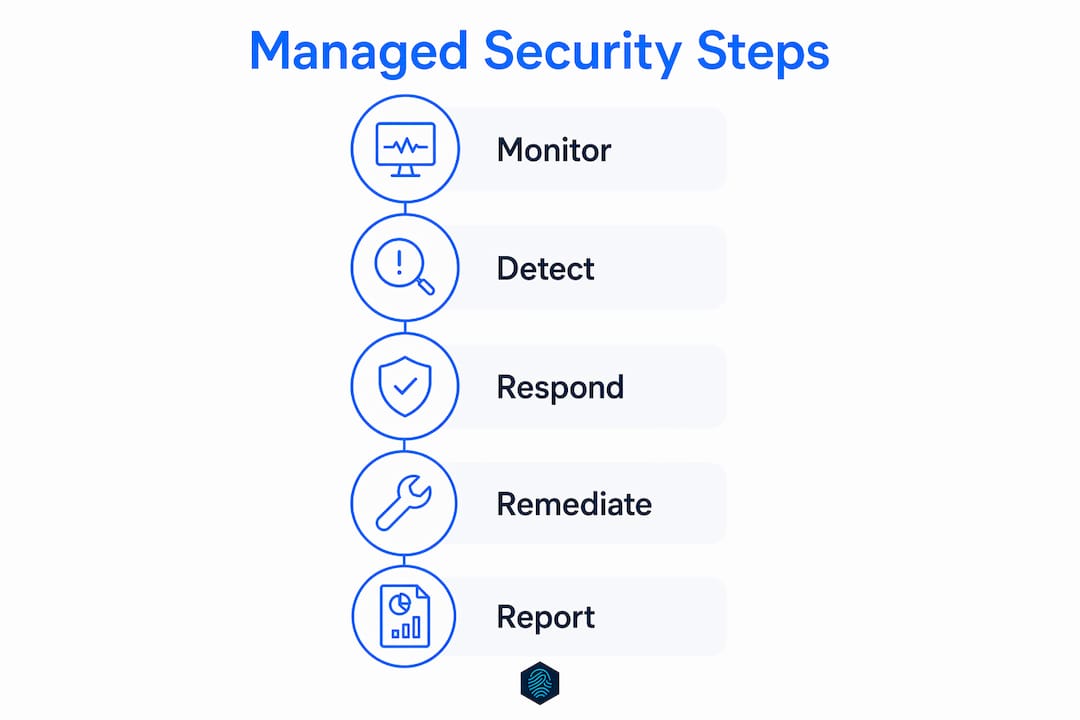
Why choose managed security: benefits that move the needle
The financial and operational case for managed security is concrete, not theoretical. Here are the six strongest reasons SMB decision-makers choose to outsource security:
-
Faster breach detection and containment. 24/7 monitoring and incident response reduce dwell time, the window between a breach and its discovery. Shorter dwell time means less damage and lower recovery costs.
-
Lower total cost than building in-house. Hiring a full security team with a SOC analyst, threat hunter, and compliance officer costs far more than an MSSP contract. Expert-led MSSP protection reduces costs compared to internal teams, especially for businesses under 500 employees.
-
Access to scarce talent. The cybersecurity workforce shortage means qualified candidates are expensive and hard to retain. MSSPs give you access to a bench of specialists without the recruiting burden.
-
Proactive security posture. Managed security shifts organizations from reactive to proactive, treating security as a strategic business function rather than a cost center. That shift matters when regulators or enterprise clients audit your controls.
-
Compliance support built in. MSSPs with experience in HIPAA, PCI-DSS, or SOC 2 reduce the time your team spends on audit preparation. They maintain documentation and reporting that regulators expect.
-
Scalability as you grow. A startup with 10 employees and a company with 200 face different threat surfaces. MSSP contracts scale with your business, adding coverage for new cloud environments, remote workers, or acquired entities without a full security rebuild.
The financial impact of a data breach at $4.44 million average cost makes one point clear: the cost of prevention is a fraction of the cost of recovery. For most SMBs, a single serious incident would be existential.
How do you evaluate and select an MSSP?
Choosing the right managed security provider is where most SMBs make their biggest mistakes. The tendency is to compare feature lists and pricing tiers. That approach misses what actually determines security outcomes.
Response quality and accountability matter far more than software tool checklists. A provider running best-in-class SIEM tools but staffed with junior analysts who take hours to respond delivers worse outcomes than a smaller firm with senior responders and clear escalation paths.
Key criteria to evaluate
Use this comparison framework when assessing MSSP candidates:
| Evaluation Area | What to Look For |
|---|---|
| Response model | Active remediation vs. alert-only notification |
| SLA commitments | Defined response times for critical, high, and medium severity incidents |
| Reporting transparency | Executive dashboards plus technical logs, not just monthly PDFs |
| Compliance experience | Proven track record with your specific regulatory framework |
| Workflow integration | Compatibility with your ticketing, SIEM, or IT management tools |
| Communication fit | Dedicated account contact, not a rotating help desk queue |
Alert fatigue is a real operational risk when internal teams receive hundreds of notifications they cannot act on. Before signing any contract, define exactly who is responsible for remediation. If that responsibility sits with your team, confirm you have the capacity to execute.
Also ask about industry-specific experience. An MSSP that primarily serves healthcare clients understands HIPAA audit trails. One focused on retail knows PCI-DSS card data environments. Generic providers can cover the basics, but regulated industries need specialists.
Pro Tip: Request a sample incident report from any MSSP before signing. The quality of that document tells you more about their operational maturity than any sales presentation.
How does managed security work in practice?
Integrating managed security into your business is a process, not a one-time purchase. Managed security is not a set-and-forget product. Successful buyers treat it as an ongoing partnership with defined roles, regular reviews, and continuous improvement.
Here is how a practical integration typically looks for an SMB:
- Define the scope upfront. Decide which assets the MSSP monitors: servers, endpoints, cloud workloads, email, or all of the above. Scope creep in either direction creates gaps or unnecessary cost.
- Assign internal ownership. Designate one person internally, often an IT manager or operations lead, as the primary liaison with the MSSP. That person owns escalations and communicates business context the MSSP cannot know on its own.
- Establish reporting cadence. Monthly executive summaries and weekly technical reviews keep both sides aligned. MSSPs that provide executive-level insights beyond raw tool data help leadership make informed decisions about risk tolerance.
- Review and tune regularly. Threat environments change. A rule set that worked in January may generate false positives by June. Schedule quarterly reviews to adjust detection logic, update asset inventories, and revisit SLAs.
- Use managed security to support continuity. Pair your MSSP coverage with a solid backup and recovery plan. Security and cloud security best practices work together. One without the other leaves gaps.
Common service bundles for SMBs include SOC monitoring plus EDR, vulnerability scanning plus compliance reporting, or email security filtering plus incident response. Start with the bundle that addresses your highest-risk area, then expand coverage as your security program matures.
MSSPs augment internal IT teams with 24/7 cybersecurity operations, which means your existing staff can focus on business-enabling IT work rather than chasing alerts. That division of labor improves both security outcomes and team morale.
Key takeaways
Managed security delivers the most value when buyers treat it as a strategic partnership, not a vendor relationship.
| Point | Details |
|---|---|
| MSSP vs. MSP distinction | MSSPs specialize in 24/7 threat detection and response; MSPs handle general IT support. |
| Financial justification | At $4.44 million average breach cost, MSSP contracts are a fraction of recovery expenses. |
| Response model matters most | Prioritize active remediation over alert-only services to avoid internal overload. |
| Co-managed is a valid option | SMBs with some IT staff can use co-managed models to fill specific security gaps. |
| Ongoing tuning is required | Review SLAs, detection rules, and asset scope quarterly to keep coverage effective. |
Why most smbs get managed security wrong from the start
I have seen the same pattern repeat across dozens of SMB security conversations. A business owner hears "managed security" and pictures a magic shield that activates the moment they sign a contract. That mental model is the root cause of most disappointments.
The businesses that get real value from managed security are the ones that treat it like hiring a senior security advisor, not buying a software subscription. They show up to monthly reviews. They ask hard questions about what the MSSP actually did when an alert fired at 2 a.m. They push back when reports are full of metrics but light on interpretation.
The other mistake I see constantly is confusing an MSP that added a security module to its service catalog with a true MSSP. Those are fundamentally different operations. One has a SOC. The other has a help desk that also handles antivirus renewals. The price difference is real, but so is the protection difference.
My honest recommendation: before you evaluate a single vendor, build a one-page internal document that lists your top five security risks, your regulatory obligations, and who internally owns the response when an incident occurs. Walk into every MSSP conversation with that document. The providers who engage seriously with it are the ones worth your time. The ones who pivot immediately to their feature list are not.
Proactive security culture does not come from a contract. It comes from leadership treating security as a business priority, not an IT checkbox. Managed security gives you the tools and the team. The culture shift is yours to make.
— Ihor
Protect your business with inSave hosting's security features
inSave Hosting builds security directly into every hosting plan, so you are not starting from zero when you add managed security services on top. Every plan includes free SSL certificates, 24/7 uptime monitoring, and LiteSpeed-powered infrastructure designed to reduce your attack surface from day one. For WordPress sites, inSave Hosting offers hardened configurations and WordPress hosting plans that integrate with your broader security strategy. If you are ready to add a foundational layer of protection, explore shared hosting plans with built-in security features, or check out SSL certificate options to secure your data in transit. Start with a solid hosting foundation, then layer your MSSP coverage on top.
FAQ
What is the managed security definition in simple terms?
Managed security is a service where an external provider continuously monitors and protects your business's networks, devices, and data against cyber threats. It replaces or supplements an internal security team with 24/7 expert coverage.
What is the difference between an MSP and an MSSP?
An MSP handles general IT support like software updates and help desk tickets, while an MSSP specializes in cybersecurity with dedicated SOC analysts, threat detection, and incident response. Treating them as the same leads to serious security gaps.
Why use managed security instead of hiring in-house?
The global cybersecurity workforce gap of 4.8 million unfilled roles makes in-house hiring expensive and unreliable. MSSPs provide immediate access to a full security team at a fraction of the cost of building one internally.
How does managed security work for small businesses?
Small businesses typically start with a co-managed or bundled MSSP service covering SOC monitoring, EDR, and email security. The MSSP handles detection and response while the internal IT contact manages escalations and business context.
What are the biggest risks when choosing an MSSP?
Alert fatigue and unclear remediation responsibility are the top risks. If your MSSP only sends alerts and your team lacks the capacity to act on them, you get the cost of managed security without the protection.