
TL;DR:
- Disaster recovery involves restoring IT systems and data after disruptions to minimize downtime.
- A tested plan defines recovery time and data loss thresholds, helping businesses restore operations quickly.
Disaster recovery is the structured process of restoring IT systems, data, and infrastructure after an unplanned disruption. The role of disaster recovery extends far beyond retrieving lost files. It defines how fast your business gets back online, how much data you can afford to lose, and whether customers ever notice the outage at all. Two metrics govern every plan: Recovery Time Objective (RTO), which sets the maximum acceptable downtime, and Recovery Point Objective (RPO), which defines the furthest back in time you can restore data without serious harm. Regulatory frameworks, insurance requirements, and customer contracts increasingly treat a documented disaster recovery plan not as optional but as a baseline expectation.
What are the core components of a disaster recovery plan?

A disaster recovery plan is a documented, tested set of procedures that guides an organization from the moment of disruption to full operational restoration. Without that structure, recovery becomes improvised, slow, and expensive.
Every effective plan contains six core components:
- Risk assessment — Identify threats specific to your environment: hardware failure, ransomware, natural disasters, or power loss.
- Business Impact Analysis (BIA) — Quantify the operational and financial consequences of each system going offline. BIA is the most critical and most frequently skipped phase in disaster recovery planning.
- RTO and RPO determination — Set recovery time and data loss thresholds for each system. RTO and RPO can range from minutes to weeks depending on how critical a process is to the business.
- Recovery strategies — Define the technical methods: failover systems, cloud replication, off-site backups, or hot standby servers.
- Communication plan — Specify who notifies whom, through which channels, and in what order during an incident.
- Testing and maintenance schedule — Commit to regular drills that go beyond tabletop exercises.
Disaster recovery vs. business continuity
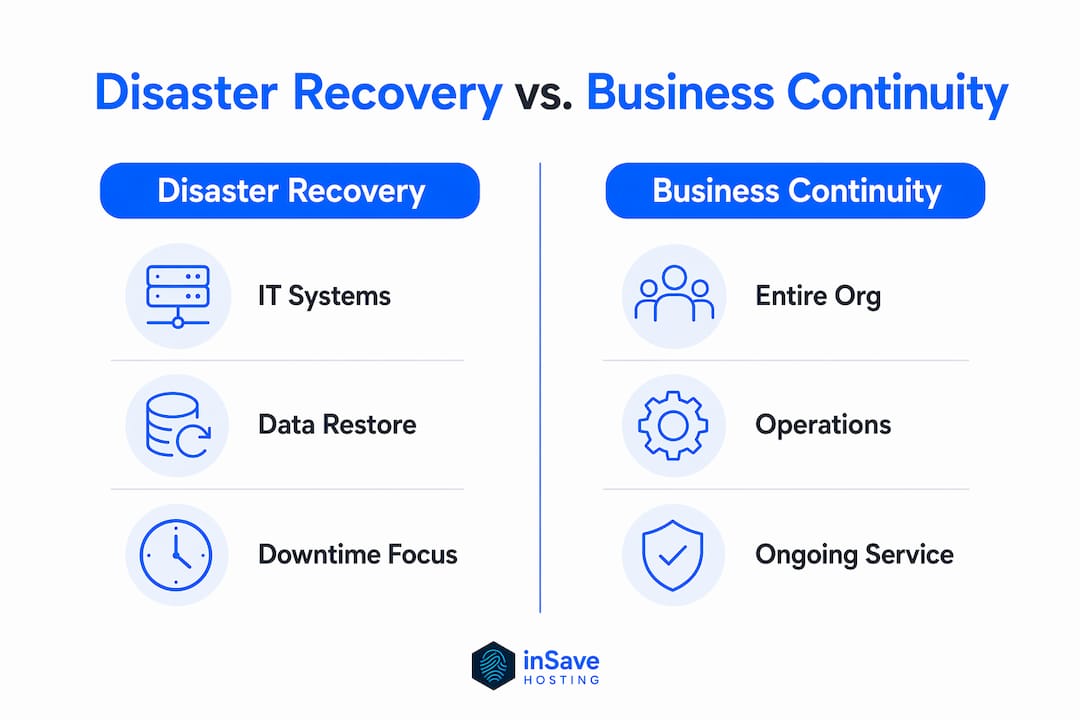
Disaster recovery and business continuity are related but distinct. Disaster recovery (DR) focuses on restoring IT systems and data after a disruption. Business continuity planning (BCP) addresses how the entire organization keeps operating during and after that disruption, including people, processes, and facilities.
| Dimension | Disaster recovery | Business continuity |
|---|---|---|
| Primary focus | IT systems and data restoration | Full organizational operations |
| Triggered by | Technical failure or data loss event | Any disruption to business operations |
| Key metrics | RTO and RPO | Recovery Time Objective plus operational KPIs |
| Ownership | IT department | Cross-functional leadership team |
| Output | Restored systems | Sustained business functions |
Pro Tip: Write your disaster recovery plan so that a competent team member with no prior DR experience can execute it. If it requires institutional knowledge to follow, it will fail under pressure when key staff are unavailable.
How does disaster recovery minimize downtime and financial loss?
The financial case for disaster recovery planning is direct. 54% of organizations reported that their most recent significant IT outage cost more than $100,000, with 6% facing costs above $1 million. That figure covers lost revenue, staff time, emergency vendor fees, and reputational damage that is harder to quantify but just as real.
The 2025 State of Resilience report puts the range in sharper focus. Businesses lose between $10,000 and more than $1,000,000 per outage depending on size and industry. A defined RTO converts that open-ended exposure into a bounded risk. If your RTO is four hours, your maximum revenue loss from downtime is calculable. Without an RTO, the loss is unlimited.
Backup is necessary but not sufficient. Disaster recovery includes orchestrated restoration of systems, networking, and interdependencies, not just data retrieval. A backup gets your files back. A recovery plan gets your business back.
This distinction matters most when multiple systems fail simultaneously. A ransomware attack rarely hits one server. It spreads across connected systems, corrupts backups that are not properly isolated, and leaves IT teams without a clear restoration sequence. An orchestrated recovery plan defines that sequence in advance, which is why businesses with tested plans restore operations dramatically faster than those relying on backups alone.
Customer trust is also at stake. Every hour of visible downtime signals instability to clients, partners, and prospects. A fast, clean recovery, one that customers barely notice, is itself a brand statement. For businesses that optimize uptime as a competitive metric, disaster recovery is the mechanism that makes that metric defensible.
What best practices should IT leaders follow for disaster recovery planning?
Effective disaster recovery planning follows a clear sequence. Skipping steps early creates gaps that only surface during an actual crisis.
-
Start with a thorough Business Impact Analysis. Map every business process to the systems that support it. Rank processes by revenue impact, regulatory exposure, and customer visibility. This ranking directly determines which systems get the tightest RTOs and RPOs.
-
Set tiered recovery objectives. Not every system needs a one-hour RTO. Prioritizing RTO and RPO by business criticality focuses your budget on the systems that matter most and avoids over-engineering recovery for low-impact processes.
-
Integrate DR with business continuity and incident response. Integrating disaster recovery with business continuity and incident response plans prevents conflicting instructions during a crisis. All three documents should reference each other and assign non-overlapping responsibilities.
-
Run failover simulations, not just tabletop exercises. The most common failure in disaster recovery is not testing regularly. Tabletop exercises identify logical gaps. Failover simulations reveal technical failures that only appear when systems actually switch over.
-
Keep documentation short and executable. A 200-page DR plan is a documentation artifact, not an operational tool. Each procedure should fit on one page with numbered steps, clear decision points, and named contacts.
-
Review and update after every significant change. A new cloud migration, a new SaaS tool, or a new office location all change your recovery dependencies. Plans that are not updated become obsolete and ineffective faster than most IT leaders expect.
Pro Tip: Assign a DR plan owner who is not the CTO or IT director. Senior leaders are often unavailable during the first hours of a crisis. A mid-level IT manager with clear authority and a tested runbook executes faster than a senior leader improvising under pressure.
Understanding why backups alone are insufficient is the first step toward building a plan that actually works. Backups are an input to recovery, not recovery itself.
Is disaster recovery a competitive advantage or just insurance?
Disaster recovery is a strategic survival mechanism, not a technical insurance policy. That reframing changes how business owners should budget for it, staff it, and communicate about it.
The competitive advantage becomes visible during industry-wide disruptions. When a major cloud provider experiences a regional outage, every business in that region faces the same disruption. The ones with tested failover strategies restore service in hours. The ones without them spend days in reactive mode. Effective disaster recovery plans provide a competitive edge by restoring services faster, preserving brand reputation, and maintaining customer trust when competitors cannot.
The strategic benefits of a mature disaster recovery program extend well beyond avoiding downtime:
- Regulatory compliance. Frameworks like SOC 2, ISO 27001, and HIPAA require documented and tested recovery procedures. A compliant DR plan removes a significant audit risk.
- Faster incident response. Pre-defined escalation paths reduce the decision-making burden during a crisis, which directly shortens recovery time.
- Stronger vendor and partner relationships. Enterprise clients and government contracts increasingly require proof of a tested DR plan before signing agreements.
- Lower cyber insurance premiums. Insurers price policies based on demonstrated resilience. A tested plan with documented RTOs signals lower risk.
- Operational clarity. The process of building a DR plan forces organizations to document system dependencies they often do not fully understand until something breaks.
For businesses running on shared or managed hosting, the enterprise network design principles that underpin fast recovery, redundant routing, failover DNS, and geographic distribution, apply at every scale. The tools differ, but the logic is identical.
Key takeaways
A tested, documented disaster recovery plan is the single most effective tool for converting unpredictable outage costs into bounded, manageable risk.
| Point | Details |
|---|---|
| RTO and RPO are the foundation | Set recovery time and data loss thresholds for every critical system before a crisis occurs. |
| BIA drives prioritization | Business Impact Analysis determines which systems get the tightest recovery objectives and the most resources. |
| Backups are not recovery | Orchestrated restoration of systems, networks, and dependencies is required to resume full operations. |
| Testing must be real | Failover simulations reveal failures that tabletop exercises miss; test regularly or the plan becomes obsolete. |
| DR is a competitive tool | Businesses with tested plans restore faster than competitors during industry-wide disruptions, protecting revenue and reputation. |
Why I think most DR plans fail before a crisis even starts
Most disaster recovery plans I have reviewed share the same flaw. They are written to satisfy an audit, not to guide a person under pressure at 2 a.m. when the primary database is down and the team lead is unreachable.
The documentation trap is real. Organizations invest weeks building detailed plans, then file them in a shared drive that no one opens until something breaks. By then, the plan references systems that were decommissioned, contacts who left the company, and procedures that were never tested against the actual infrastructure.
The fix is not a better plan. It is a simpler one. Disaster recovery must be executable by non-experts under crisis conditions. That means short runbooks, clear decision trees, and contacts verified every quarter. The organizations that recover fastest are not the ones with the most detailed plans. They are the ones whose plans are actually used in drills, updated after every infrastructure change, and short enough that anyone on the team can follow them.
If your DR plan requires a specialist to interpret it, it will fail the moment that specialist is unavailable. Simplicity is not a shortcut. It is the whole point.
— Ihor
How inSave Hosting supports your uptime and recovery goals

Downtime is not a hypothetical for small and mid-sized businesses. It is a direct revenue and reputation event. inSave Hosting builds uptime protection into every plan through LiteSpeed servers, free CDN integration, and a 99.9% uptime commitment that gives your infrastructure a reliable foundation before a disruption ever occurs. For WordPress sites, managed WordPress hosting includes staging tools and migration support that reduce recovery complexity when you need to act fast. Pair that with dedicated fiber connectivity and you have the network reliability that fast recovery depends on. Explore inSave Hosting's full hosting plans to find the right foundation for your business continuity strategy.
FAQ
What is the role of disaster recovery in business?
Disaster recovery restores IT systems, data, and infrastructure after unplanned disruptions, minimizing downtime and financial loss. It defines how fast a business returns to normal operations through pre-set RTO and RPO targets.
What is the difference between disaster recovery and business continuity?
Disaster recovery focuses on restoring IT systems after a failure. Business continuity covers how the entire organization, including people and processes, keeps functioning during and after a disruption.
Why are backups not enough for disaster recovery?
Backups restore data but do not address system interdependencies, network configurations, or the sequence needed to bring applications back online. Full recovery requires orchestrated restoration of all connected components.
How often should a disaster recovery plan be tested?
Disaster recovery plans should be tested at least annually through failover simulations, not just tabletop exercises. Plans must also be reviewed and updated after any significant infrastructure change.
What is a Business Impact Analysis and why does it matter?
A Business Impact Analysis (BIA) maps business processes to the systems that support them and ranks them by operational and financial impact. It is the foundation for setting realistic RTO and RPO targets across the organization.