
What are the best single website hosting plans in 2026?
For hosting one website affordably in 2026, IONOS Single Website Hosting and Hostinger Single Website Plan lead on price, while Namecheap's range covers everything from shared hosting to dedicated servers. Every plan worth considering includes a free SSL certificate, at least a 99.9% uptime guarantee, a 30-day money-back guarantee, and 24/7 customer support.
Shared hosting is the most popular web hosting option globally., and for good reason. It's the most affordable entry point, fully managed, and more than capable for a new or small site.
Here's how the top single-site plans stack up:
| Plan | Starting Price | Websites | Storage | SSL | Backups | Support | Best For |
|---|---|---|---|---|---|---|---|
| IONOS Single Website Hosting | $1/mo (12 mo) | 1 | Unlimited | Free | Daily | 24/7 + consultant | Budget-conscious beginners |
| Hostinger Single Website Plan | — | 1 | 50 GB SSD | Free | Weekly | 24/7 live chat | Easy setup, AI tools |
| Namecheap Stellar Shared Hosting | Low intro rate | 1 | 20 GB SSD | Free | Weekly | 24/7 | Individuals, first sites |
| Namecheap Stellar Business Shared Hosting | Mid-tier | 1 | 50 GB NVMe | Free | Daily | 24/7 | Small business sites |
| Namecheap EasyWP Starter Hosting for WordPress | From $2.99/mo | 1 WP site | 10 GB NVMe | Free | Auto | 24/7 | WordPress beginners |
| Namecheap Launch Email Hosting | Low monthly | 1 domain | Email only | Included | — | 24/7 | Branded email add-on |
| Namecheap Magnetar VPS Hosting | ~$6/mo | 1+ | Scalable | Free | Optional | 24/7 | Scaling beyond shared |
| Namecheap Hypernova VPS Hosting | Higher tier | 1+ | More CPU/RAM | Free | Optional | 24/7 | High-demand sites |
| Namecheap Xeon E-2234 Dedicated Hosting | — | Unlimited | Full server | Free | Custom | 24/7 | Enterprise, high traffic |
Why these plans work for individuals and small businesses:
- Free domain registration for the first year on most shared plans
- Free SSL certificates protect visitor data and improve search rankings
- Daily or weekly backups guard against data loss
- 99.9%+ uptime guarantees keep your site accessible around the clock
- 30-day money-back guarantees let you test without financial risk
- 24/7 support via live chat or phone means help is always available
How do these single-site hosting plans compare in detail?
The gap between plans widens when you look past the headline price. Here's where each option actually earns or loses points.
IONOS Single Website Hosting starts at $1/month for the first 12 months, which is genuinely hard to beat. Every account gets a personal consultant, daily backups, free SSL, and a free domain. The catch is that IONOS's renewal pricing rises after the introductory term, so calculate your second-year cost before committing.
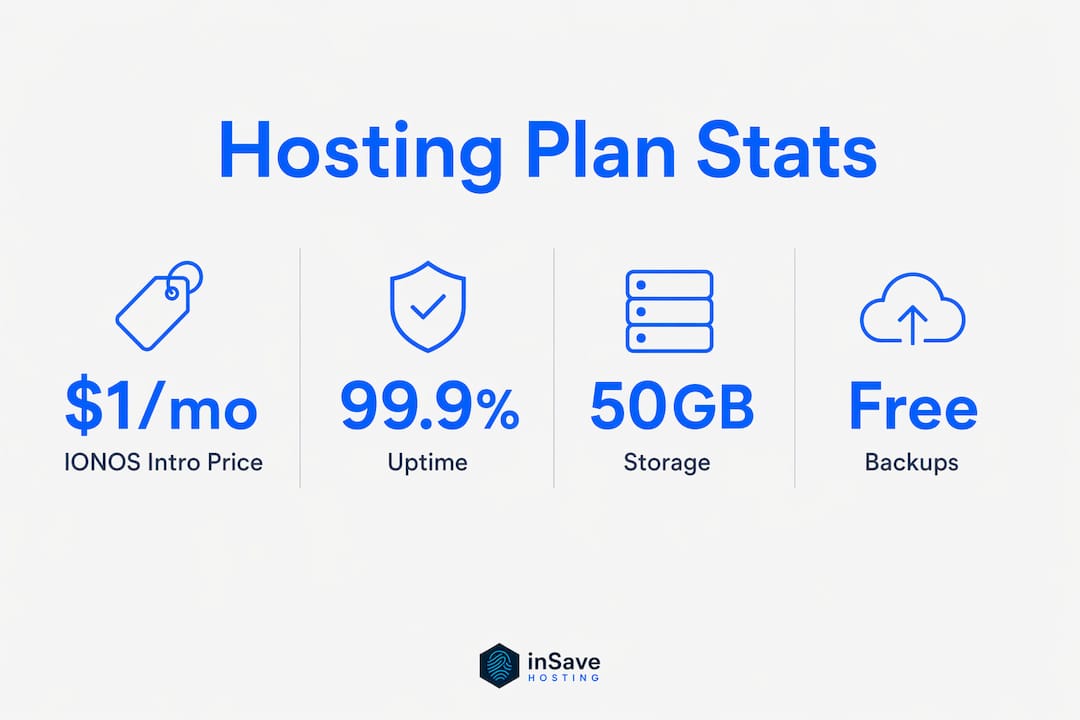
Hostinger Single Website Plan pairs a low starting price with an AI-powered website builder, managed WordPress support, and NVMe SSD storage. Renewal rates for Hostinger run around $10.99–$11.99/month, which is among the lower renewal rates of major hosts. Weekly backups are included on all plans.

Namecheap Stellar Shared Hosting suits someone building their first site on a tight budget. It covers one website with 20 GB SSD storage, a free domain for year one, and free SSL. Support is solid, and the price stays accessible even at renewal.
Namecheap Stellar Business Shared Hosting steps up to 50 GB NVMe storage and daily backups, making it the better pick for a small business site that handles more traffic or stores more files. The NVMe drives deliver noticeably faster load times than standard SSDs.
Namecheap EasyWP Starter Hosting for WordPress is a managed WordPress plan, meaning Namecheap handles core updates, security patches, and automatic backups. Managed WordPress hosting typically starts at low monthly rates for semi-managed plans., and EasyWP Starter sits in that range. If you want to build a WordPress site without touching server settings, this removes most of the friction.
Namecheap Launch Email Hosting is not a full website hosting plan. It pairs with a domain to give you professional branded email, spam protection, and a clean inbox. Think of it as a complement to a hosting plan, not a replacement.
Namecheap Magnetar VPS Hosting and Namecheap Hypernova VPS Hosting are for sites that have outgrown shared hosting. Entry-level VPS hosting generally falls within a moderate monthly cost range., and Magnetar sits at the lower end of that range. Hypernova adds more CPU and memory for sites with heavier traffic or custom applications. Both require some comfort with server management, though managed options are available.
Namecheap Xeon E-2234 Dedicated Hosting is a full dedicated server with Xeon processing power, complete resource isolation, and maximum customization. Dedicated servers typically begin at higher monthly price points. and suit enterprise users or high-traffic sites that have exhausted VPS options. Most single-site owners will never need this level.
Pro Tip: Before signing up for any plan, check the renewal price, not just the introductory rate. Renewal rates can run 2–4 times the signup price, so a plan that looks cheap in year one can double your costs by year two.

How to choose the right web hosting plan for one website
The single biggest mistake buyers make is choosing a plan based on the introductory price alone. Experts recommend calculating the 3-year total cost of ownership before committing, because renewal rates often land 2–4 times higher than the signup rate.
Beyond price, here are the criteria that actually matter for a single-site owner:
- Budget (real cost): Factor in renewal pricing, not just the first-term deal. A $1.99/month intro rate that renews at $12/month changes the math significantly over three years.
- Technical skill: Shared hosting requires almost none. VPS and dedicated plans require progressively more server knowledge.
- Uptime guarantee: Look for 99.9% minimum with a real SLA. Vague uptime claims with no compensation policy are a red flag.
- Storage and bandwidth: Most single sites need under 20 GB of storage. Unlimited claims often come with fair-use limits buried in the terms.
- Security: Free SSL, daily or weekly backups, and malware scanning are the baseline. Plans that charge extra for backups should be viewed with skepticism.
- Support quality: 24/7 live chat and phone support remain the top trust signals for individual and small business site owners. A host with only ticket-based support can leave you waiting hours during an outage.
- Scalability: Check whether upgrading to a higher plan is straightforward. Migrating from shared to VPS or dedicated hosting is often smooth with modern providers, but confirm the process before you sign up.
Common red flags to avoid:
- No stated uptime guarantee or SLA
- Backups sold as a paid add-on rather than included
- Support limited to email tickets with no live chat option
- Renewal pricing buried in fine print or not listed at all
- "Unlimited" storage claims with no fair-use policy disclosed
For most individuals and small business owners hosting one site, shared hosting handles sites with fewer than around 25,000 monthly visitors comfortably, costs the least, and requires no server management. Managed WordPress hosting is the right step up if your site runs on WordPress and you want automatic updates and backups handled for you. VPS makes sense when traffic grows or you need custom server software.
Migrating an existing website to a new host is rarely as complicated as it sounds. Most reputable hosts offer free migration assistance, and the process typically takes a few hours rather than days.
What does "1 website" actually mean in a hosting plan?
When a hosting plan says it supports "1 website," it means you can host one domain and its associated content under that account. That single domain can still have multiple subdomains (like blog.yoursite.com or shop.yoursite.com), so the restriction is on root domains, not on the structure of your site.
Single website plans typically include one main database, a specified storage quota, email accounts tied to that domain, and free SSL for the primary domain. Here's what that usually covers in practice:
- One domain: You can point one registered domain to the hosting account.
- Subdomains: Most plans allow multiple subdomains under the single domain.
- Storage: Ranges from 10 GB on entry plans to 50 GB or more on business tiers.
- Databases: Entry shared plans often include one or a few databases; business plans typically offer more.
- Email accounts: Usually tied to the single domain, with limits varying by plan.
- SSL certificate: Free on virtually every current plan, covering the primary domain and often subdomains.
- Backups: Daily or weekly depending on the plan tier.
The practical implication is that a "1 website" plan is purpose-built for focus. You get resources sized for one site, which keeps costs low and management simple. If you later need to add a second domain, you'd need to upgrade to a multi-site plan or open a second account.
On shared hosting, your site shares server resources with other sites on the same machine. That's fine for most small sites, but if traffic spikes heavily, you may notice slower load times. VPS and dedicated plans give your site its own resource allocation, eliminating that variability. For a new or small site, shared hosting is the most affordable and beginner-friendly starting point, freeing you to focus on your content rather than server maintenance.
Pro Tip: If you're unsure how much storage you need, check your current site's file size in your file manager or cPanel. Most small business sites use well under 5 GB, making even entry-tier plans more than adequate.
inSave Hosting is worth a look before you decide
If the providers compared above feel like a lot to sort through, inSave Hosting offers a straightforward alternative worth considering. It's built specifically for individuals and small business owners who want affordable shared hosting with real performance features, not just a low sticker price.
inSave Hosting runs on LiteSpeed servers with LSCache, MariaDB, HTTP/2, PHP8, and free CDN integration, which means faster page loads without any configuration on your end. Every plan includes a free SSL certificate, one year of free domain registration, and 99.9% uptime. WordPress hosting is available with one-click installation, staging tools, and managed security features. Free migration is included, so moving an existing site over doesn't require technical expertise. For small business owners who want a hosting provider that handles the technical side while keeping costs predictable, inSave Hosting is a solid option to put alongside the names in this comparison.
FAQ
What is single website hosting?
Single website hosting is a plan that lets you host one domain and its associated files, subdomains, and email accounts under one hosting account. It's designed for individuals or small businesses that need a straightforward, cost-effective setup for one site.
How much does web hosting cost for one site?
Shared hosting introductory pricing typically runs $1.99–$15/month, with renewal rates of $7–$20/month. Managed WordPress plans start around $2.99/month for semi-managed options, and VPS hosting runs $6–$30/month.
What's the best web hosting for beginners?
IONOS Single Website Hosting and Hostinger Single Website Plan are strong starting points for beginners, offering low entry prices, free SSL, free domains, and 24/7 support with no technical setup required.
Is 1&1 (IONOS) a reliable web hosting provider?
Yes. IONOS, formerly 1&1, offers a 99.9% uptime guarantee, daily backups, free SSL, and assigns a personal consultant to every account, making it a dependable choice for single-site hosting.
How do I avoid surprise costs when choosing a hosting plan?
Calculate the total cost over three years, not just the first-term price. Renewal rates often increase significantly after the introductory period, so a plan that looks cheap at signup may cost significantly more by year two.
Key Takeaways
For a single website in 2026, shared hosting is the right starting point for most owners: affordable, fully managed, and capable of handling sites with fewer than around 25,000 monthly visitors without any server expertise.
| Point | Details |
|---|---|
| Renewal pricing matters most | Renewal rates often run 2–4 times higher than the introductory price, typically falling in the $7–$15/month range, so calculate your 3-year total cost before signing up. |
| Shared hosting fits most single sites, handling typical small website traffic comfortably at low introductory pricing. | |
| Security baseline to require | Every plan should include a free SSL certificate, regular backups, and 24/7 support as standard. |
| When to upgrade beyond shared | Move to VPS ($6–$30/month) when traffic grows or you need custom server software. |
| inSave Hosting as an alternative | inSave Hosting offers LiteSpeed-powered shared and WordPress hosting with free SSL, free domain, and 99.9% uptime for small business owners. |