
TL;DR:
- A top-level domain is the last segment of a domain name, such as .com or .org, and it determines website categorization. There are over 1,400 recognized TLDs governed by ICANN and IANA, with many niche extensions added over the years. The choice of TLD influences trust, branding, regional targeting, renewal costs, and eligibility, affecting your website’s perception and performance.
A top-level domain (TLD) is the final segment of a domain name appearing after the last dot, such as .com, .org, or .net. It sits at the highest level of the Domain Name System (DNS) hierarchy and tells the internet how to categorize and locate your website. Two organizations govern the TLD space: ICANN (Internet Corporation for Assigned Names and Numbers) sets global policy, and IANA (Internet Assigned Numbers Authority) maintains the official root zone database. There are currently 1,437 recognized TLD extensions in the IANA root zone, with some sources counting over 3,500 variations including niche extensions. That number shows just how much the domain space has grown beyond the original handful of extensions most website owners recognize.
What is a TLD and what are the main types?
TLDs are grouped into five main categories: generic, country-code, sponsored, internationalized, and infrastructure. Each type serves a different purpose and carries different registration rules.

Generic TLDs (gTLDs)
Generic TLDs are the most widely used extensions on the internet. The most recognized examples are .com (commercial), .net (network), and .org (organization). These extensions carry no geographic restriction, so anyone anywhere can register them. The .com extension remains the default choice for most businesses because of its global familiarity and user trust.
Country-code TLDs (ccTLDs)
Country-code TLDs represent specific geographic regions. Examples include .us (United States), .uk (United Kingdom), .ca (Canada), and .de (Germany). Many ccTLDs enforce residency or physical presence requirements for registration. A website using .ca signals to visitors that it serves a Canadian audience, which can strengthen local credibility.
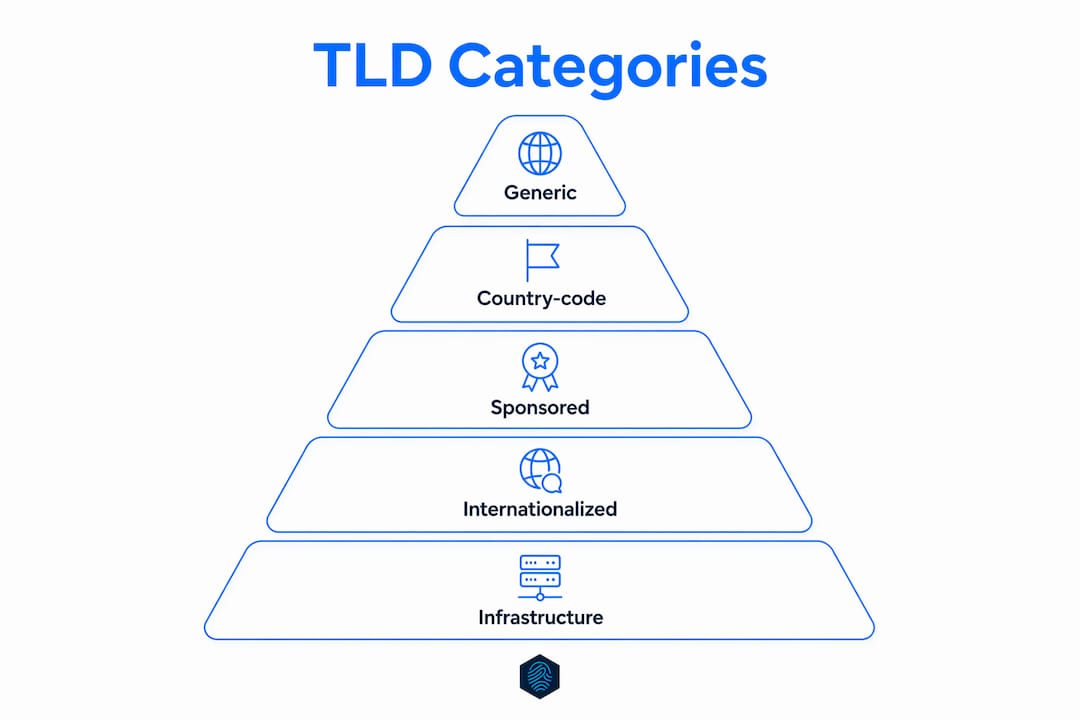
Sponsored TLDs (sTLDs)
Sponsored TLDs are managed by private organizations that vet eligibility based on community themes. The .gov extension is reserved for U.S. government entities. The .edu extension is limited to accredited educational institutions. These extensions carry strong trust signals precisely because access is restricted.
Internationalized domain names (IDN ccTLDs)
IDN ccTLDs allow domain names written in non-Latin scripts, such as Arabic, Chinese, or Cyrillic characters. They follow the same country-code logic but serve audiences whose native languages use different writing systems. This category has expanded significantly as internet access has grown in non-English-speaking regions.
Infrastructure TLDs
The .arpa extension is the only infrastructure TLD. It handles technical internet operations, specifically reverse DNS lookups. Website owners never register .arpa domains. It exists purely to keep the internet's internal systems running.
How do TLDs work within the DNS?
The DNS is a hierarchical system that translates domain names into IP addresses so browsers can load websites. TLDs sit at the top of that hierarchy, directly below the DNS root. Understanding this process helps you see why TLDs are not just labels but active participants in every page load.
The DNS resolution process works in steps:
- You type a domain name into your browser, such as example.net.
- Your browser contacts a recursive DNS resolver, which acts as a middleman.
- The resolver queries the DNS root servers, which point it to the correct TLD server.
- The TLD server for .net then directs the resolver to the authoritative name server for that specific domain.
- The authoritative name server returns the IP address.
- Your browser connects to that IP address and loads the website.
Each step takes milliseconds. The TLD server is the critical routing point in step four. Without it, the resolver would have no way to find the right authoritative server among billions of registered domains.
Pro Tip: If you want a deeper look at how DNS affects your website's performance and reliability, the DNS management guide from inSave Hosting covers the full picture in plain language.
Why does your TLD choice matter for your website?
The TLD you pick shapes how visitors perceive your site before they even click a link. Technical performance is consistent across TLDs, but credibility and recognition are not. A .com address signals a general commercial website to most internet users worldwide. A .gov or .edu address signals authority and restricted access. A niche extension like .tech or .ai tells visitors immediately what industry you operate in.
Here is what your TLD choice directly affects:
- Credibility. Visitors trust .com, .org, and .gov more than unfamiliar extensions. A new visitor landing on a .xyz domain may hesitate before entering personal information.
- Branding. TLDs help convey website purpose, geographic location, or the sponsoring organization. A nonprofit using .org reinforces its identity with every link shared.
- Regional targeting. A ccTLD like .ca or .uk tells search engines and users that your site serves a specific country. This can improve local search visibility.
- Industry signaling. Extensions like .tech, .ai, .store, or .law communicate your niche without a single word of copy.
- Renewal costs. Promotional registration rates can be low initially, but renewals may run 3–5 times higher. Specialized or niche TLDs sometimes exceed $100 per year on renewal. That gap catches many first-time website owners off guard.
- Eligibility restrictions. Some TLDs require proof of residency, business registration, or organizational status. Registering without meeting those requirements risks losing the domain at renewal.
Pro Tip: Always check the renewal price before you register a domain, not after. A $1.99 first-year deal that renews at $89.99 is a budget trap.
The SEO angle is worth clarifying directly. Google has stated that generic TLDs carry no inherent ranking advantage over each other. A .com does not outrank a .net or .org by default. What matters is the site's content, authority, and technical setup. The trust perception among human visitors, however, is real and measurable in user behavior.
How to choose the right TLD for your website
Choosing a TLD comes down to four factors: your audience, your brand, your industry, and your budget. Get those four right and the decision becomes straightforward.
Match the TLD to your purpose
A business selling products globally should default to .com. A nonprofit organization fits .org. A local service business in Canada benefits from .ca. A tech startup building credibility in the developer community might choose .io or .tech. The right domain extension reinforces what your site does before a visitor reads a single headline.
Check registration policies before you commit
Some ccTLDs enforce residency rules that can result in losing your domain if you fail to meet them at renewal. Read the registry's terms before purchasing. This is especially true for country-code extensions outside your home country.
Compare registration and renewal costs
| TLD type | Typical first-year cost | Typical renewal cost |
|---|---|---|
| Popular gTLDs (.com, .net, .org) | Low to moderate | Stable and predictable |
| Niche gTLDs (.tech, .ai, .store) | Often discounted | Can exceed $100 per year |
| ccTLDs (.us, .ca, .uk) | Varies by registry | Generally stable |
| Sponsored TLDs (.gov, .edu) | Restricted access | Not publicly available |
The table above shows why renewal cost matters more than registration cost. A niche TLD that costs $2.99 to register but $110 to renew is not a bargain.
- For a personal blog: .com or .blog keeps things simple and familiar.
- For a nonprofit: .org signals mission-driven work immediately.
- For a local business: a ccTLD matching your country builds regional trust.
- For a tech product: .io or .tech communicates industry focus clearly.
Pro Tip: Renewal policies vary by registry. Read the terms before purchasing any domain, especially niche or country-code extensions.
Common misconceptions about TLDs
Several persistent myths about TLDs lead website owners to make poor decisions. Clearing them up saves time and money.
The biggest myth is that TLDs affect website speed or hosting quality. They do not. Your hosting provider, server location, and technical configuration determine speed. The TLD is purely a naming and routing label.
A second misconception is that .com domains are always available if you just try enough variations. The .com namespace is heavily registered. Many desirable .com names are taken, parked, or held by domain investors at premium prices. Checking availability early in your branding process avoids wasted effort.
"Not every domain has a subdomain; second-level domains are the most memorable part of a domain name, situated before the TLD."
Understanding domain structure matters for avoiding confusion. In the address developer.mozilla.org, "developer" is the subdomain, "mozilla" is the second-level domain (SLD), and ".org" is the TLD. The SLD is what you register and own. The TLD is the category it belongs to. A subdomain is a prefix you create yourself after registration.
A third myth is that newer or niche TLDs carry SEO penalties. Search engines treat all generic TLDs equally for ranking purposes. The real risk with unusual extensions is user hesitation, not algorithmic punishment. Visitors may simply trust a .com more than a .xyz, which affects click-through rates and time on site.
Finally, many website owners ignore renewal policies until it is too late. Domains that lapse can be snapped up by competitors or domain squatters within hours of expiration. Set auto-renewal and keep your payment information current with your registrar.
Key takeaways
A TLD is the final segment of a domain name that defines its category, signals its purpose, and plays a direct role in DNS routing, making it one of the most consequential choices a website owner makes before launch.
| Point | Details |
|---|---|
| TLD definition | A TLD is the last part of a domain name, such as .com or .org, managed by ICANN and IANA. |
| Five TLD types | Generic, country-code, sponsored, internationalized, and infrastructure TLDs each serve distinct purposes. |
| DNS role | TLD servers route DNS queries to the correct authoritative name server during every page load. |
| Renewal cost risk | Niche TLDs can cost over $100 per year at renewal, far above their discounted registration price. |
| TLD and SEO | Search engines treat generic TLDs equally for ranking, but user trust perception still varies by extension. |
Why TLD choices matter more than most beginners realize
I have watched website owners spend weeks on logo design and minutes on domain selection. That order is backwards. The TLD you pick follows your brand for as long as the site exists. Changing it later means rebuilding links, updating every mention across the web, and potentially losing search visibility you spent years earning.
The expansion of the TLD space over the past decade has been genuinely useful for niche businesses. A law firm using .law or a design studio using .design communicates something instantly that a generic .com cannot. But that benefit comes with a catch: many of these newer extensions carry renewal prices that are not obvious at registration. I have seen small business owners register a .ai domain for $4.99 and then face a $79.99 renewal bill twelve months later.
My practical advice is this: if your brand works with .com, use it. The familiarity advantage is real, especially for audiences outside the tech world. If .com is unavailable and a niche TLD genuinely fits your brand, go for it. Just read the renewal terms first and budget accordingly. The domain selection process deserves the same attention you give your hosting plan and your content strategy.
The ccTLD question is worth one more note. If you serve a local market, a country-code extension can strengthen your regional credibility. But verify the eligibility rules before you register. Losing a domain because you failed a residency check is an avoidable problem that I have seen derail more than one small business launch.
— Ihor
Domain registration made straightforward with inSave Hosting
Picking the right TLD is only the first step. You also need a registrar that shows you the full cost upfront, including renewal pricing, and gives you the tools to manage your domain without surprises.
inSave Hosting offers domain registration across popular extensions including .com, .org, and .net, with transparent pricing on both registration and renewal. The platform includes domain management tools alongside affordable hosting plans built for small businesses and first-time website owners. Free SSL certificates, 99.9% uptime, and one-year free domain registration come standard with qualifying hosting packages. If you already have a domain elsewhere, inSave Hosting also handles domain transfers with support at every step.
FAQ
What does TLD stand for?
TLD stands for top-level domain. It is the last segment of a domain name, such as .com, .org, or .net, and sits at the highest level of the DNS hierarchy.
How many TLDs exist?
There are currently 1,437 recognized TLD extensions in the IANA root zone, with some sources counting over 3,500 variations including niche and new generic extensions.
Does my TLD affect my Google ranking?
Google treats all generic TLDs equally for ranking purposes. The TLD itself does not boost or penalize rankings, but user trust and click-through behavior can vary based on how familiar the extension is.
What is the difference between a TLD and a second-level domain?
The TLD is the final segment of a domain name, such as .org. The second-level domain (SLD) is the part directly before it, such as "mozilla" in mozilla.org. The SLD is what you register and own.
Can anyone register any TLD?
Generic TLDs like .com and .net are open to anyone. Sponsored TLDs like .gov and .edu have strict eligibility requirements. Many ccTLDs enforce residency rules that restrict registration to residents or businesses operating in that country.