
You might assume that launching a web hosting business requires expensive servers, technical expertise, and significant upfront investment. Reseller hosting flips this assumption on its head. It allows entrepreneurs to enter the hosting market with minimal capital and zero server management responsibilities. By purchasing hosting resources in bulk and reselling them under your own brand, you can build recurring revenue streams while your provider handles the technical infrastructure. This guide breaks down what reseller hosting is, how it compares to alternatives like VPS, and how you can leverage it to grow your business in 2026.
Table of Contents
- What Is Reseller Hosting? Definition And Core Concepts
- How Reseller Hosting Works: Structure, Resources, And Management
- Reseller Hosting Vs VPS: Pros, Cons, And Who Should Choose Which
- Maximizing Profits And Success With Reseller Hosting In 2026
- Explore Reseller Hosting Plans At InSave Hosting
- What Is Reseller Hosting? Frequently Asked Questions
Key takeaways
| Point | Details |
|---|---|
| Reseller hosting lets you sell web hosting services under your brand | You purchase resources from a provider and create hosting accounts for clients without managing servers |
| Pricing typically ranges from $10-100 monthly depending on plan size | Profit margins can reach 40-90% as you scale by charging clients $10-50 per account |
| Minimal technical management required compared to VPS or dedicated servers | Provider handles server maintenance, security, and infrastructure while you manage client accounts |
| Shared resources may limit performance versus VPS solutions | Multi-tenancy can cause slowdowns, making VPS better for high-traffic or resource-intensive sites |
| Best suited for startups and agencies seeking low-risk market entry | Ideal for freelancers, web designers, and small businesses wanting to offer hosting services |
What is reseller hosting? Definition and core concepts
Reseller hosting involves purchasing web hosting resources from a provider and selling hosting accounts to clients under your own brand. Instead of investing in physical servers or managing complex infrastructure, you buy a reseller plan that allocates you specific amounts of storage, bandwidth, and processing power. You then divide these resources among your clients, creating individual hosting accounts they access as if you were the primary hosting company.
This model serves as a low-cost entry point compared to owning physical servers or VPS servers. Reseller hosting plans typically cost $10-100 monthly depending on the resources included. Starter plans usually run $10-20 per month, while enterprise-level packages can reach $100 monthly. You can charge clients $10-50 per month for their hosting accounts, creating profit margins between 40-90% as your customer base grows.
The beauty of reseller hosting lies in its simplicity. Most plans include management tools that handle customer hosting accounts without requiring deep technical skills. You gain brand control, build recurring revenue streams, and avoid the headaches of server management. The typical users are agencies managing multiple client websites, freelancers offering bundled web services, and entrepreneurs launching new hosting businesses.
Key benefits include:
- Complete white-label branding so clients see only your company name
- Control panels like WHM and cPanel that simplify account creation and management
- Scalable resources that grow with your business needs
- Recurring monthly revenue from client subscriptions
- No need to hire server administrators or security specialists
For entrepreneurs exploring reliable hosting examples, reseller hosting removes technical barriers while preserving profitability. You focus on customer acquisition and support while your provider maintains the underlying infrastructure.
How reseller hosting works: structure, resources, and management
Reseller hosting builds on shared server resources where the provider allocates you a portion of bandwidth, storage, and CPU capacity. Think of it as buying a wholesale package that you break into smaller retail units. Your provider owns and maintains the physical servers, while you receive a defined allocation to distribute among your clients.
You create separate hosting accounts for clients within your allocated resources. Each client gets their own control panel, email accounts, and website space. Management panels like WHM (Web Host Manager) and cPanel simplify this process dramatically. WHM lets you create and manage individual cPanel accounts, set resource limits, and monitor usage without touching server configurations.

Unlike VPS hosting, reseller hosting provides no server management responsibilities to you. Your provider handles operating system updates, security patches, hardware maintenance, and network infrastructure. You never log into the underlying server or configure firewalls. This separation makes reseller hosting accessible to non-technical entrepreneurs.
The shared hosting foundation underlying reseller plans can affect performance due to multi-tenancy. Multiple resellers share the same physical server, and their clients all draw from the same hardware pool. If one client runs resource-intensive applications or experiences traffic spikes, it can slow down other sites on the server. This differs from VPS environments where resources are isolated and guaranteed.
Pro Tip: Carefully select plans with sufficient resources and monitor client usage patterns to avoid performance bottlenecks that damage your reputation.
Resource allocation works on a tiered model:
- You receive total disk space, bandwidth, and account limits
- You decide how to divide these among clients
- Clients cannot exceed the limits you set for their accounts
- You cannot exceed your total allocation from the provider
For businesses wanting to offer hosting without infrastructure investment, explore detailed reseller hosting plans that match your expected client load. The right plan balances cost, resources, and scalability to support your growth trajectory.
Reseller hosting vs VPS: pros, cons, and who should choose which
Reseller hosting delivers affordability and simplicity, while VPS hosting provides power and control. Understanding these differences helps you choose the right foundation for your business model.
Reseller hosting suits low-risk entry for agencies and freelancers, while VPS offers better performance and scalability at higher cost and technical demand. Reseller plans require minimal technical knowledge because your provider manages the server environment. VPS requires you to handle server administration, security configurations, and software updates, or hire someone who can.
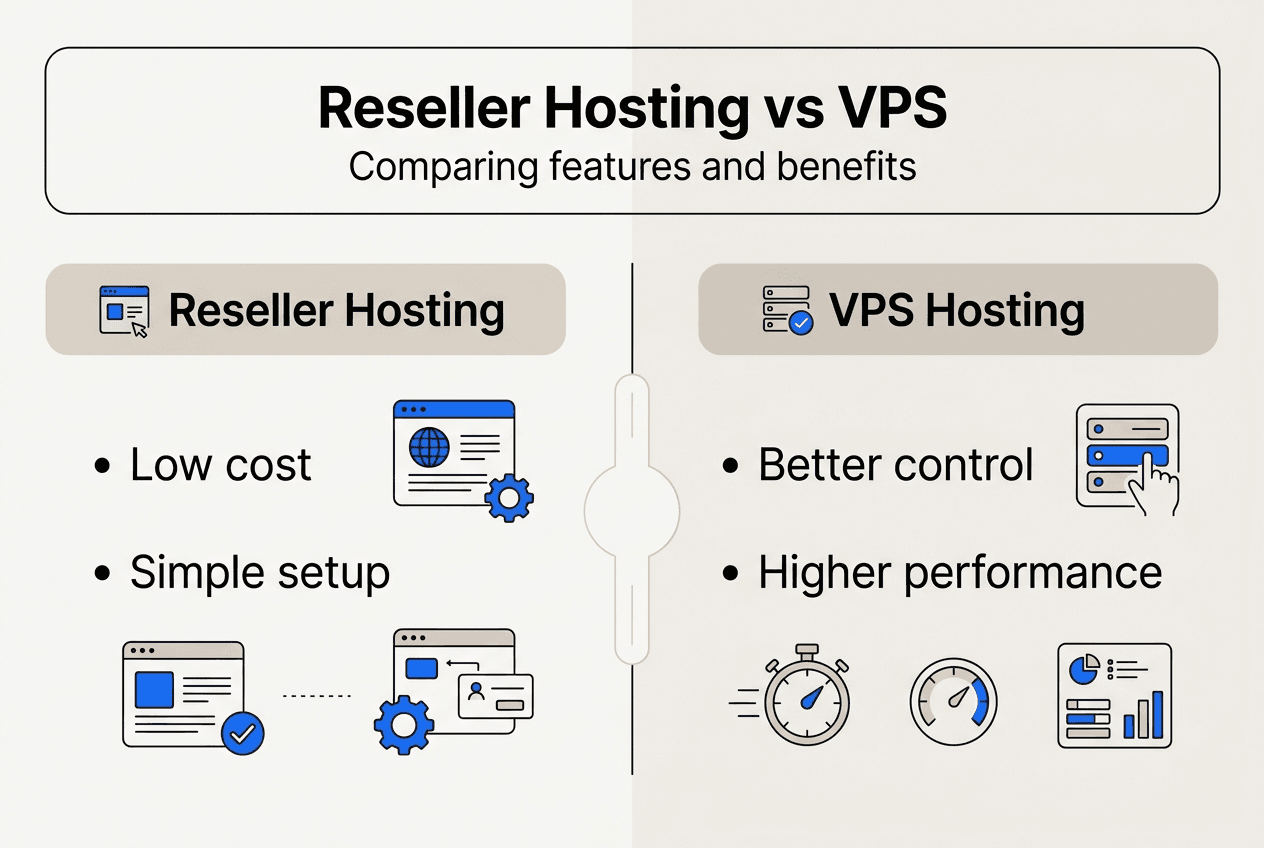
VPS provides dedicated resources and better isolation, resulting in higher performance and scalability. Each VPS operates independently with guaranteed RAM, CPU cores, and storage. Your sites never compete with other users for resources. Shared reseller hosting can experience slowdowns from multi-tenancy, especially during traffic spikes or when neighboring sites consume excessive resources.
| Feature | Reseller Hosting | VPS Hosting |
|---|---|---|
| Monthly cost | $10-100 | $20-200+ |
| Technical complexity | Low, provider manages servers | High, requires server administration |
| Performance | Moderate, shared resources | High, dedicated resources |
| Scalability | Limited by reseller plan | Highly scalable with root access |
| Best for | Agencies, startups, hosting resellers | Growing businesses, high-traffic sites |
| Resource control | Divided among clients | Full control over allocation |
| Risk level | Low, minimal investment | Moderate, requires technical expertise |
Reseller hosting fits perfectly when you want to offer hosting services to multiple clients without managing infrastructure. It works for web design agencies bundling hosting with development services, freelancers managing client websites, or entrepreneurs testing the hosting market with minimal capital.
VPS suits businesses needing full control, better speed, and readiness to handle server administration or hire experts. Choose VPS when:
- Your sites require guaranteed resources and consistent performance
- You need custom server configurations or specialized software
- You have technical staff or budget to hire system administrators
- Your business demands maximum uptime and isolation from other users
Pro Tip: Evaluate your technical skills, budget, and growth plans before choosing hosting type. Start with reseller hosting to build your client base, then migrate to VPS as your technical capabilities and revenue increase.
For entrepreneurs managing multiple websites without technical teams, shared hosting overview explains another accessible option that complements reseller solutions.
Maximizing profits and success with reseller hosting in 2026
Building a profitable reseller hosting business requires strategic planning, competitive pricing, and exceptional customer service. Follow these steps to establish and scale your hosting operation effectively.
- Research your target market to understand pricing expectations and service requirements
- Choose a reseller hosting plan that matches your expected client base and provides room for growth
- Set competitive pricing between $10-50 monthly depending on resource allocation and support level
- Create service packages that bundle hosting with domains, SSL certificates, and email accounts
- Develop a professional website showcasing your hosting plans and company credibility
- Market your services through targeted channels reaching entrepreneurs, freelancers, and small businesses
- Provide responsive customer support to build loyalty and reduce churn
- Monitor client resource usage and upgrade plans proactively to maintain performance
- Track expenses and revenue monthly to ensure margins remain healthy as you scale
Choosing the right reseller hosting plan forms your foundation. Assess your expected client count, average website size, and anticipated traffic levels. Starter plans work for 10-25 small business websites, while enterprise plans support 100+ accounts. Underestimating resources leads to performance issues and client complaints.
Resellers can achieve 40-90% profit margins as client numbers grow by charging $10-50 monthly per hosting account. Your costs remain relatively fixed while revenue scales linearly with each new client. A reseller paying $50 monthly who manages 20 clients at $25 each generates $500 in revenue and $450 in gross profit.
Offering added value differentiates your service from competitors. Custom support, website migration assistance, and domain management create sticky relationships that reduce client churn. Many entrepreneurs lack technical knowledge and will pay premium prices for white-glove service.
Marketing channels targeting entrepreneurs and small businesses include:
- Content marketing through blogs and guides addressing common hosting questions
- Local business networking groups and chambers of commerce
- Partnerships with web designers and digital marketing agencies
- Social media advertising targeting business owners launching websites
- Referral programs rewarding existing clients for new customer introductions
Pro Tip: Build recurring revenue through bundled packages including SSL certificates, email hosting, and automatic backups. Clients value convenience and will pay extra for comprehensive solutions.
Providing reliable uptime and responsive support retains customers long-term. Most clients never contact support, but those who do expect quick, helpful responses. Consider offering live chat during business hours and email support with 24-hour response times. Your reputation depends on solving problems efficiently.
Explore inSave reseller hosting plans designed specifically for entrepreneurs and agencies building hosting businesses. Their infrastructure and management tools let you focus on growth rather than technical maintenance.
Explore reseller hosting plans at inSave Hosting
Ready to launch your hosting business or consolidate client websites under one management platform? inSave Hosting offers reseller hosting plans tailored to startups and small business needs. Their easy-to-use management tools and reliable infrastructure reduce your technical workload while maintaining the performance your clients expect.
Their platform includes WHM and cPanel access, free SSL certificates, and 99.9% uptime guarantees backed by advanced technologies like LiteSpeed and CDN integration. You get the tools to manage multiple client accounts without server administration headaches. Complement your reseller offerings with shared hosting options for personal projects and domain registration services that let you provide complete web solutions.
Start your hosting business or expand your online presence with expert support from inSave. Their team helps you migrate existing sites, configure accounts, and troubleshoot issues so you can focus on growing your client base and revenue.
What is reseller hosting? Frequently asked questions
Can I use reseller hosting for my own websites only?
Absolutely. Many entrepreneurs purchase reseller plans to manage multiple personal or business websites under one account with centralized billing. You gain WHM access to create separate cPanel accounts for each site, making organization and management simpler than juggling multiple shared hosting subscriptions.
Do I need technical skills to run a reseller hosting business?
Minimal technical knowledge is required. Your provider manages server maintenance, security, and infrastructure while you handle client account creation through WHM and cPanel. Basic understanding of domains, email setup, and website fundamentals helps, but you do not need server administration or coding skills to succeed.
How do I handle customer support as a reseller?
You provide first-line support for account-related questions, billing issues, and basic troubleshooting. Most reseller plans include white-label support options where your provider assists with complex technical problems under your brand name. You can also outsource support to virtual assistants or use ticketing systems to manage requests efficiently.
What happens if I exceed my reseller plan resources?
Your provider typically suspends new account creation or throttles performance until you upgrade to a larger plan. Monitor your resource usage through WHM to avoid hitting limits. Proactive upgrades prevent service disruptions and maintain client satisfaction as your business grows.
Is reseller hosting profitable in 2026?
Yes, when managed strategically. With plans costing $10-100 monthly and client pricing at $10-50 per account, margins reach 40-90% as you scale. Success depends on customer acquisition, retention, competitive pricing, and value-added services that differentiate your offering from larger hosting companies.
Can I migrate from reseller hosting to VPS later?
Most providers offer migration assistance when you outgrow reseller plans. VPS gives you dedicated resources and full control as your technical capabilities and client demands increase. Starting with reseller hosting minimizes risk while you build revenue and expertise before investing in more complex infrastructure.