
Pick .com if it's available at a normal retail price. It's the safest default for nearly every small business and personal brand. Choose .org only if you're running a genuine nonprofit, open-source project, or mission-driven community, and fall back to .net when your ideal .com is taken and your brand leans technical or infrastructure-focused. None of this affects your Google ranking directly. It's about trust and clarity, not search algorithms.
TL;DR:
- A .com domain is the safest choice for most businesses due to its high recognition and the habit of defaulting to .com in user behavior.
- .org signals a nonprofit or mission-driven purpose, making it ideal for charities, advocacy groups, and foundations but less suitable for commercial sales.
- .net, originally for network infrastructure, now serves as a neutral fallback mainly for technical audiences or when .com is unavailable, with no significant SEO advantage.
- When choosing a domain, prioritize audience expectations, availability, and cost, and consider registering similar variants to protect your brand.
- Rarely worth paying premium prices on the aftermarket unless the domain is critical to your brand, and always check WHOIS history before acquisition.
Table of Contents
- Com Vs Org Vs Net: The Fast Answer
- What .com Really Means and Why It Still Wins
- What .org Signals and When It's the Right Call
- What .net Is Actually For Today
- How To Choose Between .com, .org, And .net
- How Pricing And Renewals Change The Decision
- Registering And Protecting Your Domain Without Overspending
- When A Different TLD Actually Makes More Sense
- Common Mistakes People Make Choosing Between These Three
- Real-World Examples Of How The Choice Plays Out
- Where This Is All Heading
- A Straight Answer From Someone Who's Watched This Debate Go In Circles
- Get Your Domain And Hosting Sorted In One Step
- Sources
- FAQ
Com Vs Org Vs Net: The Fast Answer
If you want the short version before reading further, here it is in a handful of lines.
- .com is best for: general businesses, e-commerce, personal brands, anything selling to consumers.
- .org is best for: nonprofits, foundations, associations, and community or advocacy projects.
- .net is best for: tech companies, network infrastructure providers, or as a fallback when .com is gone.
- People still type ".com" out of habit even when they mean a different site, so a mismatched extension can quietly lose you direct traffic.
- If your exact .com isn't available, consider registering the .net or .org version too, even if you never build on it, just to keep competitors and copycats off your name.
The pattern holds across almost every industry: when in doubt, .com wins the trust contest. The exceptions are narrow enough that most readers can settle this in five minutes.
What .com Really Means and Why It Still Wins
.com was one of the original top-level domains delegated back in 1985, built for commercial entities. Four decades later, it's still the default mental model most people have for "a website." Type almost any brand name into a browser without the extension, and the browser fills in .com automatically. That habit is baked into how people navigate the internet.
Consumer trust data backs this up. Most people show a clear preference for .com over other extensions, and it remains the most recognized and trusted TLD for general audiences. That recognition translates into real behavior: higher click-through on search results, fewer typos in URL bars, and less hesitation before someone hands over an email address or a credit card number.
The catch is scarcity. Short, dictionary-word .com names were mostly claimed years ago, and the ones still available on the open market often carry aftermarket price tags in the low thousands to tens of thousands of dollars depending on demand, according to CentralNic's reseller data. That reality shapes a lot of the decision-making covered later in this guide.
When to buy at aftermarket price, and when to walk away:
- Buy if the name is core to your brand identity and the price is a small fraction of your first-year marketing budget.
- Walk away if the seller wants more than you'd spend on six months of paid advertising. Put that money into growth instead.
- Always negotiate. Asking prices on domain marketplaces are rarely the floor.
What .org Signals and When It's the Right Call
.org was delegated in the same original 1985 root as .com, but it developed a very different reputation over the decades. It became the unofficial home for nonprofits, open-source projects, and community organizations, even though registration has never actually been restricted to nonprofit status. Anyone can register a .org today.
That history still shapes perception. When a visitor sees .org, they tend to read it as "mission-driven" before they read anything else on the page. That's a genuine asset if you're running a charity, a professional association, an advocacy group, or a large open-source project. It signals purpose over profit before a single word of copy loads.
The trade-off shows up when a for-profit business uses .org to borrow that credibility. Savvy users notice, and it can read as a mismatch between what the site claims to be and what it's actually selling.
Where .org helps and where it hurts:
- Helps: donation pages, membership associations, advocacy campaigns, research foundations, software foundations.
- Helps: fundraising emails and grant applications, where .org reads as a category signal to reviewers.
- Hurts: online stores, SaaS products, or agencies trying to look like a cause when they're really a business.
- Neutral: personal blogs and hobby communities, where either .com or .org works fine.
If your revenue model is subscriptions or product sales, .org will eventually feel like a costume that doesn't fit.
What .net Is Actually For Today
.net originally stood for "network" and was meant for internet infrastructure companies, ISPs, and telecom providers. That meaning has faded into something more neutral: today .net mostly reads as "a reasonably legitimate alternative to .com," without any strong emotional signal one way or the other.
That neutrality makes it a sensible fallback in specific situations. A developer tools company, a hosting-adjacent service, or a B2B software platform can use .net without raising eyebrows, since the audience is technical and less swayed by consumer branding cues. For a bakery, a boutique, or a local law office, though, .net can feel like a compromise the visitor notices immediately.
- Reasonable fit: developer platforms, network services, technical SaaS products, internal tools with external landing pages.
- Awkward fit: consumer retail, hospitality, healthcare practices, anything where warmth and approachability matter more than technical credibility.
- Pricing tends to sit close to .com at retail, with far less aftermarket premium since demand is lower.
- Renewal costs are usually comparable to .com, so cost alone rarely decides between the two.
How To Choose Between .com, .org, And .net
Run through this in order. Most people can finish the whole checklist in under ten minutes.
- Check who you're actually talking to. A general consumer audience wants .com. A donor or member audience responds to .org. A developer or IT-buyer audience tolerates .net just fine.
- Check availability. Search your exact name plus close variants using a domain availability tool before you get attached to any single option.
- Check email deliverability. Legacy TLDs used to have a slight edge here, but proper SPF, DKIM, and DMARC setup largely closes that gap for any non-spammy domain, legacy or new.
- Check enterprise procurement norms, if relevant. Buyers in technical or corporate markets still lean toward .com or a local country-code domain when signing contracts; newer extensions carry a smaller trust gap than they used to, but it isn't zero.
- Check geographic targeting needs. If you're only serving one country, a country-code domain might outperform any of the three generic options for local search relevance.
Two quick, low-effort tests catch problems before you commit money: say the domain out loud to a stranger and see if they can spell it back correctly, and search the exact name across major social platforms to confirm the handle is free too.
Pro Tip: Run a WHOIS lookup before you register anything, even a brand-new name. It takes thirty seconds and tells you if the domain has ever been registered before, which matters if you're buying secondhand.
If your ideal .com is unavailable, decide fast: pay the aftermarket premium only if the name is genuinely core to your identity, otherwise pick .net or a well-matched alternative TLD and put the savings into marketing. Either way, grab available variants of your name at the standard extensions as a defensive move.
How Pricing And Renewals Change The Decision
Retail pricing for .com, .org, and .net sits close together, usually within a few dollars of each other for the first year. The number that actually matters is the renewal price, not the promotional first-year rate that shows up in ads. Registrars routinely discount year one and raise the price at renewal, so check the second-year cost before you commit to any provider.
Aftermarket pricing is where the three extensions diverge sharply. A desirable .com can run from the low thousands into the tens of thousands of dollars on the secondary market, while equivalent .org and .net names in the same style rarely command similar premiums, simply because demand is lower.
A useful guideline: if an aftermarket .com is asking more than you'd spend on your first three months of marketing, it's rarely worth it for a small business. Redirect that budget into building an audience under a clean, available alternative instead.
Before buying any secondhand domain, whatever the extension:
- Pull the WHOIS history to see how many times it's changed hands and why.
- Check the domain against major spam and malware blacklists.
- Search the name in Google to see if it carries any negative history from a previous owner.
Registering And Protecting Your Domain Without Overspending
Once you've picked your extension, move fast. Available names, especially short or brandable ones, don't stay available long.
- Register the primary domain immediately once you've confirmed it fits your name, audience, and budget.
- Set up SSL and email authentication right away. Free SSL certificates should be automatic with most modern hosting, and SPF, DKIM, and DMARC records protect your deliverability and your domain's reputation from day one.
- Register one or two defensive variants, like the common misspelling or the alternate extension, only if your budget genuinely allows it. Skip this step entirely if cash is tight. A live business on the right domain beats a portfolio of unused defensive names.
- Plan your migration checklist if you're moving from an old domain: set up 301 redirects on every old URL, add the new domain to Google Search Console, and expect search rankings to stabilize over several weeks to a few months as the redirect signals fully propagate.
Handling a move yourself is doable, but a domain transfer service can save you the headache of authorization codes and DNS timing if you're merging an existing site into a new host.
When A Different TLD Actually Makes More Sense
Sometimes none of the big three is the right answer. The total number of registered TLDs worldwide has grown substantially since ICANN's new gTLD program opened up hundreds of new extensions, and some of them solve real problems the legacy options can't.
- .io signals "developer tool" or "tech startup" instantly to a technical audience, even though it's technically a country code for the British Indian Ocean Territory that ICANN treats as generic in practice.
- Country-code domains (like .us or .ca) make sense when your business only ever serves one country and local search relevance matters more than global reach.
- Newer gTLDs (.shop, .studio, .app) can solve a brandability problem when every reasonable .com variant is gone.
Whatever new extension you pick, register the matching .com if it's affordable and redirect it to your main site. It catches type-in traffic you'd otherwise lose, and it protects your name from being grabbed by someone else. See more examples of popular TLD choices by industry before deciding.
Common Mistakes People Make Choosing Between These Three
The biggest misconception is assuming a "better" extension will boost search rankings. It won't. Search engines treat generic TLDs like .com, .org, and .net identically for ranking purposes. Any perceived SEO advantage from one extension over another is really a click-through and trust effect, not an algorithm rule.
The second mistake is a for-profit business grabbing .org purely because it "sounds trustworthy." That backfires the moment a savvy visitor notices a shopping cart on a domain that reads as a charity. Trust built on a mismatched signal collapses fast once someone looks closely, and building genuine trust online takes more than borrowing a nonprofit's extension.
A third common error is overpaying on the aftermarket for a mediocre .com match instead of accepting a stronger, available name on a different extension. A slightly less "classic" domain that's memorable and cheap almost always beats an expensive .com that's a compromise anyway.
Finally, plenty of people skip WHOIS and blacklist checks on secondhand domains, then discover months later that their new site inherited a spam reputation from the previous owner. That one omission can cost you email deliverability and search visibility for months.
Real-World Examples Of How The Choice Plays Out
A local bakery chose a short, memorable .com over a longer exact-match domain that was only available as .net. Foot traffic and word-of-mouth referrals meant customers were typing the name from memory, and .com matched what people assumed without thinking.
A regional literacy nonprofit switched from a generic .com to a matching .org during a rebrand.
A backend infrastructure startup kept its .net domain even after its ideal .com became available for purchase years later. Its buyers were IT departments and DevOps teams, an audience unmoved by consumer branding conventions, and switching would have meant rebuilding link equity and brand recognition for no real gain.
These outcomes track with the broader decision framework: audience expectations decide the winner far more often than personal preference does.
Where This Is All Heading
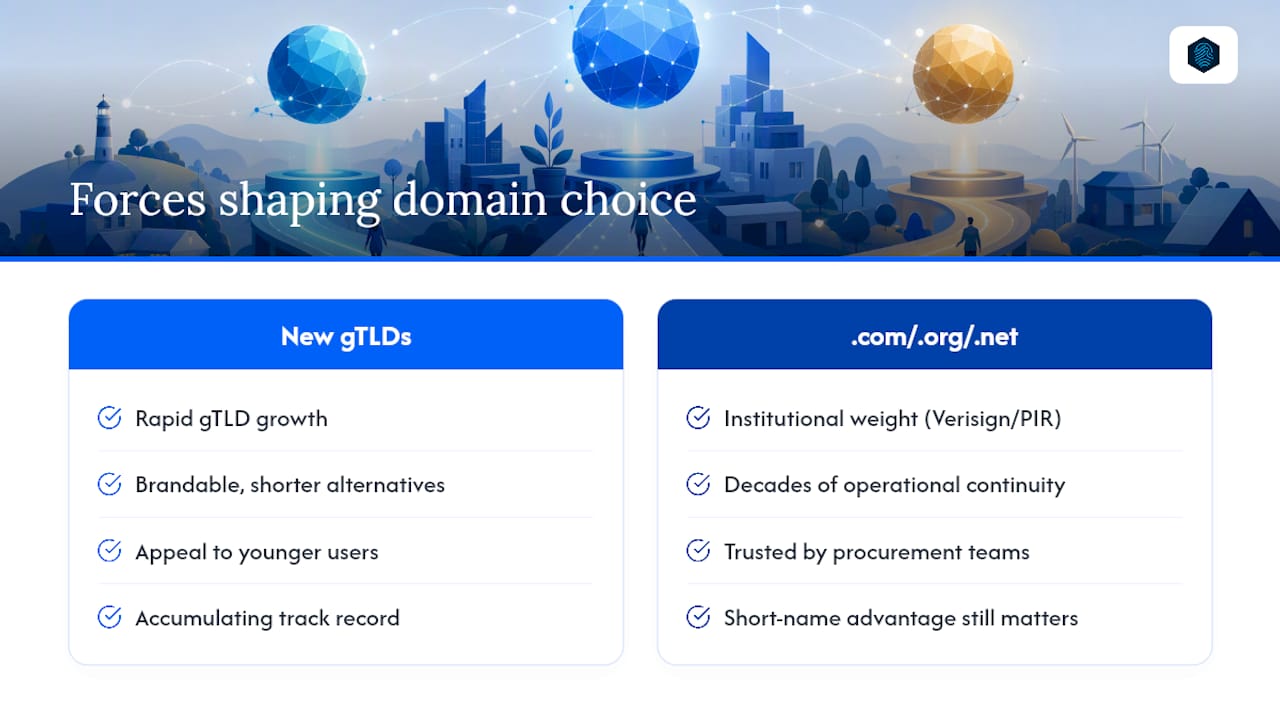
The number of top-level domains worldwide keeps climbing as new gTLDs launch across every conceivable niche, from .app to .shop to industry-specific extensions nobody had heard of a decade ago. That growth gives brandable alternatives a real shot at legitimacy, especially among younger, tech-forward audiences who don't carry the same decades-long .com conditioning as older users.
Even so, .com's institutional weight isn't going anywhere soon. Verisign has operated the .com registry for decades, and Public Interest Registry has run .org for just as long. That kind of operational continuity is exactly what makes procurement teams and cautious buyers default to the extensions they already trust.
Mobile behavior adds another layer worth watching. A large and growing share of web traffic now comes from mobile devices, where typos are more common and screen space is tighter. That trend favors short, easily typed domains regardless of extension, which may slowly erode some of .com's structural advantage if newer, shorter alternatives keep multiplying.
Expect the gap between .com and everything else to narrow gradually rather than close outright. Trust habits built over forty years don't disappear in a single product cycle, but they do soften as newer extensions accumulate their own track record.
A Straight Answer From Someone Who's Watched This Debate Go In Circles
Most of the hand-wringing over .com versus .org versus .net is wasted energy. Pick .com by default, reach for .org only if you're genuinely mission-driven, and treat .net as a fine fallback rather than a compromise. Say your final choice out loud to someone else before you register it. If they can spell it back correctly, register it that day.
— Ihor
Get Your Domain And Hosting Sorted In One Step
Picking the right extension only matters if you actually register it before someone else does. inSave Hosting gets you from decision to live website in one move: register your .com, .org, or .net and get a full year of free domain registration bundled with qualifying hosting plans, plus free SSL certificates and 99.9% uptime backing the site once it's live.
Start by checking whether your exact name is still open. If it is, lock it in through the domain names page before someone else grabs it. If you're consolidating an existing domain onto better hosting, the domain transfer process is straightforward and comes with free migration support. Whichever route you take, review the renewal price and confirm WHOIS privacy is included before you check out, then head to the hosting cart to finish setup and get your site online.
Sources
FAQ
What is .com, .net, or .org actually called?
They're generic top-level domains, or gTLDs, the suffix that follows a domain name and was originally meant to signal a category like commercial, network, or organization.
What are the main types of domain extensions?
The common categories are generic TLDs (.com, .org, .net), country-code TLDs (.us, .uk, .ca), sponsored TLDs (.gov, .edu), and newer gTLDs (.io, .app, .shop) introduced through ICANN's expansion program.
What do .com, .net, .org, .gov, and .edu each mean?
.com signals a commercial business, .net originally meant network infrastructure, .org traditionally means a nonprofit or organization, .gov is restricted to U.S. government entities, and .edu is restricted to accredited educational institutions.
Is .org still relevant today?
Yes. .org remains widely used and respected, particularly for nonprofits, foundations, and open-source projects, even though registration has never actually been restricted to nonprofit status.
Does choosing .com over .org or .net improve SEO rankings?
No. Search engines treat generic TLDs the same for ranking purposes, so the choice should come down to trust, price, and availability rather than any expected SEO boost.
Where can I register a .com, .org, or .net domain and get hosting at the same time?
inSave Hosting offers domain registration alongside hosting plans that include a free year of domain registration, free SSL certificates, and 99.9% uptime for the site once it launches.